Agricultural Films Helping to Feed the World
High-performance plastic films play a key role in global food production
AMI Consulting, a division of Applied Market Information Ltd., has just published a new report on the Agricultural Film Market in Europe 2014 analyzing the latest trends in the use of silage, mulch and greenhouse films, along with developments in technology, innovation, supply chain and post-use plastic waste management.
In order to feed a global population which is expected to top 9 billion people by 2050, food waste needs to be eliminated, distribution of food improved and food production increased. At the same time agriculture faces challenges due to changing economic and environmental trends including climate change, biofuel expansion, slowing agricultural yields, rising meat demand and ever increasing calorie intake from a growing global middle class. It is estimated that by 2050 about 70 percent of the global population will be urban, compared to 50 percent today.
Although the population increase in Europe is going to be only marginal, European agriculture will continue to play its part in global food production, while simultaneously fighting for its existence in the face of competing pressures for land use. The agricultural sector is forced to produce more food of increasing quality on less land within a shorter space of time using less resources, while generating minimum waste. Extending the growing season and increasing yields per hectare of land have been and will remain the main drivers for the use of agricultural films. In addition, plastic films protect the crops, which has direct implications on the crop's quality. Films can also improve a farm's efficiency by reducing the amount of chemicals, water and energy used.
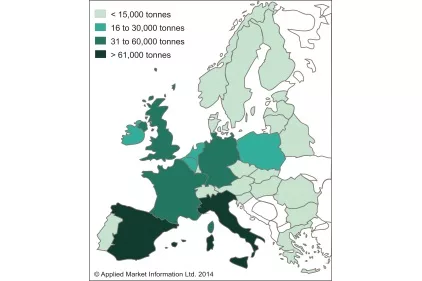
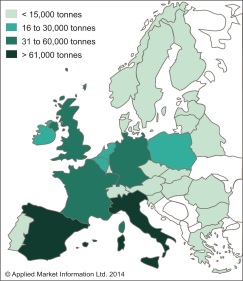
The European market for agricultural film has been experiencing steady growth over the past decade exceeding half a million tonnes in 2013. Spain and Italy are the largest markets overall, accounting for almost 40 percent of demand primarily driven by their intensive horticultural activity where large quantities of greenhouse and mulch films are used. In contrast, Northern Europe with vast areas of grass land is a major producer of animal fodder and has significant consumption of silage films both silage sheet and stretch wrap.
CONSUMPTION OF AGRICULTURAL FILM IN EUROPE
Silage film which is forecast to grow by just over 1 percent a year over the next five year period is going to be driven primarily by booming biomass production, demand for increasing quality of fodder and reduction of spoilage, increased number of dairy cows, increasing nutritional intake per cow, silage being increasingly fed to horses and haylage being also increasingly baled and wrapped.
Consumption of conventional mulch film in tonnage terms is forecast to decline slightly over the next five years as a result of the relative maturity of the market, shrinking of the area for crop cultivation and the need for the reduction of post-use plastic waste (by downgauging or by using biodegradable films instead).
Market trends for greenhouse film demand are very similar to mulch films as both types of films are increasingly used in combination. The European market is a mature one and with one season films being gradually replaced by films lasting up to 5 years, in tonnage terms the market has seen a decline and the process is expected to continue for the next five years.
The market is increasingly driven by value rather than volume. In order to increase market share in an oversupplied market, film companies will strive to develop innovative customized high performance thinner multilayer films and as well as look at opportunities for further consolidation. Some of the most recent major takeovers include RKW acquiring Hyplast and Biofol Film, ITW Mima's industrial films business being acquired by the US-based Carlyle Group, Morera & Vallejo acquiring the bankrupt TPM group in Spain and Unterland being acquired by the Britton Group now rebranded as Coveris.
In addition to its consultancy work in agricultural films, AMI also organises the annual global conference for the agricultural film industry. The next Agricultural Film Conference will be held in Barcelona, Spain on Sept. 15-17, 2014.
Applied Market Information Ltd.
+44 (0)117 924 9442
+44 (0)117 924 9442
AMI Consulting, a division of Applied Market Information Ltd., has just published a new report on the Agricultural Film Market in Europe 2014 analyzing the latest trends in the use of silage, mulch and greenhouse films, along with developments in technology, innovation, supply chain and post-use plastic waste management.
In order to feed a global population which is expected to top 9 billion people by 2050, food waste needs to be eliminated, distribution of food improved and food production increased. At the same time agriculture faces challenges due to changing economic and environmental trends including climate change, biofuel expansion, slowing agricultural yields, rising meat demand and ever increasing calorie intake from a growing global middle class. It is estimated that by 2050 about 70 percent of the global population will be urban, compared to 50 percent today.
Although the population increase in Europe is going to be only marginal, European agriculture will continue to play its part in global food production, while simultaneously fighting for its existence in the face of competing pressures for land use. The agricultural sector is forced to produce more food of increasing quality on less land within a shorter space of time using less resources, while generating minimum waste. Extending the growing season and increasing yields per hectare of land have been and will remain the main drivers for the use of agricultural films. In addition, plastic films protect the crops, which has direct implications on the crop's quality. Films can also improve a farm's efficiency by reducing the amount of chemicals, water and energy used.
The European market for agricultural film has been experiencing steady growth over the past decade exceeding half a million tonnes in 2013. Spain and Italy are the largest markets overall, accounting for almost 40 percent of demand primarily driven by their intensive horticultural activity where large quantities of greenhouse and mulch films are used. In contrast, Northern Europe with vast areas of grass land is a major producer of animal fodder and has significant consumption of silage films both silage sheet and stretch wrap.
CONSUMPTION OF AGRICULTURAL FILM IN EUROPE
Silage film which is forecast to grow by just over 1 percent a year over the next five year period is going to be driven primarily by booming biomass production, demand for increasing quality of fodder and reduction of spoilage, increased number of dairy cows, increasing nutritional intake per cow, silage being increasingly fed to horses and haylage being also increasingly baled and wrapped.
Consumption of conventional mulch film in tonnage terms is forecast to decline slightly over the next five years as a result of the relative maturity of the market, shrinking of the area for crop cultivation and the need for the reduction of post-use plastic waste (by downgauging or by using biodegradable films instead).
Market trends for greenhouse film demand are very similar to mulch films as both types of films are increasingly used in combination. The European market is a mature one and with one season films being gradually replaced by films lasting up to 5 years, in tonnage terms the market has seen a decline and the process is expected to continue for the next five years.
The market is increasingly driven by value rather than volume. In order to increase market share in an oversupplied market, film companies will strive to develop innovative customized high performance thinner multilayer films and as well as look at opportunities for further consolidation. Some of the most recent major takeovers include RKW acquiring Hyplast and Biofol Film, ITW Mima's industrial films business being acquired by the US-based Carlyle Group, Morera & Vallejo acquiring the bankrupt TPM group in Spain and Unterland being acquired by the Britton Group now rebranded as Coveris.
In addition to its consultancy work in agricultural films, AMI also organises the annual global conference for the agricultural film industry. The next Agricultural Film Conference will be held in Barcelona, Spain on Sept. 15-17, 2014.
Applied Market Information Ltd.
+44 (0)117 924 9442
+44 (0)117 924 9442
Looking for a reprint of this article?
From high-res PDFs to custom plaques, order your copy today!