Industry Q&A: Inspection & Testing
Growth, Consolidation and Advancement of Testing Instruments

Flexible Packaging recently caught up with Dave Muchorski, director of marketing at Testing Machines Inc., for an update on what’s new in the field and how coefficient of friction can impact printing and converting operations.
What’s new in the world of inspection and testing?
Muchorski: The instrument world of inspection and testing is currently experiencing growth and consolidation. In fact, TMI and several other industry leaders have recently joined Industrial Physics. The companies of Industrial Physics, Inc. manufacture and market testing instruments worldwide for measuring physical and analytical properties of a wide range of materials, products and packaging types, including plastics, metals, barrier films, paper, corrugated materials, foil, ink, coatings, cans, medical devices, paints and surfaces. Its market-leading brands include Systech Illinois, Testing Machines, Inc., Messmer Büchel, CMC-KUHNKE, FIBRO System, Ray-Ran Test Equipment, TM Electronics, United Testing Systems, OxySense, Eagle Vision, Sheen Instruments and TQC.
The TMI field service group is A2LA certified-ISO 17025 compliant, meeting the gold star standard for excellence in calibration.
Has TMI released any new products lately pertaining to flexible packaging?
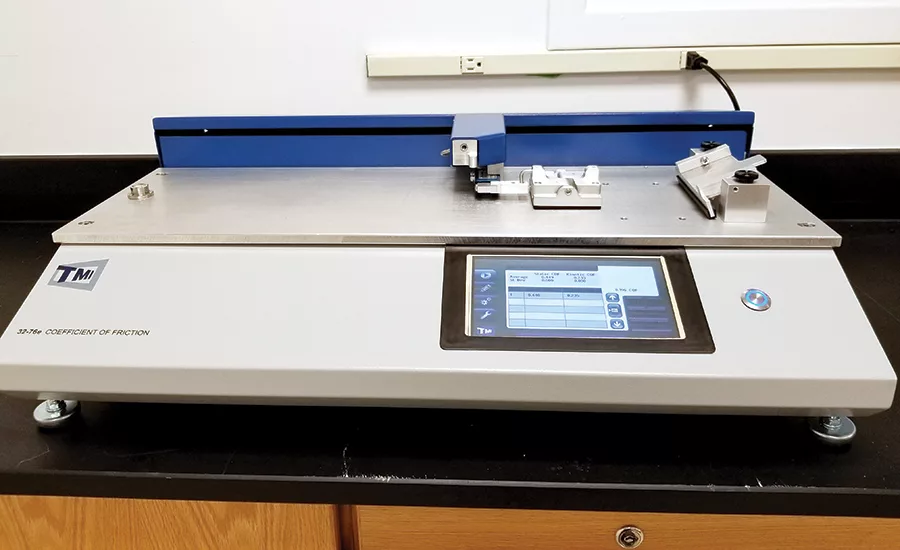
Muchorski: TMI has been very active in new product development. This year we introduced three new instruments. Our latest development is the model 32-76e COF, coefficient of friction tester, which features interchangeable fixtures for measuring 180-degree and T-peel sealing strength. In addition, new advances in static measurement capabilities allow high-speed data collection during the first second to determine the true static force. The new friction/peel unit supports GraphMaster software for curve analysis and data storage. TMI also introduced a new Spencer Impact/puncture accessory to our line of Elmendorf tearing strength testers designed according to ASTM D 3420. For measuring print durability and ink abrasion resistance, we introduced a new model 10-20 ink rub tester. Both the COF and Elmendorf units feature new microprocessor design technology and touchscreen display capability.
Can you explain the role that coefficient of friction plays in printing and converting? How can proper measurement techniques improve the quality of COF test data?
Muchorski: The study of friction between two materials began at least 500 years ago when Leonardo da Vinci noted the laws governing the motion of a rectangular block sliding over a planar surface. Although the measurement technology has changed, static and kinetic coefficient of friction of packaging film is still one of the most important and difficult material properties to measure and control for converters.
Varying ink chemistries, surface treatments, film age, tension, changes in humidity and material storage can have a significant influence on frictional properties. Chemical migration of solvents and changes in humidity can increase COF. Ink drying or lubricant migration can cause COF to decrease.
In addition to changes in COF due to the condition of the material, there are numerous test instrument variables which can impact COF. Testing instruments that perform coefficient of friction according to ASTM D 1894 can have up to five different mechanical configurations. The test instrument can be vertical or horizontal. The sled or test block can be attached directly to the force measurement device or the sled can be attached by a string. In some cases, the sled is attached by a string which travels through a pulley. Other factors, such as surface topography or roughness of the test plate, can change both static and kinetic results. Variation in the flatness of the surface area and hardness of the rubber attached to the sled may impact COF results. This is especially true primarily when measuring thin films.
When performing a test, the operator can also influence both static and kinetic friction. When measuring static friction, changes in the length of time the sled rests on the material before starting the test can increase or decrease the static result. Other factors, such as touching the measurement surface of the film or moving the sled after it is placed on the test bed, may impact result data. Proper training and standardizing on a detailed test procedure starting from sample handling and preparation, loading the specimen, zeroing the force indicator and monitoring dwell time through completing the measurement can improve COF test repeatability.
Generally, niche equipment like testing and inspecting tools can be an afterthought. Can you explain why any decision pertaining to this type of equipment should be carefully analyzed?
Muchorski: Careful consideration is necessary when choosing a vendor to supply laboratory instruments. Customers should consider the long-term nature of their investment in lab equipment. It is equally important to evaluate the capabilities of the manufacturer, including after-sale support and technical knowledge offered by the vendor.
Well-designed test equipment must be precise, simple to operate, easy to verify and provide test results quickly. Intuitive touchscreen designs, stored test method procedures and automated calculations assure consistent reproducible test results eliminating the requirement for laboratory personnel and managers to have advanced science degrees. As a result, instrument manufacturers have become a very important resource providing technical consultative support to the quality lab when measurement errors are discovered, test data does not agree or when customers are performing comparative analysis with instruments of varying quality and vintage.
Our function as a provider of test equipment is not to just deliver a new instrument to the customer. Instrument companies must also provide technical knowledge and have a thorough understanding of materials testing, which is a requirement to properly support our customers.
Looking for a reprint of this article?
From high-res PDFs to custom plaques, order your copy today!