Industry Q&A: Slitting/Rewinding
Slitting/Rewinding Equipment Aims to be More Flexible, Automated
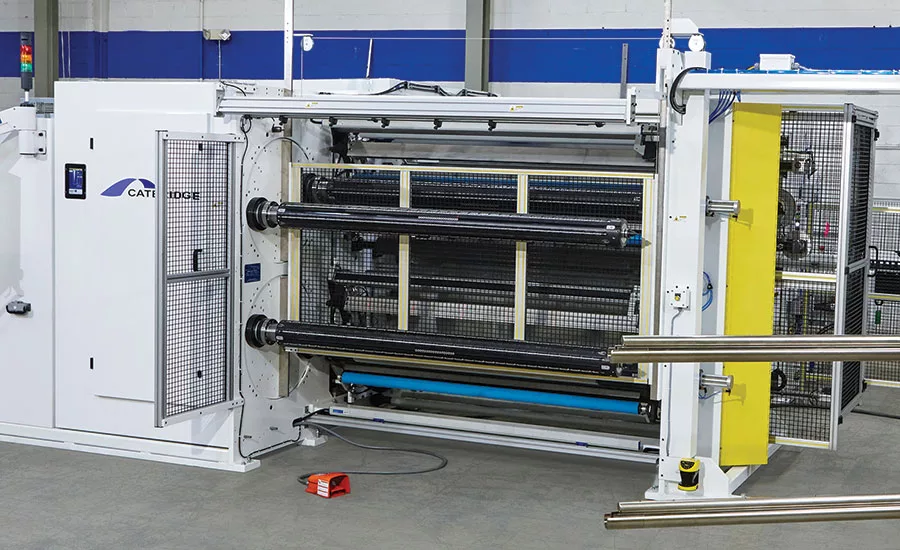
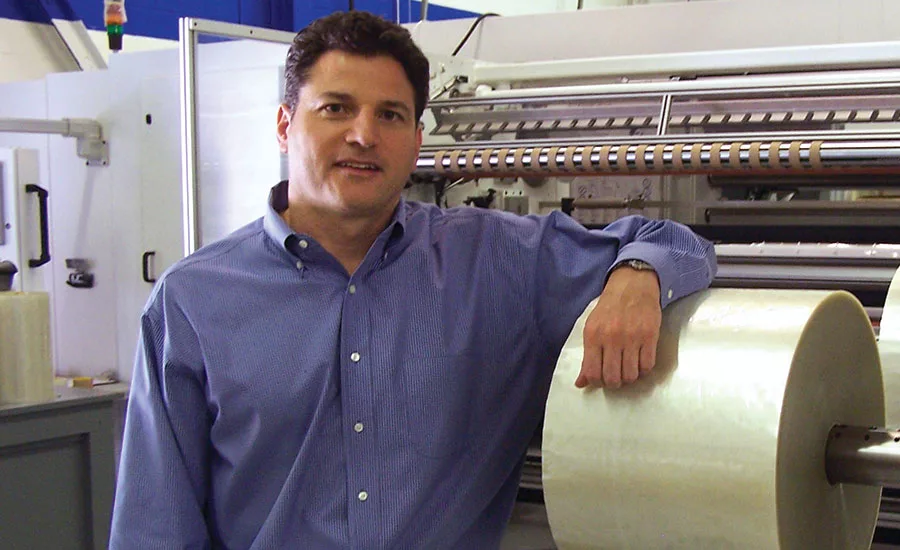
Slitting/rewinding equipment has increased its focus on ergonomics, speed and operator safety. We recently caught up with Michael Pappas, Catbridge Machinery president, to discuss these trends and more.
What’s new in slitting/rewinding? Has your company released any new products lately?
Pappas: New technologies in slitting and rewinding continue to focus on safety, ergonomic friendliness, speed and finished roll quality. Safety PLCs are controlling more and more machines. Ergonomics is of growing significance for small and medium-sized converters, as well as the larger companies, especially where repetitive motion tasks are involved. Web speed is a main priority, particularly for longer finished roll lengths. Improving roll quality continues to be important for all types of converting, from film and flex pack to tape to non-wovens.
New Catbridge products include a recently shipped paper winder capable of 6,000 fpm, a speed normally found only in mills. Additionally, we have developed new model designs for labelstock, tapes and thermoforming plastics.
We hear a lot about Industry 4.0. Can you talk about some of the initiatives – if any – that have been taken in slitting/rewinding equipment to make it smarter and more connected?
Pappas: Industry 4.0 is a concept for making an entire manufacturing process more effective. All components of a process, from raw material ordering and inventory to the shipment of finished goods, report data that’s used to optimize resource usage, scheduling, and, in the case of production machinery such as slitters, resource maintenance. An analogy would be a “smart house” which automatically monitors and adjusts systems such as heating, cooling, power and security to maximize efficiency and report anomalies. Industry 4.0 has the most potential in large integrated manufacturing processes. Companies that convert only have fewer opportunities to benefit, but slitters that report data on throughput, speed, downtime and the reasons for it can help improve efficiency through preventative maintenance and optimized scheduling.
What are some of the biggest factors that are currently influencing slitting/rewinding equipment development?
Pappas: I’d say the two biggest factors influencing equipment development today are a desire for machine flexibility and a desire to tie into automated packaging systems. The latter is very much a focus in the flexible packaging world. As slitters, especially turrets, continue to produce more rolls per hour, a real consideration becomes integrating slitter roll discharge with systems that transport rolls to a packaging area or to automated packaging equipment. Machine flexibility provides broad functional capability, including multiple slitting methods, a wide tension range, and the ability to produce small and large diameter finished rolls with equal efficiency. The resulting job flexibility can have very positive scheduling implications, allowing many types of jobs to be done in a more efficient and timely manner.
Can you explain the role of PLCs (programmable logic controllers) and how they make slitting/rewinding equipment safer and more convenient?
Pappas: Besides controlling all machine drive and mechanical systems, PLCs today greatly improve safety by integrating control of all safety equipment. Modern drives also have built-in safety systems, and all can be tied together through safety PLCs. In addition to safety enhancement, operator convenience is improved by allowing safety equipment to “have a personality.” That is, to be programmed to do something more than just e-stop. Safe zones tied to machine speed reduction prevent e-stops for common, non-threatening conditions and let an operator work more naturally and efficiently.
Is there anything else you’d like to share about slitting/rewinding?
Pappas: Slitting and rewinding is the last value-added step in the long process of producing any roll product. As such, waste must be minimized – every square inch of material carries a lot of value. Also, finished roll appearance is really the most visible representation to customers of the quality of the company they buy from. As such, rolls need to be wound to the highest standards. These two themes, efficiency and quality, have been the dominant drivers in slitter design for years, and will surely continue to be.
Looking for a reprint of this article?
From high-res PDFs to custom plaques, order your copy today!