FPA Update
Reporting on the Sustainability Benefits of Flexible Packaging
Flexible Stand-up Pouches for Motor Oil Result in More Favorable Environmental Outcomes than HDPE Bottles
The Flexible Packaging Association’s (FPA) report, A Holistic View of the Role of Flexible Packaging in a Sustainable World, highlights the sustainability benefits of flexible packaging. FPA commissioned PTIS, LLC to provide a holistic view on the sustainability benefits that flexible packaging offers; provide foresight into future sustainability implications for flexible packaging; and develop six Life Cycle Assessment (LCA) case studies comparing flexible packaging to other packaging formats across a range of products.
The LCA case studies were developed using the EcoImpact-COMPASS® LCA software, which allows for quick life cycle comparisons between different packaging formats. The results from the case studies show that flexible packaging has more favorable environmental attributes for carbon impact, fossil fuel usage, water usage, product-to-package ratio, as well as the amount of packaging material going to the landfill when compared to other packaging formats for the same products.
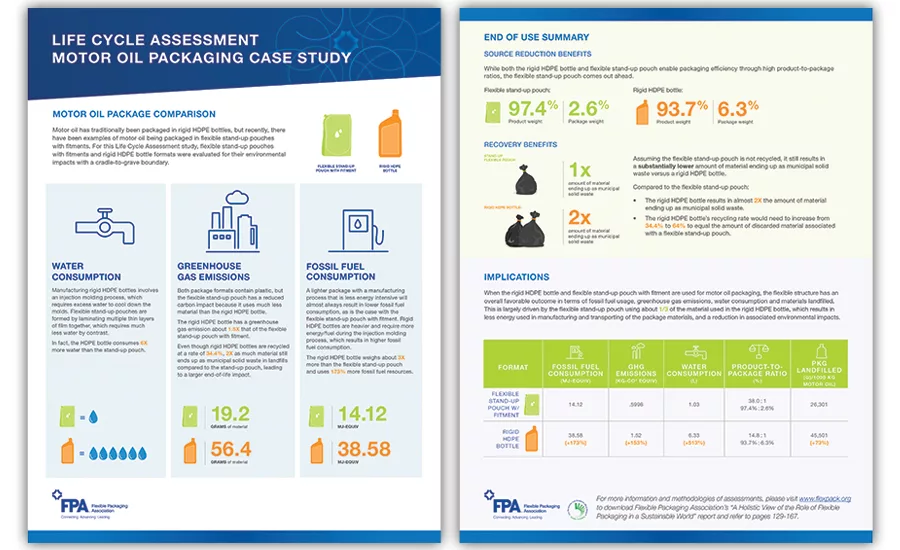
Motor oil has traditionally been packaged in rigid HDPE bottles, but recently, there have been examples of motor oil being packaged in flexible stand-up pouches with fitments. For this LCA study, flexible stand-up pouches with fitments and rigid HDPE bottle formats were evaluated for their environmental impacts with a cradle-to-grave boundary.
Manufacturing rigid HDPE bottles involves an injection molding process, which requires excess water to cool down the molds. Flexible stand-up pouches are formed by laminating multiple thin layers of film together, which requires much less water by contrast. In fact, the HDPE bottle consumes 6X more water than the stand-up pouch.
Both package formats contain plastic, but the flexible stand-up pouch has a reduced carbon impact because it uses much less material than the rigid HDPE bottle. The rigid HDPE bottle has a greenhouse gas emission about 1.5X that of the flexible stand-up pouch with fitment. Even though rigid HDPE bottles are recycled at a rate of 34.4 percent, 2X as much material still ends up as municipal solid waste in landfills compared to the stand-up pouch, leading to a larger end-of-life impact.
A lighter package with a manufacturing process that is less energy intensive will almost always result in lower fossil fuel consumption, as is the case with the flexible stand-up pouch with fitment. Rigid HDPE bottles are heavier and require more energy/fuel during the injection molding process, which results in higher fossil fuel consumption. The rigid HDPE bottle weighs about 3X more than the flexible stand-up pouch and uses 173 percent more fossil fuel resources.
When the rigid HDPE bottle and flexible stand-up pouch with fitment are used for motor oil packaging, the flexible structure has an overall favorable outcome in terms of fossil fuel usage, greenhouse gas emissions, water consumption, and materials landfilled. This is largely driven by the flexible stand-up pouch using about one-third of the material used in the rigid HDPE bottle, which results in less energy used in manufacturing and transporting of the package materials, and a reduction in associated environmental impacts.
For More Information
For more information on the case study and the sustainability benefits of flexible packaging, visit www.flexpack.org, or contact FPA at fpa@flexpack.org or 410-694-0800.
Looking for a reprint of this article?
From high-res PDFs to custom plaques, order your copy today!