Printing: Inks
How to Use Less Ink When Printing
Minimizing ink usage doesn’t have to mean minimizing quality.
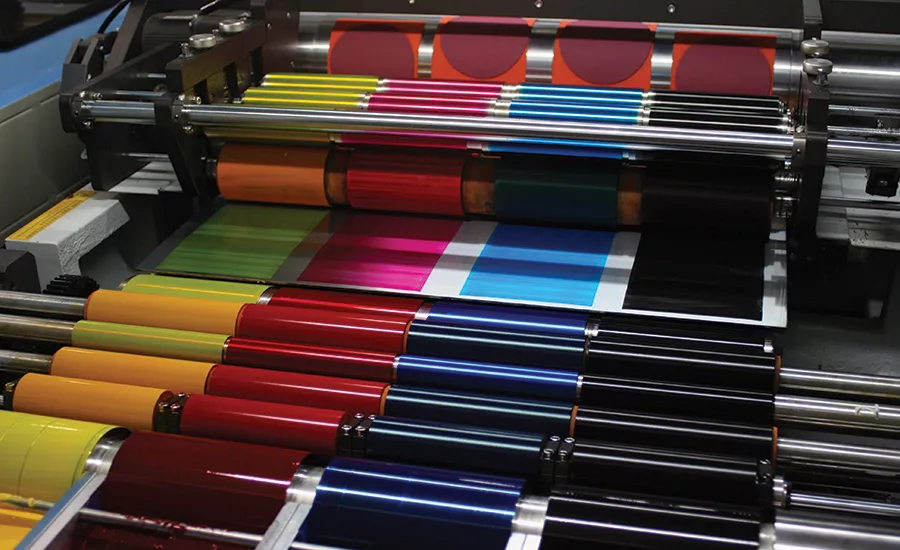
In commercial printing, ink is one of the main consumables that can be managed to potentially reduce costs. All commercial printing managers are looking for ways to control this cost. This applies to industrial inkjet printing as well as analog printing, like flexo printing or offset printing.
Applying only the precise amount of ink necessary to produce your required printing results is the obvious way to save on this budget line item.
We’ll look at the additional benefits of reducing ink usage that also improve the bottom line, including some ways to achieve savings that apply to industrial inkjet printing and other commercial printing systems.
Cost Benefits of Using Less Ink
Shorter Drying Time: Less ink on the substrate leads to shorter drying times. That’s especially important if using an external ink curing system such as LED-light or UV-light. These savings add up to less energy use and increased life of the lighting system. The same is true for heat curing systems.
Higher Production Speed: Production managers have to sacrifice production speed to ensure the substrate has cured completely. With less ink used and a shorter drying time, print jobs can be completed faster. That creates greater printing capacity or reduced labor costs.
Less Ink Optimizes Quality: While it seems counterintuitive, using less ink through optimization can improve printing results. The reality is that too much ink can negatively impact quality as much as too little ink.
- Dot Gain: The preparation of image files must account for the type of substrate being used and ink to compensate for dot gain, which is more pronounced on porous substrates. Dot gain, or tone value increase (TVI), is the spread of the ink in the halftone dots as the ink is absorbed. Color profiles for different substrates account for the expected dot gain. Too much ink will make the printed image look darker than intended because light is not reflected from the “white space” between the dots.
- Bleed Through: Beside the negative effect of dot gain on image quality, too much ink on the substrate can result in bleed through. In the case of thin, porous substrates, printing with too much ink can impact the reverse side of the printing material when the ink is absorbed.
Environmental Benefits of Using Less Ink: As more brands look to reduce their environmental impact because of increasing regulation and consumer demand, they are turning to their suppliers to contribute to sustainability efforts.
For inkjet printing, less ink consumption reduces the natural resources needed to produce the ink, the number of cartridges used and the energy needed during printing. All of this adds up to reduced environmental impact and increased savings throughout the supply chain.
How to Optimize Ink Usage for Savings
Added together, the combination of actions can lead to 20-30% reduction in ink consumption.
Choose the Right Printing Resolution: It may be tempting to use the highest resolution the printer can deliver. Just because a printhead can lay down ink at 600 dpi it doesn’t mean it is necessary. In the case of barcodes and matrix codes, that may be necessary to avoid scanning errors, other jobs may require a significantly lower resolution. That’s where dot gain can work to your advantage. Only use the resolution necessary to achieve the quality for the customer. Inkjet printing offers the distinct advantage of testing samples to determine the best results because there are no costly prepress expenses of plates.
Choose Gray Component Replacement: Black ink is your friend. When printing four-color (CMYK) projects, ink consumption can be drastically reduced. Rather than creating gray tones with trichromatic colors layers of cyan, magenta and yellow inks, the black ink in CMYK can often achieve the same result.
An added benefit is greater edge definition. Unless it is absolutely necessary to have the richest black tonal range, GCR can deliver significant savings.
Choose ‘Eco-fonts’: Consult with the designer to identify fonts that can reduce ink consumption. A client may require specific typefaces to maintain brand identity, but there may be options for some print jobs where that may not be necessary.
Light-face fonts and sans-serif fonts can deliver incremental ink savings, especially on larger jobs such as transactional documents. Weigh the impact of choosing a different typeface with the readability of the text.
Other Steps for Conserving Ink
- Care for Your Printheads: Inks with a short decap can waste ink. When the ink dries in the print head, purging and cleaning wastes ink. This is especially problematic for TIJ printing with solvent ink which notoriously has had short decap times. Inks like Kao Collins’ SIGMA ink can solve that problem, it has a decap time of 12 hours.
- Use Original Print Cartridges: All the initial savings of using non-original cartridges can be lost when these cartridges fail, and you’re left with ink inside that can’t be used. Companies like Kao Collins packages inks in original, factory new cartridges, such as those from HP and Funai.
- Install Bulk Ink Systems: Small amounts of ink remaining in single cartridges adds up during the production cycle. Bulk supply systems reduce unused ink. Bulk systems also increase efficiency.
Data Drives Decisions
Carefully tracking the yield of cartridges or bulk ink delivery helps you analyze the steps you’re taking to reduce ink consumption and overall production. Choosing the right ink for the substrate is equally important for achieving optimum quality and production efficiency.
Contact Kao Collins for more info on the inks it has available for best performance.
Looking for a reprint of this article?
From high-res PDFs to custom plaques, order your copy today!