Industry Partnering
Amazon Private Label Gains Market Share with Circular Leadership
Private label and retailers partner with non-traditional stakeholders in race to consumer connections
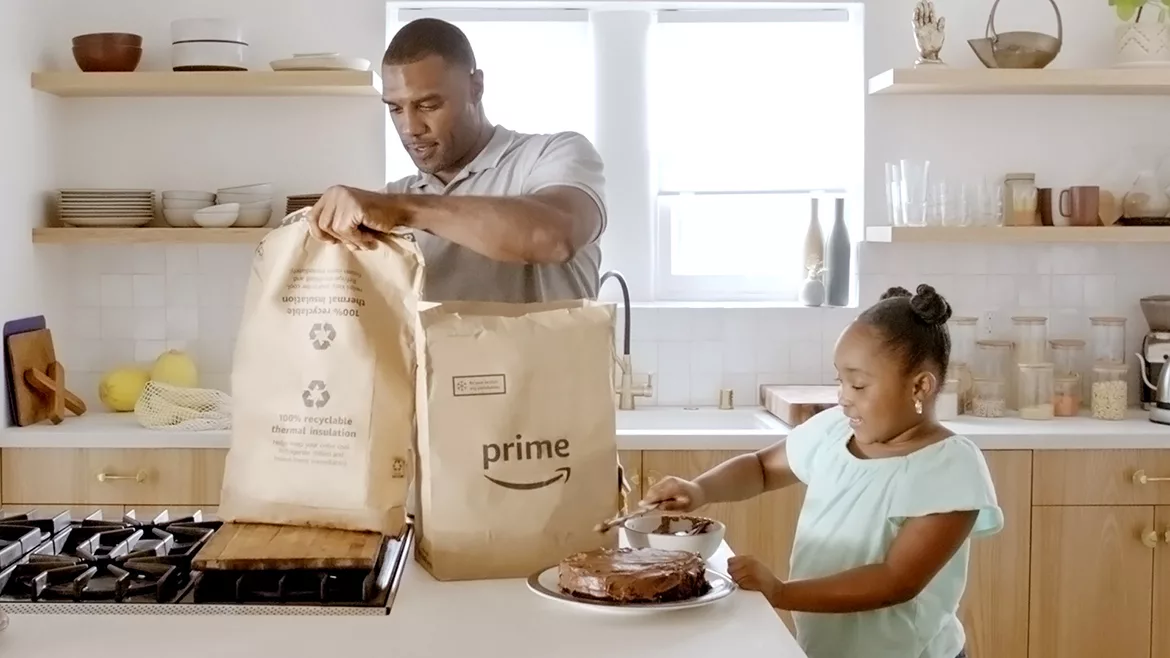
Flexible packaging is so popular and keeps growing marketshare year-over-year in the food and beverage segment, but retailers and private labels are now evaluating numerous paths for larger marketshare as sustainability desires by consumers take hold. Many industry stakeholders are moving quickly to post-consumer recycled content, but some retailers and private labels are in a unique position to execute deeper strategies — buoyed by its supply chain — and drive a sustainable packaging design that consumers crave.
One example of this trend is Amazon Grocery and its new insulated, secondary packaging made of recycled paper tissue in a layered format for frozen and chilled foods. In November 2021, Amazon Grocery introduced this secondary packaging solution and stated the importance of being able to recycle this material via traditional curbside pickup operations.
Amazon started investigating a solution for the plastic liners and bubble-bag insulation in 2019, but nothing on the market met the company’s physical, thermal and sustainable design criteria. Amazon began developing a solution in the lab and then with a pilot program to multiple cities in 2020.
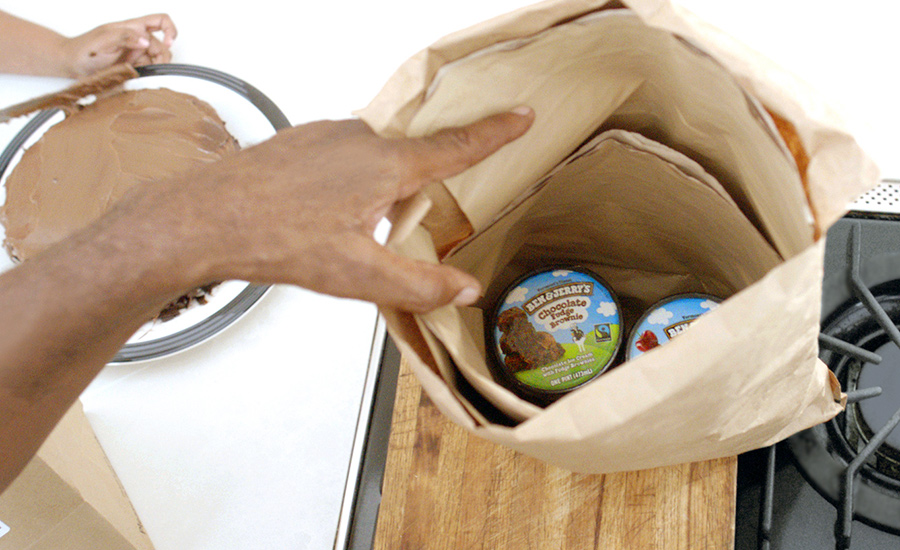
Image courtesy of Amazon Grocery
According to Joe Rake, senior program manager at Amazon, the criteria for the new packaging solution came down to five key considerations:
- High bar for food safety
- Compact packaging
- Easy recyclability
- Inexpensive and scalable
- Generate less packaging for consumers
Amazon’s estimates show that the move to this curbside-recyclable insulation program will replace approximately 735,000 pounds of plastic film, 3.15 million pounds of natural cotton fiber and 15 million pounds of non-recyclable mixed plastic each year.
This secondary packaging will be used for Amazon’s “chill chain” in the colder months, according to the company’s blog post. Flexible Packaging magazine reached out to Amazon for comment on its supplier of the secondary packaging and the geographic areas that would be participating, but Amazon has not responded.
“Private labels with sustainability messages are in front of consumers, so private label brands are going to have positioning to succeed,” says Claire Koelsch Sand, owner and CEO of Packaging Technology and Research.
In 2021, Walmart announced an increase in its post-consumer resin (PCR) use in its private label packaging in North America even though the PCR supply remained flat globally, according to the company. Walmart increased its percentage of PCR in private brand packaging from 7% in 2019 to 9% in 2020 — Walmart includes Canada, U.S. and Mexico in its North America calculations.
Walmart is shooting for 20% PCR in North America and 17% globally by 2025, according to Resource Recycling.
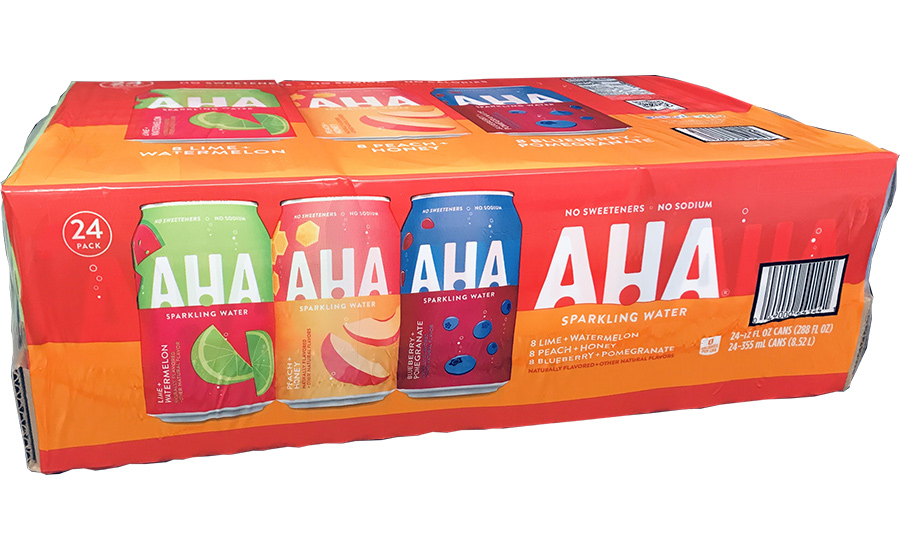
Image courtesy of TC Transcontinental Packaging
Vertical Integration
While supply chains struggle with higher demand after the pandemic and show how vital they are to the food and beverage industry, flexible packaging stakeholders are evaluating on how to minimize supply disruptions, drive costs lower and find ways to increase recycled plastic supply. The answer for some larger companies is to consider vertical integration and to bring certain supplier production in house, such as owning recycling operations or more research and development around plastic recycling.
TC Transcontinental Packaging, a printer and converter based in Montréal, acquired Enviroplast Inc. and its recycling equipment and Quebec plant assets in June of 2020. TC Transcontinental collects plastic waste from sorting facilities and commercial sources, and produces recycled plastic resin from these operations.
“The circular economy is the way of the future," says Sylvain Levert, senior VP of the recycling group at TC Transcontinental Packaging. “This equipment acquisition is part of our goal to vertically integrate the recycling of plastics in our packaging production chain in Canada, the United States and Latin America, ultimately ensuring stable procurement of recycled resin.”
TC’s large footprint in the converting and printing industry includes contracts with large beverage companies like Coca-Cola, which is moving quickly toward its 2025 sustainability mandates. Coca-Cola recently leveraged TC Continental’s sustainable investments and now uses TC’s post-consumer recycled Integritite-based shrink film for its flavored, sparkling water brand, AHA. The Integritite PCR resin makes up 33% of the reverse-printed collation shrink film for the AHA application.
AHA uses the shrink film for its 24-can multipacks that can be found in Sam’s and BJ’s Club store shelves throughout the U.S. Specifically, The Flexographic Technical Association (FTA) awarded TC Transcontinental and its Integritite collation shrink film with a Sustainability in Excellence Award in 2021, and TC plans “to increase the PCR content to 50% in the very near future,” according to Nate Miranda, director, innovation platforms and sustainability at TC Transcontinental.
Another large company in the food and beverage industry pushing for more PCR in the supply chain is Procter & Gamble (P&G). In the early 2000s, P&G’s lab came up with “a purification process that creates a solvent from recycled polypropylene (PP),” says Dr. John Layman, R&D director of sustainable materials for Procter & Gamble during a 2021 webinar. “The solvent would be the base material to create PP for packaging.”
Why is that important for P&G? Polypropylene is P&G’s lead plastic material and, if displaced, could aid in the company’s goal of reducing 50% of its virgin plastic from its products by 2030.
P&G and PureCycle Technologies entered into an agreement in 2017 on the IP technology where PureCycle would finalize the process of scaling the advanced recycling of PP. “That (PureCycle) has the potential to unlock significant volumes of polypropylene and open up a wide range of uses that just haven't been feasible before in the past,” says Jack McAneny, VP global sustainability at P&G at the recent Reuters Next Conference in December 2021. “Innovation is going to be critical to freeing up greater supplies.”
On November 16, PureCycle also signed an agreement with Berry Global Group to supply PCR to Berry starting in summer 2023. According to a press release on the agreement, this would be Berry Global Group’s largest contract to purchase “advanced recycled material.”
Across the Pond
Regulations in the UK and European markets are also driving new strategies among non-traditional partners, such as supermarket chain Morrisons and Scotland-based Yes Recycling. The two companies in November 2021 announced that Morrisons acquired a significant stake in a soft plastics recycling plant in Scotland. The UK supermarket company says the recycling plant will be “fully operational” by the end of 2021 and will have an initial capacity of 15,000 tons. The aim is to process hard-to-recycle soft plastics like chocolate wrappers, crisp packets and flexible food packaging.
“This is a groundbreaking site and we will use new patented plastic recycling technology, which we’ve developed over the last seven years,” says Omer Kutluoglu, co-owner of Yes Recycling.
Morrisons and Yes Recycling are evaluating a range of applications. The recycling process creates pellets and can be the material building blocks for store fixtures, fittings and a product called Ecosheets, an alternative to plywood. The recycling plant will produce Ecosheets, and these will be used in the construction and agricultural industries.
“Lots of work has been done by retailers to reduce plastic, but little to recycle what remains,” says Jamie Winter, procurement director at Morrisons. “We’re taking on that challenge and making a significant investment in a state-of-the-art soft plastic recycling site.” Yes Recycling also secured a “pre-investment” of £1.65 million for the plant by Nestlé UK and Ireland in September, according to a company press release.
Serious Challenges
The need for more recycled plastic content is undeniable and first movers like private labels and large retailers are certainly positioned to make deep connections with consumers and optimize supply chains. This story will have its ebb and flow, but first movers should begin to emerge in 2022 and 2023.
Looking for a reprint of this article?
From high-res PDFs to custom plaques, order your copy today!