Labels & Labeling: Processes
Managing Static and Contamination on Label Printing
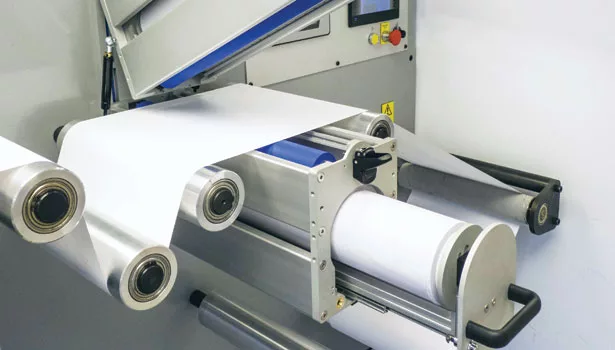
The series of issues that static can cause when present on a production line are numerous, which is why today’s businesses operating in the labeling sector need to be aware of its effects, especially its ability to attract considerable amounts of dirt and dust to the web’s surface. Not only will this result in a series of labels with poor print quality, it also means the labeling press will require frequent cleaning and subsequently slow production down.
It’s no good if a labeling company offers a fast service if they have to keep interrupting production flow to clean their machines because of the build-up of contamination attracted by static charges, or if at the inspection stage labels are rejected, which not only qualifies as waste, but also expense. This matters even more if the end use for the label is perhaps medical or a clean environment.
End users are demanding more sophisticated standards in the goods they purchase than they may have done a number of years ago. For instance, filmic materials are being used more commonly now as they are pleasing on the eye, but at the same time they tend to generate higher static charges. Or take a digital label printing line as another example, where a massive static charge can be generated both during the printing process and as the film or paper is unwound from a roll. These charges are capable of attracting dust to the web from several feet away and once it has deposited on the material, it will negatively affect the final print quality.
Static and high-speed webs go hand in hand, and when you add in the range of substrates now available you have a potent cocktail for potential production problems. Today’s lines are capable of running at upwards of 1200 feet/min, packaging is getting more complex, and lightweight substrates such as PET, PVC and Mylar are especially vulnerable to the effects of this phenomenon.
Static arises when an external force causes an electrical charge to move from one material to another, leaving one positively charged and the other negatively charged. Speed and force of the friction, pressure and separation are all factors that contribute to the size of the charge, with increased force or faster processes leading to larger charges being generated. If one of the materials is conductive, it won’t hold the charge, but if the material is non-conductive the charge is unable to move across the surface, creating a static “pool” of electrical charges.
Uncontrolled static can cause products to misbehave – print can be out of register, tiny holes appear in extruded film, and static charges can cause blockages in the most modern machinery – but dust attraction is arguably the biggest issue in a sector concerned with quality control, as airborne particles are attracted to charged surfaces, leading to high reject rates and rework levels where the packaging calls for completely clean substrates.
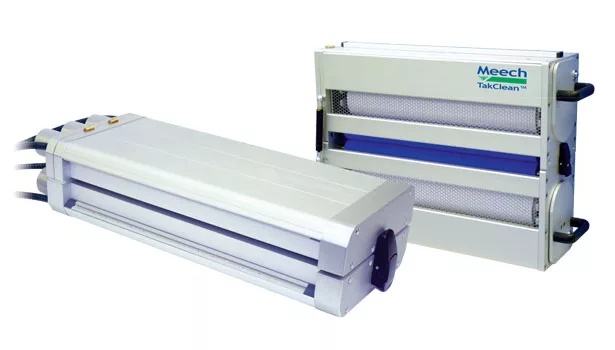
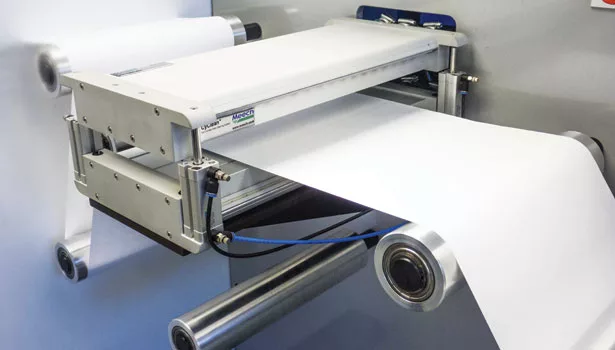
In order to deal with such varying degrees of dust, a non-contact web-cleaner proves to be an ideal solution, as the system performance is not affected by the contamination level and no consumables are required, which helps reduce ongoing costs. Some of the latest non-contact web cleaning systems designed for the narrow web industry are capable of removing contamination to below 1 micron, as well as incorporating fluid dynamic principles to deliver higher levels of cleanliness for label
printing applications.
However, while the web-cleaner provides a solution for contamination on the substrate, there is also the necessity to eliminate the presence of static on the web, which may re-attract dust to its surface. Active static control utilizes ionization technology, employing high voltage AC or “Pulsed” DC to produce ionized air to neutralize surface charges. The voltage is fed to an array of titanium emitter pins mounted on an ionizing bar, creating a high-energy “ion cloud” of positive and negative ions. In its AC guise, as the AC cycle changes, positive or negative ions are produced in approximately equal quantities, and a statically-charged surface of either polarity passing close to the cloud is quickly neutralized.
Recently launched static control bars have marked a transition from AC systems to 24v integrated power supplies, providing more efficient ionization. Long range ionization systems achieve great static control in general applications, whereas for short to medium range applications (with target distances varying between 2 to 20 inches), plug and play bars are better suited. Newer products tend to be more resilient to the build-up of contamination which occurs during their use and also allow for easier cleaning, while their improved shockless design makes them safer for operators to handle.
Being fully aware of the ever-growing importance of the labeling market, and with a long heritage in static and web-cleaning, Meech’s aim is to provide solutions that can benefit companies in this sector and advise them on some of the issues static and contamination can pose left untreated.
Meech International
Looking for a reprint of this article?
From high-res PDFs to custom plaques, order your copy today!