Technology: Roll Handling
Nip Rollers in the Blown-film Process
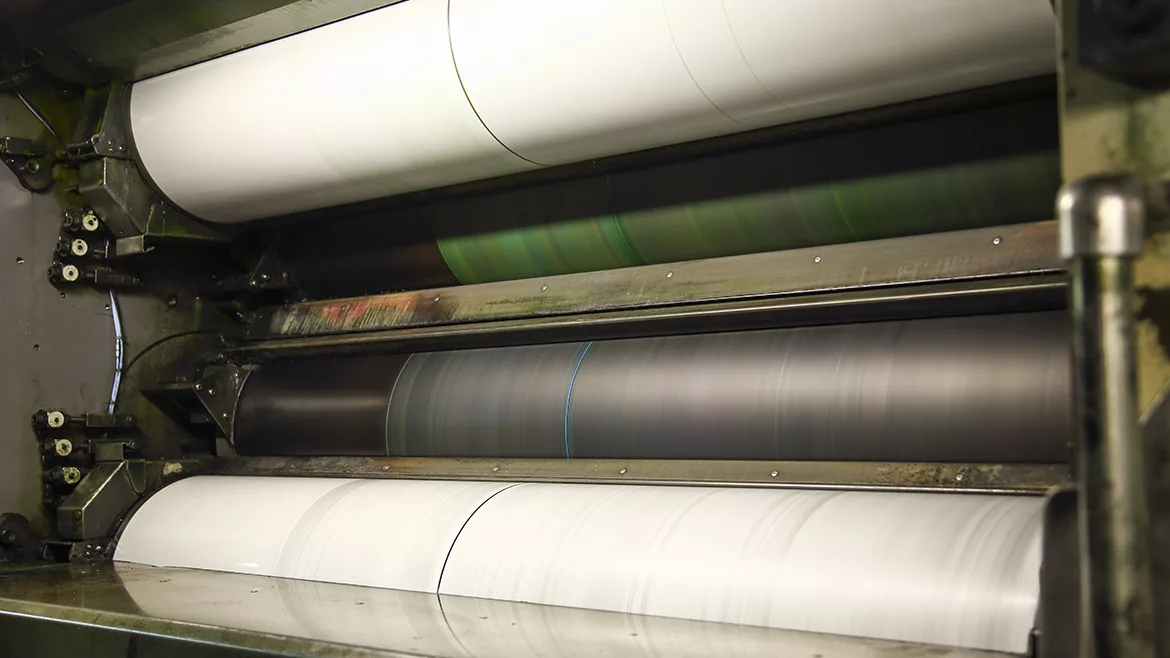
Image Source: tomazl / iStock via Getty Images Plus
Any web process is certain to have nip rollers. Typically, one roller is hard and the other is soft. They are commonly opened and pressed together with one or more air cylinders whose air pressure is controlled through an air-pressure regulator. In a blown-film process, the primary nip rolls at the top of the tower perform three functions. They must open to allow a startup knot through them, while also opening the tops of the collapsing frame below. They must draw the film from the extrusion die consistently with no speed variations, and must also trap air inside the bubble, especially on a conventional non-IBC air ring cooling system.
Running at a consistent speed is more challenging. This has a direct effect on film quality and profitability. Any short- or long-term speed variation in primary nip rolls will affect the average film gauge, assuming that the extrusion system is producing a consistent output. Short-term speed variations will have additional consequences including bubble instability and lay-flat width variations. It should also be understood that a primary nip’s speed can be increased or overhauled by web tension from another downstream nip, even with a right-angle gear reducer driving the primary nip. That is why a regenerative DC or AC drive with dynamic braking are commonly used, only on the primary nip rollers. Such a drive has the ability to hold the nip at the proper continuous speed even if downstream web tension tries to increase its speed. This can be dramatically demonstrated if a wire supplying the primary nip drive is removed during production and you observe that the line continues to run.
In addition, it is not uncommon to see zero or negative amps on a primary nip drive during this condition where a secondary nip is actually trying to pull the primary nip at a faster web speed. In any case, your FPM or M/M web speed gage should indicate a steady reading always. Very short-term variations such as anything out-of-round or bad bearings, may be impossible to see on a digital web-speed indicator. Such variations can be more easily observed using an analog gage measuring nip speed and also observing steady analog amps on the nip drive.
Trapping air in the bubble can also be challenging. Both nip rollers must have a surface that is flat, smooth, centered and round, in order to seal against each other continuously. Any defects in the surfaces, including surface cuts, tape or crud, can allow a tiny bit of air to be carried through the inside of the bubble with each nip roll rotation. This air generally gets trapped at subsequent nips and the bubble gets progressively smaller on non-IBC systems.
The durometer, or softness of the covering on the rubber roller, will determine how well it can conform to the slight distortion caused by the film passing between the rollers, especially the folded edges or gusseted films. This covering will also affect the amount of creasing (film damage) that will occur from crushing the folds. These coverings commonly age over time and become harder, sometimes accelerated by ozone from corona surface treaters. Their surface also wears to a smaller diameter in the center portion, where film contact is the highest. Such wear can be discovered by using a Pi tape to measure the circumference around the rubber roller’s surface every few inches across its length, when it is clean.
Repairing the rubber roller’s surface so that it is flat, smooth and round normally requires removing it and sending it to a qualified shop for regrinding or recovering. Regrinding will normally remove defects that are not too deep, assuming that sufficient covering remains on the roller. This can also remove most of the surface material that has hardened over time. Such repairs can result in substantial downtime on the line. There are methods for grinding such rollers online and even by hand, but the process is critical and only done by a true craftsman.
Another strange cause for air loss through nip rollers involves their design. Their shafts must extend beyond the ends of the roller. Their end caps, where the shafts attach, are typically at the ends of their steel tube shells where they are easily welded. Therefore, when such rollers are squeezed together by their shafts, their tubes want to bend slightly apart in the middle, with most of the actual nip pressure being transferred to the ends of the rollers. This is evident if you close any nip on the carbon paper testing material designed and sold for this purpose.
If a pair of nip rollers is large and strong enough, maybe they will not bend enough to cause separation in the middle and lose air from the bubble. Another approach to this problem is to locate the roller’s end caps up into the steel shell and away from the ends. Now the shafts will be longer but the pivot point of mechanical pressure from the caps will move from the ends of the roller, toward its center. As a result, a bending force from the unsupported ends of the roller in the opposite direction will help counteract the potential center separation and its associated problems.
Other nips that are downstream from the primary nips have other functions. All of them are intended to control their upstream web tension, meaning the web tension between them and the previous nip. Therefore, they each require a drive system to control their “tension zone,” such as a dancer, load cells, torque or follower drive, etc. Their function may include pulling film through a folder, insuring tension through slitters and preventing web tension loss during a roll transfer. Except in the case of a post-gusseter, there is normally no need for them to trap air in blown-film tubing. Therefore, their rubber rollers can have grooves or a diamond pattern in their surface, but they still must be uniformly rounded and aligned.
Additionally, all rollers on any line must be leveled and paralleled to the primary nip rollers. It is also critical that all nip rollers be leveled with each other when closed. Otherwise, there will be a cross-axis grinding effect on the film as each roller tries to drive the film horizontally in opposite directions with great force. This often causes nip rollers to become off-set from each other, or causes premature bearing failure, etc. An easy way to determine that both nip rollers are leveled with one another is to position one of your eyes near the center of these rollers so that you can see the tops (or bottoms) of both roller surfaces when they are closed and running. You then hold steady and scan one eye left and right, looking for any slight angular difference in the surface of the two rollers. This quick method can also be used on other nearby rollers of any kind to locate one or more that is not parallel to the other.
Looking for a reprint of this article?
From high-res PDFs to custom plaques, order your copy today!