Industry Q&A: Slitting/Rewinding
New Technologies, Developments in Slitting/Rewinding
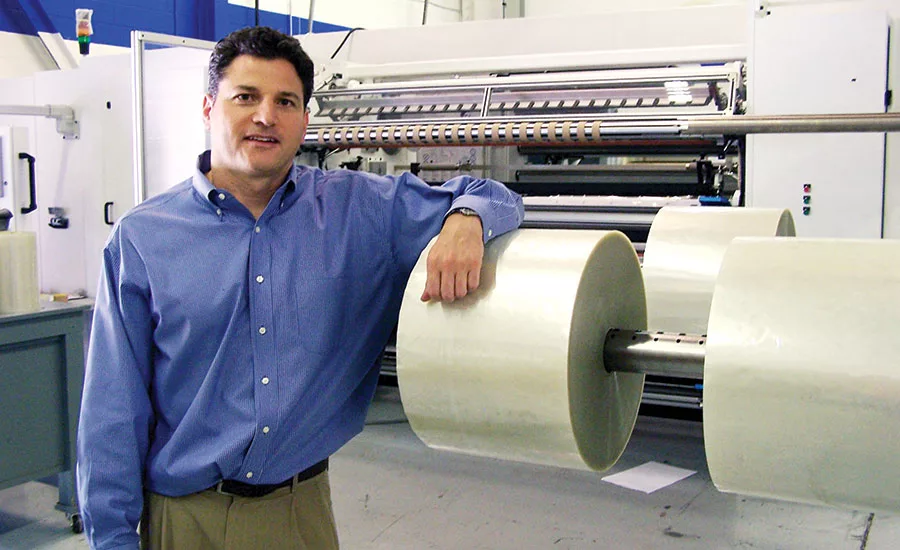
We caught up with Michael Pappas, president, Catbridge Machinery, for his take on minimizing efficiencies, tension control and more in slitting/rewinding.
Q: What’s new when it comes to slitting/rewinding?
A: New technologies and developments focus on a number of areas. One is safety. Safety concerns are not new, of course, but the technologies used are constantly advancing. For example, safety PLCs are now being employed by premier builders. While there is an associated cost, the benefits in safety and operator process control are more than justifiable.
Wind quality is another area of focus. Edge quality continues to improve as tension control and rewind shaft technologies improve. Roll build can be better than ever due to consistent tension achieved through recipe-controlled, precise taper-tension programs.
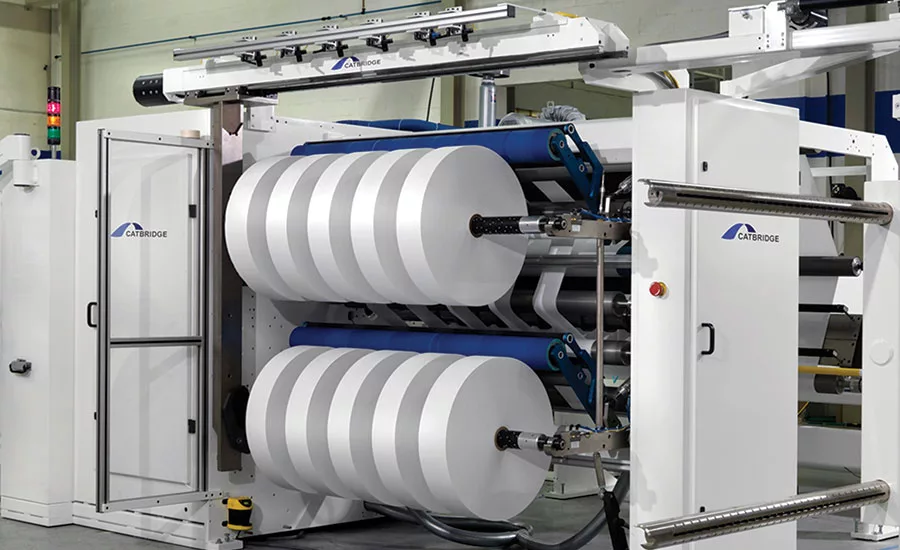
For turrets, new technologies at the start and end of roll rewinding further improve quality. The latest automated turret designs offer a tail tie to core process that all but eliminates the problem of the roll being slightly off core at the first wrap. The new process also provides proper alignment at the last wrap, which, importantly, eliminates the need to detach, realign and then re-secure the last wrap. The savings in operator time and the improved finished roll appearance to the customer are significant.
Q: What’s being done to minimize inefficiencies?
A: Inefficiencies from downtime originate from four main sources: loading new parent (jumbo) rolls, stopping and splicing for flags, knife setup changes and downtime between finished sets (when the machine stops to discharge rolls, place new cores and attach tails). Shaft-less floor pickup unwinds, auto knife placement systems, auto core loading and roll pushers address three of these inefficiencies.
For the fourth, flags, one solution is programming the PLC. Flag positions on a jumbo roll can be entered in when the roll is loaded so that the machine slows down and then stops at a flag.
From a broader perspective, eliminating the need for flags has the most beneficial effect in the slitting department. This means fixing the problem at the source, during a previous process such as printing or laminating. When this is not possible, some companies turn to the intermediate step of a roll editor. This is a machine specifically designed to deal with bad material, removing defects before the roll gets to the converting department. This adds a step to the process, of course, but time studies in some plants have shown this approach to be a significant net gain.
Q: Why is alignment and tension control so important in slitting/rewinding, and what should converters be doing to better account for these factors?
A: Tension control and alignment are critical in two areas: finished roll build quality and edge quality. However, proper tension and alignment control also impact a third important area: the speed at which material can be run. Speed can be a major efficiency factor as finished roll length increases. Modern, well built, well controlled slitters should be able to run most all materials at 2,500 to 2,800 fpm. That can make a huge throughput difference on longer rolls. For example, a 20,000 foot finished roll running at only 1,500 fpm would take roughly 14 minutes to run. The same roll at 2,500 fpm would take approximately 8.5 minutes to run (accel and decel curves a variable). That is a savings of more than 5 minutes a set, every set, every shift, every day. Even at shorter roll lengths the gains of speed must not be ignored.
Q: Aside from alignment and tension control, what other issues do converters need to be on the lookout for?
A: Selecting the proper rewind shaft technology and the proper controls for that technology is key, especially for differential winding on center winders. Gauge bands are becoming less of a problem in slitting as base materials and coating and laminating processes continue to improve in thickness consistency. But, gauge bands are still an issue. It’s critical to choose the right shafts for the job. Should they be direct friction, indirect friction, or even locked core shafts? Also, the machine itself must be able to properly control the shafts to allow them to perform as required.
Q: Sustainability and waste reduction are two hot topics in the industry right now. Are these factors carrying over into slitting/rewinding equipment?
A: Yes, they surely carry over to the slitting world. The converting department is the last step in a value-added process. Rolls coming here carry a lot of built-in value in the form of raw material cost, energy, labor and overhead. As high a percentage as possible must go out the door as finished goods. The slitter has to run good rolls, as consistently as possible. Proper tension control, alignment and recipe-driven simplicity and repeatability for the operator all help reduce waste and conserve materials and energy.
Q: Is there anything else you’d like to share about slitting/rewinding?
A: Even the seemingly smallest of gains in throughput and waste reduction, accomplished by modern slitter technology, are very significant. The gains from each shift accumulate over time, and most certainly over the life of a slitter. A fast, robust, well-built slitter with modern tension and alignment control will cost more than a base, less expensive machine. But whatever savings that might be made once, at purchase, will be paid for daily over the life of the machine in increased waste, less throughput and a greater risk of operator injury. The math is inescapable: a quality slitter is the least expensive and safest solution, day in and day out.
Looking for a reprint of this article?
From high-res PDFs to custom plaques, order your copy today!