Key Takeaways from Global Pouch Forum
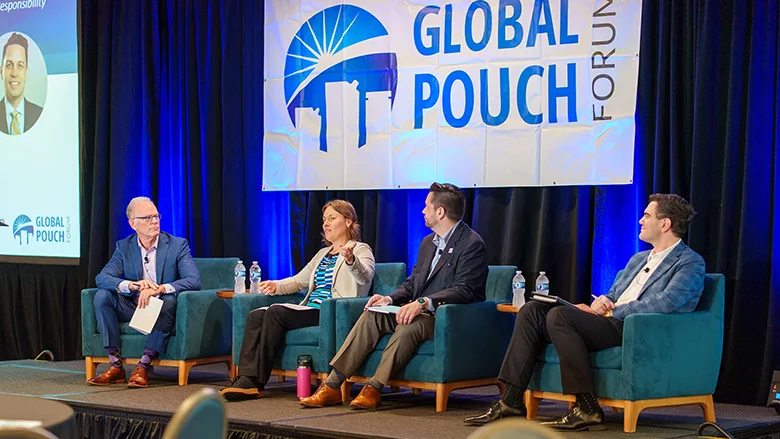
This year’s Global Pouch Forum in late May was jam-packed with engaging and informative presentations and speakers. While it’s impossible to summarize a day and a half of presentations in a single column, I thought I would highlight some of the major themes that our stellar lineup of packaging experts brought to the fore.
Extended Producer Responsibility
Anybody involved with flexible packaging knows by now that packaging EPR laws have been enacted in seven states—California, Colorado, Maine, Maryland, Minnesota, Oregon, and Washington.
In the context of EPR, Dan Felton, President and CEO of the Flexible Packaging Association, shared the group’s stance on recycling.
Felton said FPA supports all forms of mechanical recycling. He said the group also supports advanced recycling, calling it a "critical path forward for recycling more films and flexibles—and particularly for meeting food-contact packaging recycled content needs."
Felton noted that 25 states have now passed laws to allow advanced recycling, with Wyoming the most recent state to do so. However, the industry also is witnessing proposed bans on advanced recycling in states like Maryland, New York, and Oregon.
Felton noted that "restrictive recycling policies have negative implications for EPR, labeling and recycle content."
Compostable Packaging
Rodrigo Castaneda of TIPA Compostable Packaging and Jared Damman of WildKind Packaging touted the benefits of compostable packaging.
"Recycling is important, but for some packaging formats, recycling doesn’t work well," Damman said. "The packaging should go where the food waste goes."

Jared Damman of WildKind Packaging and Rodrigo Castaneda of TIPA Compostable Packaging touted the advantages of compostable packaging at Global Pouch Forum. Courtesy of BNP Media
During their presentation, Castaneda and Damman pointed out that most Materials Recovery Facilities (MRFs) are not equipped to sort flexible packaging, adding that food residue often disqualifies flexible packaging in the recycling stream.
They noted that 18.1% of the U.S. population has access to food waste and compostable packaging collection. They also highlighted that 47% of consumers are "very likely" to choose a particular brand if it has health benefits for them as well as the planet (NielsenIQ, March 2026).
They also noted that the compostable packaging provided by TIPA is a "plug & play" solution for converters. That is, TIPA compostable packaging can run on the same flexible packaging equipment as conventional packaging structures.
Mono-Material Pouches
Haley Rapp and Astrid Torres of TOPPAN Packaging Americas tag-teamed an engaging presentation on "Developing, Scaling, and Validating Mono-Material Pouches for a Circular Economy."
One part of their presentation that was extremely educational for me was how mono-material polyethylene stacks up against mono-material polypropylene.

Astrid Torres and Haley Rapp of TOPPAN Packaging Americas compared and contrasted all-PP packaging and all-PE packaging during their presentation at Global Pouch Forum. Courtesy of BNP Media
As far as aesthetics, all-PP packaging outperforms all-PE packaging when it comes to clarity and gloss.
As for mechanical properties, all-PP packaging outperforms all-PE packaging when it comes to stiffness and toughness.
As for seal performance, all-PE packaging outperforms all-PP packaging when it comes to seal strength.
And as far as thermal resistance is concerned, all-PP packaging outperforms all-PE packaging in the categories of heat resistance, hot fill, and retort.
This is just a brief snapshot of the amazing presentations that I saw at Global Pouch Forum. I’m sure I’ll be returning to these presentations in the coming months as I write about the important role of pouch packaging.

Brad Addington
Chief Editor, Packaging Strategies
(248) 227-4727
addingtonb@bnpmedia.com
Looking for a reprint of this article?
From high-res PDFs to custom plaques, order your copy today!