Industry Insights: Private Labels for CPGs
Generic No More: How Packaging Innovation Can Help Private Label Gain Market Share
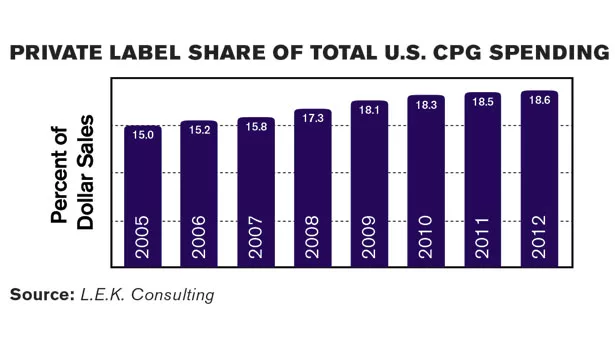
Is it time for private label packaging in the US to come of age? Fueled by the economic downturn and vast improvements in quality, store-brand product lines have recently grown by around 6 percent a year and will soon account for over $100 billion in sales in the US – a veritable growth spurt in an industry in which established national brands have struggled to grow at all in recent years. But like a teenager transitioning to adulthood, private label needs a new wardrobe.
While private label packaging has long since evolved from its early days of generic labels ("White Bread," "Bean Soup"), the category is still in the early stages of embracing the innovations in premium packaging available to the industry.
That needs to change if private label is to reach its full potential. The steps private label has taken toward innovation and improvement – primarily, multi-tiered labeling to differentiate between value and premium products – have successfully enticed broader segments of shoppers.
But these improvements only scratch the surface. The real opportunity lies in innovative packaging that drives consumers to purchase a private label product over its branded counterpart. Private label is increasingly competing not as generics, but equals, and to do that comprehensively its packaging must offer consumers valuable attributes such as customer appeal, ease of use, freshness, "green" packaging, packaging that is integrated with mobile or smartphone devices and other innovations. And, many private label brands are using flexible packing to convey these attributes.
Already, some private labels are forging new paths and innovating. The European market, where private label has earned a far greater proportion of share, offers lessons and best practices for US companies. And technological breakthroughs in packaging by national brands in the US, such as multi-layer flexible packing, have yet to be fully exploited; private label can piggyback on these breakthroughs, become fast followers and bring packaging to market that capture the innovation's full potential.
The Time is Now
Retail giants such as Walmart, Kroger and Safeway have set aggressive private label penetration goals in the coming years, and have reconfigured their in-store brand strategies, not only to take advantage of the attractive margins these products offer, but also to differentiate as a shopping destination and capture consumer loyalty. Many retailers are assembling dedicated store-brand teams to manage these offerings. To do this successfully, however, retail outlets will need to do more than make private label presentable; they will need packaging solutions that align private labels with consumer trends, shopping behaviors and product needs. And that requires innovation.
Building on our analyses of consumer trends and the packaging industry, we believe successful private label packaging will contain one or more of the following attributes:
• Customer appeal: As private label packaging moves away from simply aping major national brands, its designs must become just as eye-catching in order to compete. Successful private label packaging will feature greater surface area for images, a colorful appearance, and a unique shape or profile that enables instant recognition. For packaging converters, this may mean increased demand for higher-quality packaging materials, designs incorporating multiple material types (e.g., shining/reflective surfaces inlaid on more typical materials) and atypical package shapes. Supermarket chain A&P's private label Via Roma line of Italian prepared foods, for example, features packaging with high-quality graphics and vibrant colors.
• Private Label "Brands": At its most extreme, private label brands can develop packaging that assumes all the attributes of national brands, including logos and consistent but complex graphics. In such cases, retailers may pursue "stealth" private labels and introduce product lines that are marketed as if they are national brands.
Target's Archer Farms line, for example, is rarely identified by many consumers as private label thanks to its distinctive label and color scheme. In the United Kingdom, supermarket chain Tesco launched Venture Brands in 2011 to directly compete with national brands. Originally the products were not labeled as Tesco's, though in some cases the supermarket name has been reintroduced. The branding was so successful that some of the Venture products were eventually sold outside of Tesco stores; the store's Chokablok ice cream, for example, was a hit in parks, zoos and other venues. In another successful example, German supermarket chain Aldi sells its Moser- Roth chocolate private label without the Aldi logo, and successfully competes as a high-quality chocolate brand. The packaging includes shining gold lettering and golden borders.
• Ease of use: In most cases, packaging should be designed to increase customer convenience. Within food packaging, innovations may include single-serve portion sizes, oven-ready trays incorporated into the packaging, ready-to-eat functionality, and other additions to packaging that increase portability and reduce preparation. Outside of food, packaging will need to be increasingly designed for ease of opening and closing and durability while carried in a pocket, handbag,
or backpack.
• Green packaging: A product line with a "green" or sustainable proposition should reinforce its image through packaging. In these cases, private label packaging should have a reduced environmental impact, whether by using an increased percentage of recyclable material, requiring less materials (and thus less waste), or changing the manufacturing process to be more environmentally friendly. But the packaging must also be able to advertise that fact to the consumer.
As an example, UK retailer Waitrose introduced slimmer packaging in many of its private label products so as to reduce waste, and advertised that fact on the packaging. In Italy, Coop's Viviverde private label cosmetics have packaging specifically de-signed for environmentally friendly disposal, in keeping with the "eco-friendly" theme of the private label line.
We have also seen private label products capitalize on the "shop-local" movement by responding to local tastes and needs: New York pharmacy chain Duane Read, for example, rejuvenated store sales by introducing NYC-centric packaging labeling concepts such as UPC bar codes depicting New York's skyline.
• Freshness: Private label food packaging for perishables will increasingly need to protect and emphasize the freshness of the products contained within, so as to overcome customer perceptions of poor private label food quality. Improving product freshness will require not only packaging with improved sealing, but also re-sealing functionality and package design that provides a larger "window" for the consumer to view the product—another example of the role of flexible packaging. For example, Target has recently introduced re-sealable cereal packaging and re-closable zippers on bags of chips in their Archer Farms private label product line.
• Mobile integration: Some national brands have integrated mobile device functionality by incorporating QR codes into packaging; private label brands seeking a premium image may choose to follow this trend. In particular, private labels can benefit from apps that compare the prices of top brands to the (usually lower) prices of the private label. Apps could also provide additional producer information, providing greater detail on producer quality to counterbalance the prevailing assumption of lower private label quality. As an example, German supermarket chain Edeka Südwest incorporates QR codes in many of its private label products to provide detailed producer information.
The Global Perspective
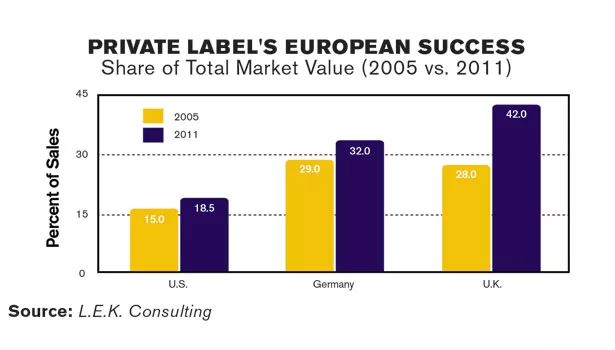
Many European companies are already far along in developing these attributes for private labels, and their success offers a best-practice guide for US private labels. In the United Kingdom, for example, an astonishing 40 percent of new product launches in 2009 were from private label offerings rather than branded products.
A main lesson from the European experience is that private labels' early successes, if they spread and gain traction, will build their own momentum and become reinforcing, putting further pressure on brands. Thanks in large part to the strength of private label, national brands in European countries have less share and wield less influence over retailers. Retailers are less dependent on the brands' promotional dollars, and therefore are better able to manage their own shelves. In contrast, US national brands maintain a greater influence over their retail partners as most US retailers are reluctant to turn away promotional dollars in exchange for favorable shelf space.
In Asia, the story is more nuanced. While many leading European retailers have been well-established in certain parts of Asia for years (e.g., Tesco, Carrefour, and Casino Group in Southeast Asia), most countries are still dominated by local grocery and hypermarket players with relatively nascent private label strategies. In Thailand, however, hypermarket operator Big C (Casino Group) has seen significant growth in its private label offerings, with an overall SKU increase of more than 50 percent since 2009. The key segment driving this growth – 'premium' private label goods – has grown from 50 to approximately 500 SKUs in just three years and requires significantly higher-quality packaging than 'discount' or 'core' items.
Ultimately, private label offerings around the world will continue to represent a growing share of sales throughout the retail sector. This shift will cause private label to converge in quality and features with the packaging of national brands. In tomorrow's marketplace, private label must be able to replicate innovations in package design, and indeed become innovators themselves. Once relegated to the back shelves, it's time for private label to step forward into the spotlight, and come of age.
Looking for a reprint of this article?
From high-res PDFs to custom plaques, order your copy today!