The New Scale in Flexible Packaging: Winning by Mastering Complexity
In flexible packaging converting, scale used to be straightforward. Bigger presses. Longer runs. Higher utilization. Broader geographic reach. For decades, operational excellence meant driving down unit cost through repetition and volume. That definition of scale is now incomplete.
Today, the defining condition of our industry is not simply growth—it is structural complexity. Brand portfolios are expanding, not consolidating. In recent industry research, a majority of brand owners reported double-digit SKU increases over the past few years, with expectations that this proliferation will continue. That is not a temporary marketing experiment. It reflects a fundamental shift in how brands compete. More SKUs. More channel-specific versions. More regulatory variation. More material formats. More frequent artwork updates. Complexity is no longer episodic. It is embedded. And yet many converting operations are still optimized for a world that prizes homogeneity. There is a growing divide in our sector. Some converters continue to focus primarily on throughput efficiency, maximizing OEE, extending run lengths, and pushing equipment harder. These metrics remain essential. But they are no longer sufficient.
The converters pulling ahead are redesigning their operating models around what I would call complexity economics. They understand that SKU proliferation is not friction to be eliminated; it is a commercial strategy to be enabled. They are engineering systems that reduce the penalty of variation rather than fighting it. This requires redefining what scale really means. Scale today is not producing more of the same. It is building operational flexibility at scale. It is the ability to shift between long-run flexo and short-run digital without destabilizing schedules. The ability to integrate new material structures without reworking the entire workflow. The ability to absorb late-stage design changes without triggering cascading delays. That kind of scale is orchestration, not expansion.

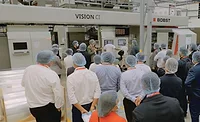
Precision inspection at Propelis’s (formerly SGK’s) Manchester facility, UK. Image courtesy of Propelis
In many converting environments, inefficiency does not originate on the press. It begins upstream, in quoting, in specification alignment, in artwork handling, and in disconnected systems. Every manual handoff introduces latency. Every silo increases the probability of error. As SKU counts rise, those inefficiencies multiply. Compressing decision cycles across the enterprise is now as important as reducing changeover time on the floor. Integrated MIS and ERP environments, automated prepress workflows, real-time production visibility, predictive scheduling; these are not incremental upgrades. They are foundational to operating in a high-variation market. But technology alone does not create an advantage. Organizational design matters just as much.
Traditional functional silos were built for predictability. In a world of constant variation, alignment becomes strategic. Sales must understand operational constraints in real time. Supply chain must anticipate material risk before it manifests as downtime. Production planning must be informed by commercial intent, not just capacity. The converters who thrive are those who reduce cognitive drag, who make it easier for decisions to move at the same pace as demand. There is also a commercial dimension that our industry does not always confront directly: complexity has value.
Managing multiple SKUs, regulatory formats, substrate transitions, and short runs requires infrastructure and expertise. Yet too often, converters absorb that cost quietly. The next generation of leaders will quantify and communicate the value they create, reduce obsolescence risk for brands, and lower finished goods inventory exposure to deliver faster promotional agility. That shifts the conversation from price per thousand to total system performance. Resilience becomes part of that equation.
Lean systems remain critical, but lean without visibility is fragile. Converters that rely on rigid production sequences or narrow material sourcing expose themselves to disruption. The leaders are designing engineered adaptability, diversified substrate options, predictive maintenance models, scenario planning embedded into production strategy. Resilience is not excess capacity. It is intelligent flexibility.

Platemaking in action at Propelis’s (formerly SGK’s) facility near Manchester, UK. Image courtesy of Propelis
At SGX, now part of Propelis, this broader view shapes how we think about the future of converting. Being part of a larger organization built around brand impact reinforces a simple truth: converting does not operate in isolation. It sits at the intersection of brand strategy, creative execution, material science, and industrial performance. That vantage point matters. It encourages deeper integration between design intent and manufacturing reality. It pushes us to connect commercial strategy with operational capability. It reminds us that speed only creates advantage when it aligns with how brands are actually competing.
When converters think beyond the plant, when they see themselves as embedded in a wider brand and supply ecosystem, priorities change. Investments shift from pure capacity expansion toward system integration. Success metrics expand beyond throughput toward adaptability and decision velocity. As we look toward the next chapter of flexible packaging, I am convinced that the converters who define it will not be those who simply add presses or square footage. They will be the ones who re-architect their businesses to thrive in complexity. They will measure performance not only by utilization, but by their ability to pivot without penalty. Not only by yield, but by responsiveness. Not only by cost control, but by the strategic advantage they create for brands operating at speed.
Scale still matters. But scale without orchestration is blunt force. The future belongs to converters who treat complexity as a design parameter and build integrated systems, aligned organizations, and disciplined commercial models that turn it into a competitive advantage. That is a different definition of leadership. And it is the one that will matter most.
Looking for a reprint of this article?
From high-res PDFs to custom plaques, order your copy today!