The Shift from Traditional Materials to Flexible Packaging
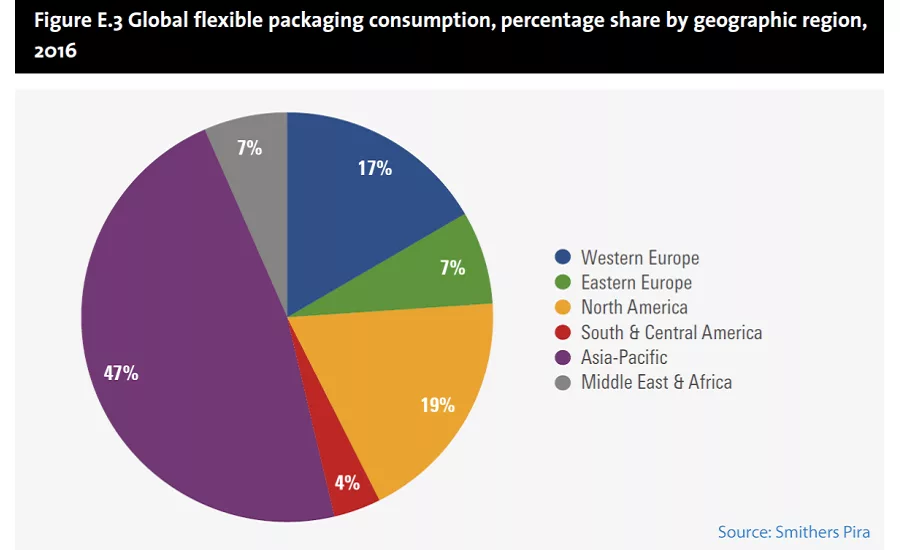
Consumer trends have contributed to a gradual replacement of rigid pack formats by flexible packaging during the last decade or so. This trend is outlined in Smithers Pira’s new report, “The Future of Flexible Packaging to 2022,” which values total flexible packaging sales at $219.5 billion in 2016, with growth expected at an annual rate of 4.3% to $282.6 billion by 2022.
Smithers Pira analysis examines what is driving market growth and why brand owners are switching from traditional packaging materials—like glass jars and metal cans—to flexible packaging types.
Consumer Preference
Consumers are more concerned about health and wellness issues because of greater media and internet attention to health matters. These concerns have led to growth in demand for packed fresh fruit and vegetables, dietary supplements, natural, organic and additive-free products, which has boosted demand for flexible packaging types.
Consumers are increasingly aware of what ingredients and additives go into the products they consume, which is emphasising the importance of concise labelling.
An increasingly urban society is leading to busy lifestyles in which time-constrained consumers choose products that offer convenience and portability. Demand is rising for microwaveable packaging, single-serve packs, carry-away packs, resealable packaging, easy-open packs and longer shelf lives. More eating away from home and on-the-go consumption suggest that more packaging will need to be designed for portability and less weight and resealability will need to be designed for products eaten at home.
Sustainable Packaging
There is mounting public pressure on brand owners and retailers to reduce the environmental impact of packaging. Brand owners are responding to consumers’ environmental concerns in several ways. These include:
- Lightweighting, reducing material usage without impairing pack performance;
- Using more recycled and recyclable polymers in packaging;
- Investigating the use of bioplastic packaging.
For the packaging converter and its logistics chain, flexible packaging uses fewer resources and less energy than other forms of packaging. It provides significant reductions in packaging costs, materials use and transport costs. Furthermore it can also be constructed on the spot from roll materials at the filling location, minimizing transportation of ready-formed empty packaging. To the consumer it takes up less space when empty than rigid packaging.
Retail chains and brand owners also continue to adopt bioplastic packaging rather than conventional plastics in order to meet their sustainability goals and minimize their carbon footprint. They also recognize that sustainable packaging presents an opportunity to differentiate their products and to present a more environmentally friendly image to consumers.
Supermarket Shopping
Packaging film demand is benefiting from the growing market share of the large retail chains worldwide. These chains have expanded the market for packaged food with their focus on cost reduction and shelf-life extension.
Retail chains have dominated food and drink markets in advanced countries for many years. Food and drink retailing in developing economies of Eastern Europe, Asia and South America, has traditionally been dominated by smaller, local and independent artisan stores, largely offering unpacked food. Domestic supermarkets chains are spreading in these regions, and are taking a growing share of food and drink consumption.
Supermarket are becoming especially favored by consumers due to their wide product ranges and diverse choice of premium brands, usually unavailable in other types of outlets. There has also been growth in the number of discount stores and private label products, which enables those on lower incomes to purchase packaged food and drinks at more affordable prices.
Pouch Machinery
Pouches—particularly stand-up pouches—are the fastest-growing product category within flexible packaging. The new generation of vertical form-fill systems (VFFS) are capable of delivering faster production speeds, greater versatility and improved sealing techniques. In the current economic climate there is a growing need to reduce the time to market for even the most basic commodity items, a trend that is placing pressure on packer fillers to meet increasingly tight delivery schedules cost effectively.
Pouch production machinery development is one of the most buoyant areas of the packaging equipment segment. A major challenge is the fill line speeds of pouches in comparison to bottles—especially for transitioning beverages to flexible formats. One of the greatest steps forward has been the development of continuous pouch filling machines to replace slower machines. Large format pouches, previously limited to 80–100 pouches per minute (ppm), can now be run off at 250 ppm.
Looking for a reprint of this article?
From high-res PDFs to custom plaques, order your copy today!