
Less plastic means more work for fillers
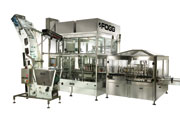
Lightweight bottles, especially PET, pose a challenge for filling systems. Here's how some of the major equipment manufacturers are adjusting.
As bottles get lighter, the burden on fillers gets heavier.
Lightweighting of beverage bottles, especially polyethylene terephthalate (PET), is one of the most prevalent trends in packaging. It’s a way to appeal to consumers’ environmental consciences, by tapping into the appeal of “sustainability,” and also save on materials.
For example, over the past 10 years, Ball Corp., a major supplier of PET bottles, has reduced the weight of its stock 500-milliliter water bottles from 23.5 grams to 15.2 grams; over the last eight years, its 20-ounce hot-fill bottles (with 43-millimeter finish) have gone from 40 to 31 grams.
Most of the progress in lightweighting has been seen in water and other non-carbonated beverages. PepsiCo recently announced an across-the-board lightweighting initiative for Aquafina water, Lipton ready-to-drink tea and other non-carbonated beverages that reduces the amount of PET used in their bottles by 20%.
Non-carbonated drinks have more potential for lightweighting bottles because they don’t generate the same internal pressure as carbonated soft drinks (CSDs).
“When you have carbonated beverages, you need the bottle to be more resistant than for still beverages,” says Sebastian Delgado, director for filling technology, Krones Inc. “The bottle has internal pressure, therefore you need a special neck and base design. That neck design is usually heavier than the one for still product bottles. The bottle base needs a special design and a bigger weight to withstand the pressure both from filling and from product carbonation.”
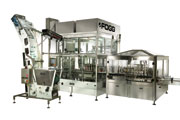
High-speed filling equipment has to accommodate the lighter weight of today's plastic bottles in a variety of ways.
Unstable bottles
But the lighter the bottle, the more problematic it is to handle and fill. Suppliers of high-speed filling equipment are constantly having to meet the challenges of getting a thin-walled, not perfectly stable container into, through and out of the filler.For a long time, most PET-filling systems have handled bottles exclusively by the neck. Practically the only exceptions are systems that switch between PET and glass, Delgado says.
Neck handling becomes even more important for lightweight bottles. “To handle these [lightweight bottles] by the bottom of the bottle is impossible,” says Jeffrey Tietz, executive director of KHS USA. “That’s been going on for some time.”
But even when handled by the neck, extra-light bottles can present challenges. One such challenge comes in moving them along rails with pneumatic air, the usual material-handling method.
“If that bottle is perpendicular to the rail of the air conveyor, it’s ideal. It slides very nicely,” Tietz says. “If that bottle moves left to right-say it’s 10 to 20 degrees out from perpendicular-you create additional drag on the neck ring, and the bottle doesn’t move as predictably or as smoothly. So you can get jams in the air conveyor that can be troublesome.”
Avoiding those troubles is a matter of precise controls, says Bob Pease, KHS USA’s commercial director. The conveyor speed and bottle density, or “population,” has to be managed precisely, both on air conveyors before filling and on belt or chain conveyors afterward. With air conveyors, that often means increasing the number of blowers that push the bottles forward.
“In the past, where we might have been able to run air conveyors with two or three blowers, we might have four or five blowers, or more specific system controls,” Pease says.
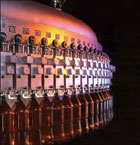
Volumetric filling of carbonated soft drinks is a way to dispense the same amount of product despite changes in a thin-walled bottle's dimensions.
On-site handoff
One way to eliminate the problem of conveying empty bottles is to eliminate conveying them in the first place. That happens in systems that blow-mold bottles on site, just before they’re filled. Several suppliers for high-volume beverage lines offer systems that incorporate blow molding immediately upstream of the filler. This on-site blow molding allows bottles to be transferred from the molder to the filler entirely by starwheels, with no belt or rail conveyance required.Systems like this allow bottles to be lightweighted even further. “Many lightweighted bottles are manufactured in-line, and the most aggressively lightweighted bottles are run on combi [combination] lines” that include blow-molding, says Andrei Paganuzzi, senior project manager, major accounts at Sidel Inc. Bottles blow-molded on site can go down to 8 grams or even lower.
The ideal is to have the bottles transferred from the blower to the filler entirely by starwheels. The goal is to avoid timing screws, sometimes known as “worms,” because extra-light bottles aren’t stable enough to stay dependably upright while the screw is spacing them out. “Wormless infeed [into the filler] is the buzzword,” Pease says. In many cases, the starwheels are specially designed for light bottles. They’re neck-level wheels that hold the bottles from the top, not around the waist.
How to fill?
The actual filling process also is affected by bottle lightweighting. In CSDs, lighter bottles have motivated a move to volumetric filling from the more conventional fill-to-level. Light bottles have a tendency to expand during the counterpressure of the filling process; volumetric filling is a way to keep the product dispensing consistently despite that situation, Tietz explains.“If the bottle is lighter, it grows more during the counterpressure phase of filling, and then if it’s filled to level, you’re potentially overfilling the bottle every time,” he says. “You can change the length of the vent tube, but volumetric filling is the way to get the same amount of product into a bottle regardless of other factors that affect the net volume of the container itself.”
The mechanics of getting the bottle under the fill valve also can be affected by light bottle weight. Fogg Filler uses systems that move the containers through the timing screw into the pocket of the filler starwheel, which then transfers the container onto the pedestal and neck support fork. The pedestal/neck support raises the container against the valve, which is opened on contact. The pedestal/neck support lowers the container after filling, closing the valves. The container is then placed in the pocket of the starwheel, which transfers it to the capping system.
End users who want to take a lot of weight out of their bottles could be adding a lot of grief if they don’t prepare for it properly. But with the right adjustment, filling equipment can accommodate even the lightest of containers. F&BP
Looking for a reprint of this article?
From high-res PDFs to custom plaques, order your copy today!