
Materials Technology: End-of-life issues plague biopolymers

Frito-Lay is playing up the compostable aspects of its
SunChips bag on its website and other advertising venues.
Polylactic acid (PLA), the leading bio-based polymer, is making strong inroads into both solid and flexible packaging. It got a big boost, in consumer visibility as well as sheer volume, with Frito-Lay’s high-profile decision to use PLA for its single-serve pouches of SunChips last year. NatureWorks LLC, the world’s largest producer of PLA under its Ingeo brand, recently expanded its production facility in Nebraska to give it a potential annual output of 300 million pounds.
Much of the appeal of PLA and other biopolymers is their capacity to be composted, in theory completing the circle of nature by turning back into dirt. However, the facts on the ground, so to speak, tell a different story, which is why NatureWorks itself is discouraging its customers from hyping the material’s compostability.
“What most brands and retailers in any applications want to talk about is what’s seen as a sexy story around compostability or biodegradability,” says Steve Davies, director of marketing and public affairs for NatureWorks. “And that’s frankly one of the most dangerous, because it’s not authentic and arguably is often greenwashing.”
Pressure situation
To compost a biopolymer, especially in the form of a rigid container, requires specialized composting equipment, including vessels that can heat, pressurize and moisturize the shredded material. Relatively few such facilities exist.The United States has some 3,400 commercial composting facilities, but the great majority of them accept only agricultural and landscaping waste. According to a recent report from the Sustainable Packaging Coalition, just 267 of them, or 4%, handle food waste-and the packaging that may arrive with it.
The only real success NatureWorks has had with end-user composting has come with foodservice utensils. That’s because many restaurants send their food scraps to composting facilities, and it’s relatively easy for them to include knives, forks and plates made from Ingeo, Davies says.
Retail packaging is a different story, and not just because of the composting situation. A large part of the problem is reliably collecting biopolymer packaging in the first place.
PLA can be recycled as well as composted. A venture, BioCor, was started earlier this year to purchase and resell used PLA. But as of now, “the majority of the PLA we are recycling is post-industrial,” company president Mike Centers noted in an e-mail.
Contamination problem
The problem centers on the existing recycling structure. The majority of rigid plastic containers in the U.S. are polyethylene terephthalate (PET) or high-density polyethylene (HDPE). Most recyclers are reluctant to handle any other kind of resin for fear it may contaminate a load of PET or HDPE due to incompatible melting points. This reluctance is especially prevalent with PLA, which has even more contamination potential.“PLA is certainly recyclable within itself, but we have yet to see any demonstration that the material, because of its low melting point, is not a contaminant for PET and other recyclables,” says Steve Alexander, executive director of the Association of Post Consumer Recyclers.
Like any polymer, PLA can be extracted from the recycling stream either manually or with sophisticated sorting equipment. But recyclers are hesitant to bear the financial burden of extraction.
“Why should recyclers pay for the innovation and the problems caused by people introducing new products into the marketplace?” Alexander says.
Dave Cornell, technical director for the Association of Post Consumer Recyclers, elaborates on that, saying that any “poly X” non-mainstream plastic would be expensive to extract.
“I might put an expensive piece of machinery in to pull the poly X bottle out, and it pulls one a month,” Cornell says. “If that machine costs $100,000, that makes it a really expensive bottle I just pulled out.”
The bottom line, recyclers say, is that there just isn’t enough PLA or other biopolymers in the market to make recycling them worthwhile.
“There is a critical mass of readily identifiable material necessary in order for recycling to happen,” Cornell says. “And right now, we don’t have enough PLA readily identifiable.”
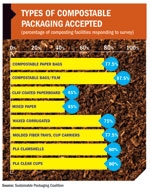
Source: Sustainable Packaging Coalition
Not just anyone
NatureWorks shares those concerns, Davies says. That’s why it has been discriminating in its choice of bottle-molding customers, and in fact hasn’t developed any new ones in the last three to four years, Davies says.“Our business model was to sell a more responsible plastic. It didn’t make sense to just sell that regardless of how it was being used,” he said. “What we said for the last couple of years to [potential clients] is, ‘this is a unique application, where we’re not just selling you the plastic to make an end article. Not that we’re trying to run your business, Mr. Bottler, but we want to understand what you’re going to do around end of life.’”
However, the most highly visible use to-date of PLA is in an application that doesn’t depend on composting: SunChips bags from PepsiCo’s Frito-Lay unit. In its ads, Frito-Lay is touting the bags’ biodegradable nature, using time-lapse photography to show a bag literally fading to earth.
“What Frito-Lay did that I think is pretty unique, versus any other brand, is they really, absolutely did the homework,” Davies says. “They did a tremendous amount of work with third-party composting certification facilities and with universities to really understand how their unique structure composted.”
In any case, the ecological appeal of packaging biopolymers doesn’t have to depend on what happens after the product is consumed. Users of PLA and other biopolymers have the potential to connect with consumers on the front end by reminding them that the product comes from a renewable resource.
Davies emphasizes that PLA or any alternative polymer must do the job of protecting the product as well as a conventional resin.
“The environmental benefit then is a tiebreaker,” Davies says. “It works well, has a lower carbon footprint and has some new end-of-life options. For brands interested in communicating this to the consumer, it’s those two pieces plus an emotional hook of doing something right, because you’re not using an oil-based package, [which can have] a pretty nasty environmental impact.”
Looking for a reprint of this article?
From high-res PDFs to custom plaques, order your copy today!