Flexible Food Packaging Systems
Boost Profit by Gentle Conveying Without Air
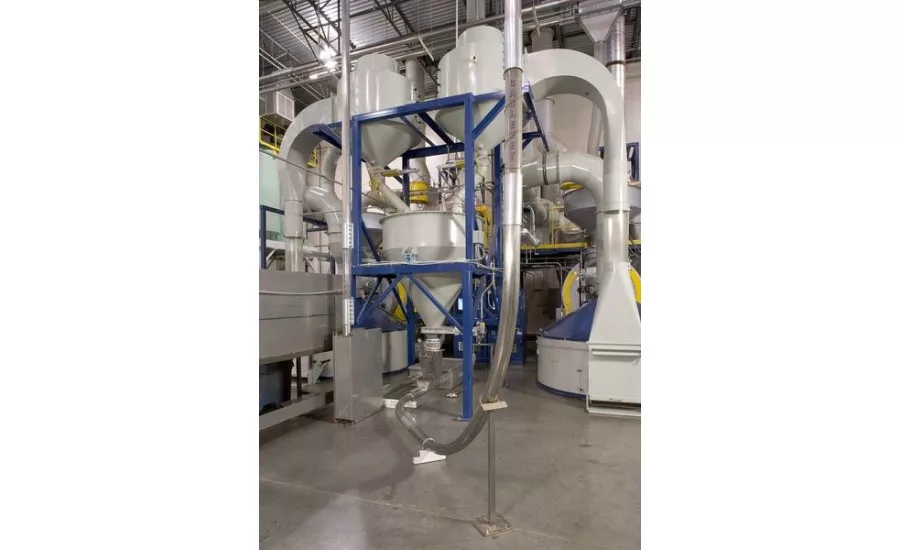
The ‘footprint’ of a Cablevey Conveyor tubular drag cable conveyor can be small compared to other conveyor systems, which helps with tight and compact manufacturing areas. Images courtesy of Cablevey Conveyors
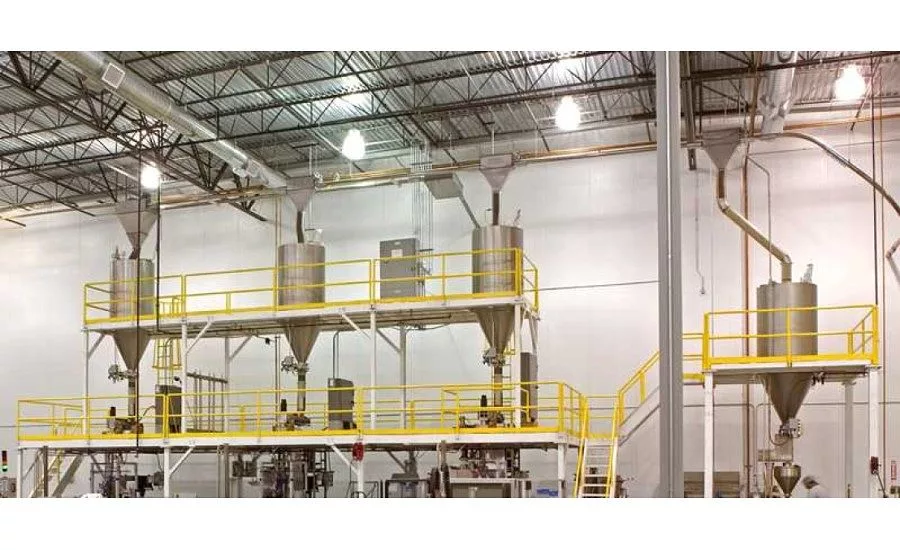
Most tubular cable conveyors have interchangeable components that allow the conveyor to be easily expanded or reconfigured to change the length, conveying path and the number of inlets an outlets. Images courtesy of Cablevey Conveyors
In food processing, greater adaptability in packaging is required as the market continues to shift from share-size bags to single-portion packages. This change requires advanced packaging machines that provide flexible packaging materials, sizes, high speeds and lower reject rates.
However, packaging size reduction requires additional adjustment of other parts of processing technology to ensure that the packaging line can cope with the produced amounts efficiently. For this reason, food processors – particularly of snacks and other high-value products – need to invest in adaptable transfer systems that can ensure the gentle and sanitary movement of specific amounts through different production stages.
This is particularly true of valuable products susceptible to damage such as nuts, chips, etc. as well as small or individual sized packages of coffee, cereal and dry pet food, where material breakage and loss is a costly problem that can harm the bottom line. Even a difference between 1% waste and 5% can mean the difference between profit or loss.
To convey such delicate food product, packagers and processors should avoid conveyors that may force the fragile material through stressful phases during transport that could impact its integrity, while still meeting high throughput requirements. Given this need, some packagers are reconsidering conveying fragile, high value products using high velocity air power through tubes, bends or sweeps before it is dumped into bins or containers.
In the coffee industry, for example, processors go to great expense to roast whole beans. However, the beans can be damaged by high velocity air conveyance, compromising flavor and aroma, according to Gary Schliebs, a process engineer and director of Plus One Percent…Engineered Solutions, a consulting firm that works in the food industry and markets food industry conveyor equipment globally.
When a whole macadamia nut is broken, its value can drop by half. Instead of a premium price for whole nuts, damaged nuts are often sold at a substantial discount and often crushed for use in cooking or processing further upstream in the food packaging industry.
“Many high-value food products can be fragile and need very gentle handling. Otherwise, whole forms can be broken, crushed to bits and even turned to powder. This significantly lowers the value of the product and damaged portions may need to be removed or disposed of to prevent perceived quality issues that could prompt customers to turn to other brands,” says Schliebs, who frequently consults on food engineering equipment design, plant layouts and process flows.
“In some cases, more than 10% of delicate product can be damaged by high velocity air-power systems. The cost to the packaging industry is compounded because the damage often comes at the end of the process, after considerable value has been added, only to have it degraded by a poor choice in the selection of transfer conveying equipment,” says Schliebs.
The Limitations of Air Conveyors
Food packagers and processors need to be aware that a wide range of fragile, high dollar value food products can be prone to excess breakage when conveyed at high velocity by air-power, such as in pneumatic and aeromechanical systems.
Pneumatic conveyor systems utilize air by creating air pressure above or below the atmospheric level. These systems use filters that require regular replacement. The two main types of pneumatic conveyors – dilute phase and dense phase – differ by speed and pressure, and both can be configured as a pressure or vacuum system.
In dilute phase conveying, the food product is suspended in the air as it is transported through the conveying pipe at extremely high velocities of typically 3,400-5,000ft/min. While the product usually has minimal breakage during straight pathways, most systems have bends and sweeps where it can be forced through constricted areas, quickly change direction and be damaged. In such cases, high-dollar value food often can be too fragile.
Dense phase pneumatic conveyor systems, where the product is not suspended in air since it is heavy or abrasive, function at lower velocity than dilute phase. However, with air speeds of about 700-1,500ft/min., delicate food items are still susceptible to breakage at bends and sweeps.
While aeromechanical conveyors have a different method of conveyance, these enclosed, high-capacity mechanical systems can also degrade delicate product. With these systems, a wire rope with evenly spaced discs within a tube travels at high speed, running in sprockets at each end of the conveyor. This generates an internal air stream traveling at the same high velocity as the discs that carry product along in the tube. However, these conveyors may also force vulnerable materials through stressful phases during transport, which could impair their integrity.
“Any fragile or friable food product conveyed at high velocity is prone to damage, particularly if it changes direction or exits with impact. This can be the case with either pneumatic or aeromechanical conveyors,” says Schliebs.
A Gentler Approach Boosts Profitability
According to Schliebs, a gentler alternative to protect sensitive, high-value packaged food products is to utilize tubular cable conveyors. These systems move product through a sealed tube using a coated, flexible stainless-steel drag cable pulled through on a loop. Solid circular discs (flights) are attached to the cable, which push the product at low speed through the tube without the use of air, preserving product integrity and minimizing waste.
“Food industry manufacturers can decrease product damage down to 1-2% with a slower process like a Cablevey Conveyors tubular cable system. With it, product is gently transferred at low speed, so there is minimal to no damage,” says Schliebs.
Cablevey Conveyors is an Iowa-based premium, specialty material moving, mechanical conveyor company that has designed, engineered and serviced enclosed cable and disc tube conveyors for almost 50 years in more than 66 countries.
In the packaged food industry, the conveyors are utilized for products such as snacks, nuts, cereal, coffee, pet food, beans and seeds. The systems can convey up to 2,000 cubic feet per hour (56m3/hr.) of flakes, pellets, shavings, crumbles, granules, regrind, chunks, parts, prills and powders with numerous layouts using multiple inlets and outlets.
Since the material is carried between the flights, it is also much easier to safely convey some sticky or easily compacted materials in a tubular cable conveyor than in air-powered conveying systems, where such materials can form plugs.
“With pneumatic or aeromechanical conveying systems, any soft or sticky material, like dried fruit, can smear and adhere to surfaces, particularly at bends and sweeps that change direction, which is not an issue with tubular cable conveyors,” says Schliebs.
According to Schliebs, the tubular cable conveyor’s modular construction can also help reduce product damage by enabling it to slide out on a gentler gradient, rather than simply drop out, as is more typical with conveyors utilizing air.
“To minimize product damage, it is important for food industry manufacturers to not only transfer gently, but also get product in and out of the conveyor safely and gently as well. That is more achievable with a conveyor like Cablevey that allows product to slide down rather than drop out the end,” says Schliebs.
For packaging lines, in fact, most tubular cable conveyors have interchangeable components that allow the conveyor to be easily expanded or reconfigured to change the length, conveying path and the number of inlets and outlets. These modifications are more complex and time-consuming with a pneumatic conveying system because it has more components and electrical connections.
Cablevey systems has a ‘footprint’ that can be quite small compared to other conveyor systems and that really helps with tight and compact packaging and manufacturing areas.
“Because of the ‘bespoke’ design of each Cablevey system for customer specific requirements, we can tailor the design to be very ‘non-intrusive’ in the work area and not hinder access for people and maintenance, as other systems can. This is a real bonus for safety, access and saving floor space, which is another cost to manufacturing,” says Schliebs.
Less Energy Use, Less Noise
On food packaging and process lines, since pneumatic systems convey product at high velocity, this typically requires larger, power-hungry motors that run fans, blowers and rotary valves. In a dense phase system, a pressure tank requiring compressed air consumes additional power.
In terms of noise level, pneumatic conveying systems also generate considerable noise. Aeromechanical systems, running at high speed, generate considerable motor and disc noise as well.
Given that smaller motors are used, tubular cable systems are quieter overall and utilize much less energy. “A low-speed tubular cable system is quiet enough to easily have a conversation around it while it is running,” says Schliebs. “In regards to energy, it utilizes about one-tenth that of pneumatic systems. For dense phase models, the electricity savings by using a tubular conveyor can be sizeable, with one year ROI in some cases.”
For more information visit cablevey.com.
Looking for a reprint of this article?
From high-res PDFs to custom plaques, order your copy today!