
Packaging Strategies logo
search
cart
facebook twitter linkedin youtube
  • Sign In
  • Create Account
  • Sign Out
  • My Account
Packaging Strategies logo
  • FEATURED
    • Brand Packaging
    • Extended Producer Responsibility
    • New Products & Materials
      • Featured Products
    • Packaging News
    • Packaging Perspectives Podcasts
    • Steve Fairfield Innovation Award
    • Supply Side
    • Top 100 Food & Beverage Packaging Companies
      • Submit Your Company
  • FLEXIBLE PACKAGING
  • VERTICAL MARKETS
    • Beer / Wine / Spirits Packaging
    • Beverage Packaging
    • Candy / Confectionery
    • Dairy Food Packaging
    • FoodService Packaging
    • Household Packaging
    • Meat / Seafood Packaging
    • Personal Care Packaging
    • Pet Food Packaging
    • Pharma / Medical Packaging
    • Produce Packaging
    • Snack Food Packaging
  • MATERIALS
    • Adhesives / Sealants
    • Beverage Multipacks
    • Blister Packaging
    • Cans & Bottles
    • Closures/Lids
    • Films & Coatings
    • Labels
    • Material Converting
    • Paperboard / Corrugated / Cartons
    • Rigid Containers
    • Sustainable Packaging
  • MACHINERY
    • Automation / Controls
    • Case Forming / Packing / Sealing
    • Cartoning
    • Coding / Marking / Printing
    • Conveyors
    • Form-Fill-Seal / Filling & Closing
    • Inspection / Detection / Vision
    • Labeling
    • Unitizing / Palletizing
    • Robotics
    • Track & Trace / Serialization
  • DIRECTORIES
    • Packaging Strategies Resource Guide
    • Flexible Packaging Buyer's Guide
  • EVENTS
    • Converters Expo
    • Converters Expo South
    • Global Pouch Forum
    • Industry Events
    • Webinars
  • MORE
    • Videos
    • Book Store
    • Classifieds
    • Custom Content & Marketing Services
    • eXTRA Newsletter
    • Market Research
    • PACKSTRAT Wordplay
    • PS Resource Guide
    • Sponsor Insights
  • EMAG
    • eMagazines
    • Archived Issues
    • Contact Us
    • Advertise
  • SIGN UP!
Automation/ControlsRobotics

Why Operational Tech and Cybersecurity Must Work Hand in Hand
By John Robertson, Michael Hoyt
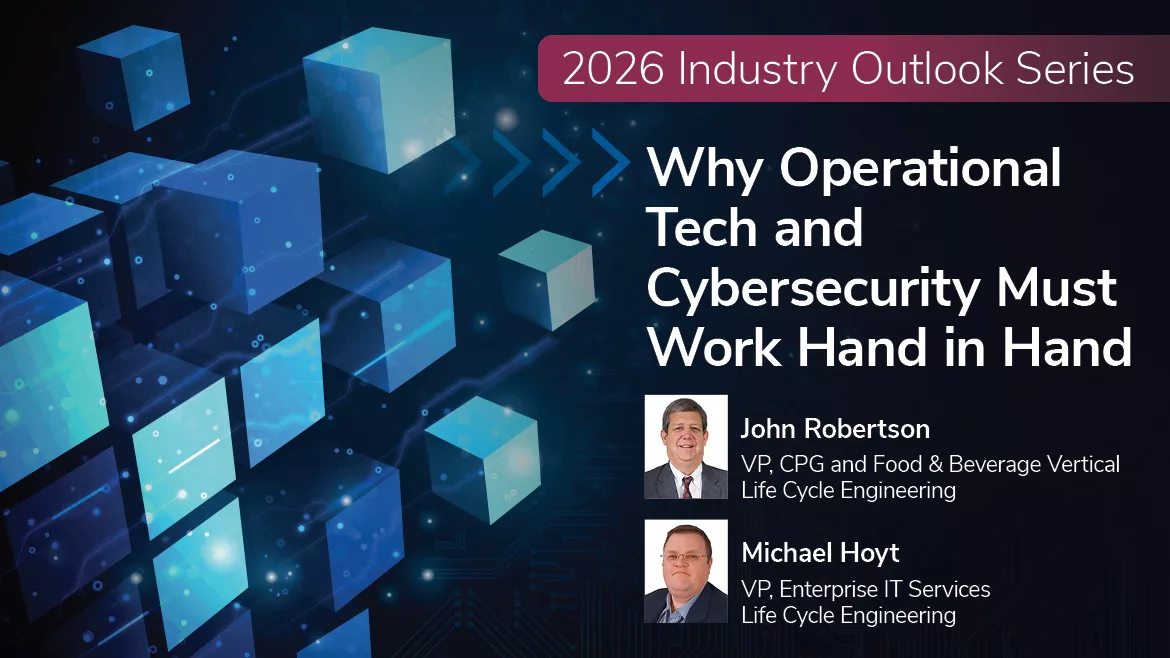
Foreground: 2026 Industry Outlook Series - Why Operational Tech and Cybersecurity Must Work Hand in Hand– Headshots of John Robertson and Michael Hoyt of Life Cycle Engineering. Background: Small blue cubes on dark blue gradient technology background
Image Credit: Background: Cemile Bingol / DigitalVision Vectors via Getty Images Plus. Headshots: Courtesy of Life Cycle Engineering
January 19, 2026

Key Predictions Overview: 

  • Advanced robotics will continue to grow in importance to maintain efficient operations.
  • Cybersecurity and Operational Technology will become an urgent C-suite priority, mandating the integration of security deep into the production environment.
  • Companies will need to establish a risk-management approach creating protocols to minimize and address security breaches. 

As we begin 2026, the Consumer Packaged Goods and Food & Beverage sectors are poised for a dramatic shift. The accelerated investment in robotics, automation, and smart manufacturing is no longer just a competitive advantage; it is the industry standard. However, this rapid technological expansion is creating a critical cybersecurity blind spot.

For decades, Operational Technology (OT) and Information Technology (IT) have existed in separate silos. But as we approach 2026, the convergence of these two worlds will become the defining challenge for manufacturers. The prediction is clear: cybersecurity for OT will transform from a technical footnote into an urgent C-suite priority, mandating the integration of security deep into the production environment to mitigate the risks of intellectual property theft and production line reliability.

The Security Blind Spot in Smart Manufacturing

The push for automation is driven by necessity, but it is creating a dangerous paradox. As factories become smarter, they often become more vulnerable. Historically, the OT environment where robotics operate has been neglected, relying on an antiquated "defense in depth" model rather than modern "zero trust" architectures. 

We are seeing a surge in robotics entering the factory floor, yet many of these systems lack basic security protocols. In past incidents, communications with robotic systems were intercepted and altered because the system lacked basic cryptography, a failure that simple encryption could have prevented. This issue is compounded by a lack of accountability. Manufacturers of industrial control systems are rarely held responsible for the security of their platforms once they leave the factory.

This vulnerability goes beyond downtime. It threatens the core value of the business. Forward-thinking CPG manufacturers are now linking cybersecurity directly to their process systems—specifically manufacturing and packaging machinery—to protect proprietary formulas and intellectual property. They recognize that a breach isn't just a mechanical failure; it is a potential theft of the company's secret sauce.

As we begin 2026, this risk will only intensify with the adoption of Artificial Intelligence. While AI offers optimization, it also creates a dependency on data accuracy. A significant risk for 2026 is the potential for bad actors to not just shut down a line but to manipulate the data AI uses, causing systems to make flawed production decisions, an issue that is referred to as “hallucination.” Furthermore, the massive influx of data points required for AI provides significantly more opportunities for network penetration.

Mandatory Cybersecurity & Operation Technology

To secure the factory of the future, we must abandon antiquated security models. The old “defense in depth” model is obsolete. The sophisticated nature of modern cyber threats means that once a perimeter is breached, bad actors can move laterally with ease if internal controls are weak.

In 2026 there will be widespread adoption of zero-trust architectures within OT environments. In a zero-trust model, no device, user, or connection is trusted by default, regardless of whether it is inside or outside the network perimeter. This cultural shift is difficult but necessary. It requires moving away from simple, shared passwords on shop floor keypads to complex, user-specific authentication wherever possible.

This security model also requires a shift in human behavior. Workforce training must go beyond basic operations; operators need to understand what to look for in process control systems to identify abnormalities. They must be able to distinguish between a standard mechanical quirk and an anomaly that signals a potential breach.

This shift must be driven from the top down. While end-users on the floor are primarily concerned with safety and equipment functionality, worrying that a hack could cause a machine to malfunction or injure a worker, the C-suite must view this as a reputation and solvency issue. Historically, finance departments have acted as a negative driver against cybersecurity investment, viewing it as a cost center rather than an insurance policy. In 2026, CFOs and CTOs will likely be forced to align, realizing that the cost of a single incident—measured in downtime, safety violations, and reputational damage—far outweighs the investment in proactive cyber hygiene.

The Need for Risk Management

Addressing this convergence requires a shift from reactive to proactive protocols. You cannot secure what you do not know you have. Therefore, the first step is a comprehensive asset inventory to identify every device on the network and how it connects to the outside world.

However, prevention is only half the battle. By 2026, CPG leaders must implement a Risk Priority Plan — a protocol similar to those used for catastrophic events like hurricanes. This protocol must address four critical stages:

  • Identification and Defense: Clearly defining what assets are critical (like proprietary formulas) and applying specific defenses to them.
  • Breach Detection: Training operators to distinguish between a standard mechanical anomaly and a security breach.
  • Isolation: Establishing a protocol to immediately quarantine affected systems to prevent lateral movement across the network.
  • Prevention: A post-incident strategy to minimize damage and close the vulnerability to prevent recurrence.

We must accept that a 100% secure environment is impossible. However, by adopting a mindset of doing the best possible rather than waiting for a perfect fix, companies can significantly reduce their risk profile.


KEYWORDS: AI consumer packaged goods (CPG) food and beverage packaging

Share This Story

Looking for a reprint of this article?
From high-res PDFs to custom plaques, order your copy today!

Johnrobertson 356x439

John Robertson is Vice President of CPG and Food & Beverage Vertical at Life Cycle Engineering.

Michaelhoyt 356x439

Michael Hoyt is Vice President of Enterprise IT Services at Life Cycle Engineering.

Recommended Content

JOIN TODAY
to unlock your recommendations.

Already have an account? Sign In

  • Golden award trophy in the shape of a star. Text: 2026 Top 100 Food and Beverage Companies

    Top 100 Food and Beverage Packaging Companies of 2026

    Celebrating 30 years as a B2B journalist, I’ve revisited...
    Materials
    By: Brad Addington
  • Women In Packaging 2025 homepage hero

    Women in Packaging: Seizing Opportunities, Pushing Boundaries

    Seven women share their personal journeys in the...
    Materials
    By: Brad Addington
  • Image of the Spyder Pick and Place Joint Robot sorting pre-rolls.

    Cannabis Packaging Goes High-Tech

    Packaging Strategies doesn't often cover cannabis...
    Inspection/Detection/Vision
    By: Brad Addington
Subscription Center
  • eMagazine Subscription
  • Manage My Preferences
  • Newsletters
  • Subscription Customer Service
  • Online Registration

More Videos

Sponsored Content

Sponsored Content is a special paid section where industry companies provide high quality, objective, non-commercial content around topics of interest to the Packaging Strategies audience. All Sponsored Content is supplied by the advertising company and any opinions expressed in this article are those of the author and not necessarily reflect the views of Packaging Strategies or its parent company, BNP Media. Interested in participating in our Sponsored Content section? Contact your local rep!

close
  • Hand Holding Various Semaglutide and Insulin Injection Pens for different stages of the treatment.
    Sponsored byInline Plastics

    How GLP-1 Is Reshaping Food Packaging, and Why It Matters More Than You Think

  • A stack of clear plastic containers, the bottom full of mixed fruit
    Sponsored byInline Plastics

    Packaging Trends Shaping 2026: Where Trust Is Won

Popular Stories

Podcast | Packaging EPR’s 2026 Reality Check” with guest Anna Kendall headshot and title. Also pictured Cardboard boxes on conveyor belt.

PODCAST | Packaging EPR’s 2026 Reality Check

Logo for New Earth Ventures

Atlantic Packaging Launches New Earth Ventures to Accelerate Packaging Technology

Main image for podcast with Kevin Kelly regarding Flexible Packaging for Produce. Main image includes Kevin Kelly’s headshot and an image of potatoes in a bag incorporating 30% PCR content.

Looking Forward to Global Pouch Forum

See the Top 100 Food and Beverage Packaging Companies of 2026

Products

Advances in Sustainable Food Packaging Technology

Advances in Sustainable Food Packaging Technology

See More Products

Packaging Perspectives Podcast

Play Packaging Strategies' captivating WordPlay game, PackStrat! There's a new word every Tuesday.

Related Articles

  • All-in-One Cartoning System Can Form Cartons, Hand Load or Go Full Automation

    All-in-One Cartoning System Can Form Cartons, Hand Load or Go Full Automation

    See More
  • 31-OpX-Wheeltransparent300dpi.jpg

    The OpX Leadership Network Drives Operational Excellence

    See More
  • Clean application robots must meet high standards

    See More

Related Directories

  • Vemax Finishing Solutions

    Vemax provides leading edge solutions for the Slitter Rewinder Finishing industry. We work in the new, used and material handling category. We serve the plastic, paper, foil, label, tag, and converting industries. Come to us to solve your production problems.
  • Cama North America

    For over 40 years Cama has been an international leader in the engineering and production of high technology secondary packaging systems. We offer complete integrated packaging lines – from primary packages to final packaging, including Cartoners, Case Packers, Sleevers, Robotic Loading and Assembly systems, all of which are operated through open architecture controls.
  • Syntegon Packaging Technology LLC

    Syntegon is a global leader in processing and packaging technologies for the pharmaceutical, biotech, and food industries. With 160 years of expertise and 47 worldwide locations, we deliver innovative, sustainable solutions that ensure safety, efficiency, and reliability - helping customers improve lives, enhance performance, and build future-ready operations.
×

Keep the info flowing with our Newsletters!

Get the latest industry updates tailored your way.

JOIN TODAY!
  • RESOURCES
    • Advertise
    • Contact Us
    • Directories
    • Store
    • Want More
  • SIGN UP TODAY
    • Create Account
    • eMagazine
    • Newsletter
    • Customer Service
    • Manage Preferences
  • SERVICES
    • Marketing Services
    • Reprints
    • Market Research
    • List Rental
    • Survey/Respondent Access
  • STAY CONNECTED
    • LinkedIn
    • Facebook
    • YouTube
    • X (Twitter)
  • PRIVACY
    • PRIVACY POLICY
    • TERMS & CONDITIONS
    • DO NOT SELL MY PERSONAL INFORMATION
    • PRIVACY REQUEST
    • ACCESSIBILITY

Copyright ©2026. All Rights Reserved BNP Media, Inc. and BNP Media II, LLC.

Design, CMS, Hosting & Web Development :: ePublishing