
What's on the minds of packagers
by Pan Demetrakakes, Editor
Sustainability is more important than ever, operations people are easier to work with than graphics people, and the end of the line is where problems tend to pile up.
Those are some of the conclusions from Food & Beverage Packaging’s State of the Industry survey.
The survey, of packaging professionals who subscribe to our magazine, was an online poll taken in summer 2010 about issues ranging from sustainability to changeover issues. It was conducted by Clear Seas Research, the research arm of BNP Media.
Here are selections from the 56 questions on the survey, with commentary in some cases from industry experts.
The survey allowed written supplemental responses, many of which underscored the importance of operational issues:
• Cutting costs while keeping the packaging relevant to the consumer
• Doing more with less manpower and money
• Leaning the process
• Equipment sanitation, line efficiency improvements
• Obsolescence of our packaging machinery
• Keeping up with cost cutting measures in the declining economy
Chuck Yuska, president of PMMI, says these results are consistent with those from Vision 2015, a series of focus groups PMMI conducted at last fall’s Pack Expo show.
“Vision 2015 participants talked in depth about three major trends in their plants: lean operations, a need for suppliers to build relationships with them and provide solutions to their business challenges, and the need for complex, sophisticated and easy to use automation,” Yuska says. “The lean manufacturing movement is definitely in the mainstream American of manufacturing, and has been for some time. But lately, it seems to be taking on a new level of importance.”
A perspective on a major company’s priorities was provided by Perfecto Perales, senior director of packaging research at Kraft Foods.
“In North America, I’d say the biggest challenges are going to be how retailers can keep raising the bar on innovations versus private labels,” Perales said in an email. “In Europe, it’ll be how to continue to raise the bar on packaging graphics and innovation. And in developing markets, as consumers’ spending power increases, the challenge will be how to bring the demand for premium/customization in expanding markets like Brazil/China at the right cost/value to consumers.”
Guarded optimism seemed to be the prevailing outlook. Asked about their packaging expenditure plans for 2010-2011, a plurality (42%) said they expect to spend more, and another 36% said they expect to spend about the same.
Again, this was roughly in line with PMMI’s data. Its quarterly Purchasing Index Survey led to the prediction that packaging machinery investments in the last months of 2010 would expand compared to fourth quarter 2009. However, the same outlook also predicted that overall growth for the food and beverage sectors, while continuing, will slow down: 2.1% for food in 2011, compared with 4.7% in 2010; and 1.8% for beverages, coffee and tea in 2011, compared with 5.4% in 2010.
David Turner, principal of Turner Duckworth, a design firm that has done projects for food companies including Kraft and Coca-Cola, says the prevalence of graphics outsourcing is probably inspired more by cost-cutting than a desire for “outside” ideas.
“We saw a period, back in the last recession, where those [in-house graphics] departments were cut, because an easy way to reduce costs is to cut a department and then outsource,” Turner says. He adds that the trend seems to be shifting back toward in-house design, partly because of the success of companies like Apple Inc., whose products feature design as a key part of their overall appeal. But while design is an integral part of Apple products, “with food and beverage companies, you have to use packaging to bring the product to life,” he says.
Whatever the trend, Turner says, an outside graphics consultant can bring three important aspects to a packaging project: objectivity, perspective and credibility.
“We’re an outside group, we’re looking from the outside in, much as the consumer would, and so it’s much easier for us to bring a consumer point of view to a project,” he says.
Objectivity can help an outside graphics consultant in another way: dealing with company politics.
“Any large organization has a fairly complex political structure that has to be navigated,” Turner says. “Being somewhat isolated from that can be a very positive thing. I think what works brilliantly well in our experience is when you have people within the client company who really understand the internal structure and politics, who really understand design and can help navigate design through the corporation.”
Manufacturers of end-of-line equipment, not surprisingly, say circumstances are more to blame than unreliability of their equipment. Problems have a way of cascading down a packaging line and piling up at the end.
“One reason [for that perception] is, we’re at the end of the packaging line, so we’re most visible,” says Brian Piekarski, case packing product manager for Brenton Engineering.
Operations consultant John Henry, who manages the website www.changeover.com, agrees that end-of-line equipment may be getting something of a bad rap.
“I don’t really know if end-of-line equipment is the most inefficient, but when it is inefficient, it seems more visible,” Henry says. “It’s a perception, but it might not be a true perception.”
Henry admits to being pleasantly surprised by the good relationship with operations.
When disconnects occur, Henry says, it’s usually for the entirely human reason of not understanding the other person’s concerns.
“People will say, ‘Marketing wants us to make this package and our machinery just can’t do it,’” he says. “Or they’ll come up with eight different bottle sizes, which could probably be grouped into maybe two or three different families.” In other words, it’s more efficient to use the same diameter for two or more different bottle sizes, so that they can be handled without the need to change out parts like timing screws or star wheels.
“If they need a different diameter, they need a different diameter, and operations just has to live with it,” Henry says. “But I think a lot of times it’s due to ignorance. They just don’t know the impact.”
As for graphics, Turner says packaged goods companies are becoming more aware of the importance of packaging appearance, but it’s an uphill struggle. F&BP
Sustainability is more important than ever, operations people are easier to work with than graphics people, and the end of the line is where problems tend to pile up.
Those are some of the conclusions from Food & Beverage Packaging’s State of the Industry survey.
The survey, of packaging professionals who subscribe to our magazine, was an online poll taken in summer 2010 about issues ranging from sustainability to changeover issues. It was conducted by Clear Seas Research, the research arm of BNP Media.
Here are selections from the 56 questions on the survey, with commentary in some cases from industry experts.
Ops on the brain
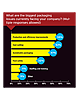
Operations seems to weigh the most heavily on the minds of our respondents. Asked to identify the most important packaging-related issues they face, with multiple responses allowed, 55% said “production and efficiency improvements” and 53% said “cost cutting”-which, of course, go hand in hand.The survey allowed written supplemental responses, many of which underscored the importance of operational issues:
• Cutting costs while keeping the packaging relevant to the consumer
• Doing more with less manpower and money
• Leaning the process
• Equipment sanitation, line efficiency improvements
• Obsolescence of our packaging machinery
• Keeping up with cost cutting measures in the declining economy
Chuck Yuska, president of PMMI, says these results are consistent with those from Vision 2015, a series of focus groups PMMI conducted at last fall’s Pack Expo show.
“Vision 2015 participants talked in depth about three major trends in their plants: lean operations, a need for suppliers to build relationships with them and provide solutions to their business challenges, and the need for complex, sophisticated and easy to use automation,” Yuska says. “The lean manufacturing movement is definitely in the mainstream American of manufacturing, and has been for some time. But lately, it seems to be taking on a new level of importance.”
A perspective on a major company’s priorities was provided by Perfecto Perales, senior director of packaging research at Kraft Foods.
“In North America, I’d say the biggest challenges are going to be how retailers can keep raising the bar on innovations versus private labels,” Perales said in an email. “In Europe, it’ll be how to continue to raise the bar on packaging graphics and innovation. And in developing markets, as consumers’ spending power increases, the challenge will be how to bring the demand for premium/customization in expanding markets like Brazil/China at the right cost/value to consumers.”
Things are looking up
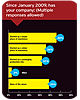
Respondents were asked about their companies’ progress in packaging operations, both recently and for the immediate future. Since January 2009, a near-majority (46%) had started up a major piece of machinery, and about one-third had started up either a minor piece of machinery or an entire packaging line.Guarded optimism seemed to be the prevailing outlook. Asked about their packaging expenditure plans for 2010-2011, a plurality (42%) said they expect to spend more, and another 36% said they expect to spend about the same.
Again, this was roughly in line with PMMI’s data. Its quarterly Purchasing Index Survey led to the prediction that packaging machinery investments in the last months of 2010 would expand compared to fourth quarter 2009. However, the same outlook also predicted that overall growth for the food and beverage sectors, while continuing, will slow down: 2.1% for food in 2011, compared with 4.7% in 2010; and 1.8% for beverages, coffee and tea in 2011, compared with 5.4% in 2010.
Worker training
Outsourcing
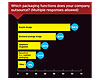
By a significant margin, graphics is the packaging function most likely to be outsourced. Fifty-eight percent of respondents said they hired outside help for their packaging graphics, followed by structural package design (42%) and equipment integration (25%).David Turner, principal of Turner Duckworth, a design firm that has done projects for food companies including Kraft and Coca-Cola, says the prevalence of graphics outsourcing is probably inspired more by cost-cutting than a desire for “outside” ideas.
“We saw a period, back in the last recession, where those [in-house graphics] departments were cut, because an easy way to reduce costs is to cut a department and then outsource,” Turner says. He adds that the trend seems to be shifting back toward in-house design, partly because of the success of companies like Apple Inc., whose products feature design as a key part of their overall appeal. But while design is an integral part of Apple products, “with food and beverage companies, you have to use packaging to bring the product to life,” he says.
Whatever the trend, Turner says, an outside graphics consultant can bring three important aspects to a packaging project: objectivity, perspective and credibility.
“We’re an outside group, we’re looking from the outside in, much as the consumer would, and so it’s much easier for us to bring a consumer point of view to a project,” he says.
Objectivity can help an outside graphics consultant in another way: dealing with company politics.
“Any large organization has a fairly complex political structure that has to be navigated,” Turner says. “Being somewhat isolated from that can be a very positive thing. I think what works brilliantly well in our experience is when you have people within the client company who really understand the internal structure and politics, who really understand design and can help navigate design through the corporation.”
Trouble at the end
When respondents were asked which kind of packaging equipment was most likely to break down or otherwise result in downtime, many pointed toward the end of the line. A plurality of 21% named “cartoner, case packer or shrinkwrapper” as the equipment most liable to stoppages, and another 12% named “downstream-palletizers or shrinkwrapper.”Manufacturers of end-of-line equipment, not surprisingly, say circumstances are more to blame than unreliability of their equipment. Problems have a way of cascading down a packaging line and piling up at the end.
“One reason [for that perception] is, we’re at the end of the packaging line, so we’re most visible,” says Brian Piekarski, case packing product manager for Brenton Engineering.
Operations consultant John Henry, who manages the website www.changeover.com, agrees that end-of-line equipment may be getting something of a bad rap.
“I don’t really know if end-of-line equipment is the most inefficient, but when it is inefficient, it seems more visible,” Henry says. “It’s a perception, but it might not be a true perception.”
Teamwork
Respondents were asked to rate the relationships of the packaging department with other departments in their companies. There was a tight spread, with the majority of relationships being rated “good” or “excellent.” But when the responses are averaged, reported relationships are best with operations and engineering, worst with art/graphics.Henry admits to being pleasantly surprised by the good relationship with operations.
When disconnects occur, Henry says, it’s usually for the entirely human reason of not understanding the other person’s concerns.
“People will say, ‘Marketing wants us to make this package and our machinery just can’t do it,’” he says. “Or they’ll come up with eight different bottle sizes, which could probably be grouped into maybe two or three different families.” In other words, it’s more efficient to use the same diameter for two or more different bottle sizes, so that they can be handled without the need to change out parts like timing screws or star wheels.
“If they need a different diameter, they need a different diameter, and operations just has to live with it,” Henry says. “But I think a lot of times it’s due to ignorance. They just don’t know the impact.”
As for graphics, Turner says packaged goods companies are becoming more aware of the importance of packaging appearance, but it’s an uphill struggle. F&BP
METHODOLOGY
This study was conducted last August by Clear Seas Research, the information-gathering arm of BNP Media, parent company of Food & Beverage Packaging. All subscribers with an e-mail address in our files were invited to respond, and 153 did so. Respondents completed surveys online. Tabulations were generated using SPSS, a statistical equipment package.Looking for a reprint of this article?
From high-res PDFs to custom plaques, order your copy today!