
Packaging Strategies logo
search
cart
facebook twitter linkedin youtube
  • Sign In
  • Create Account
  • Sign Out
  • My Account
Packaging Strategies logo
  • FEATURED
    • Brand Packaging
    • Extended Producer Responsibility
    • New Products & Materials
      • Featured Products
    • Packaging News
    • Packaging Perspectives Podcasts
    • Steve Fairfield Innovation Award
    • Supply Side
    • Top 100 Food & Beverage Packaging Companies
      • Submit Your Company
  • FLEXIBLE PACKAGING
  • VERTICAL MARKETS
    • Beer / Wine / Spirits Packaging
    • Beverage Packaging
    • Candy / Confectionery
    • Dairy Food Packaging
    • FoodService Packaging
    • Household Packaging
    • Meat / Seafood Packaging
    • Personal Care Packaging
    • Pet Food Packaging
    • Pharma / Medical Packaging
    • Produce Packaging
    • Snack Food Packaging
  • MATERIALS
    • Adhesives / Sealants
    • Beverage Multipacks
    • Blister Packaging
    • Cans & Bottles
    • Closures/Lids
    • Films & Coatings
    • Labels
    • Material Converting
    • Paperboard / Corrugated / Cartons
    • Rigid Containers
    • Sustainable Packaging
  • MACHINERY
    • Automation / Controls
    • Case Forming / Packing / Sealing
    • Cartoning
    • Coding / Marking / Printing
    • Conveyors
    • Form-Fill-Seal / Filling & Closing
    • Inspection / Detection / Vision
    • Labeling
    • Unitizing / Palletizing
    • Robotics
    • Track & Trace / Serialization
  • DIRECTORIES
    • Packaging Strategies Resource Guide
    • Flexible Packaging Buyer's Guide
  • EVENTS
    • Converters Expo
    • Converters Expo South
    • Global Pouch Forum
    • Industry Events
    • Webinars
  • MORE
    • Videos
    • Book Store
    • Classifieds
    • Custom Content & Marketing Services
    • eXTRA Newsletter
    • Market Research
    • PACKSTRAT Wordplay
    • PS Resource Guide
    • Sponsor Insights
  • EMAG
    • eMagazines
    • Archived Issues
    • Contact Us
    • Advertise
  • SIGN UP!
New Products & MaterialsSustainable Packaging

Researchers Invent 100% Biodegradable 'Barley Plastic' Suitable for Food Packaging
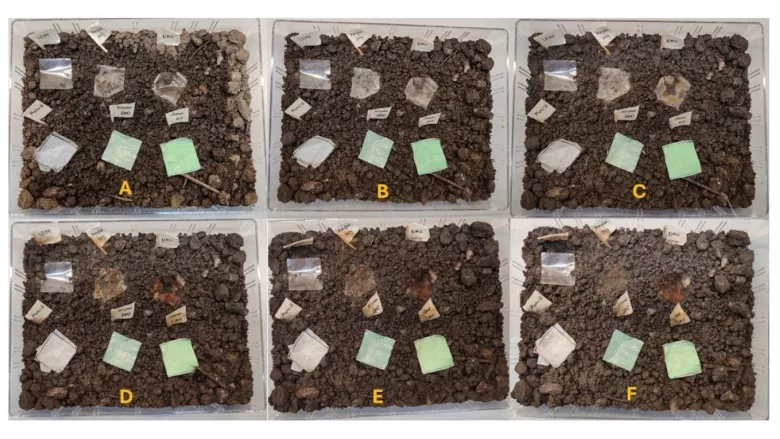
Image showing experiments on the degradation of different plastic materials.

Experiments on the degradation of different plastic materials. Top left is a common LDPE plastic film. Top center and right are the researchers' amylose-based bioplastic and a plastic made from corn starch, respectively. At the bottom are three different bags made from conventional bioplastics. A) shows the start of the experiment. B) shows the degradation after 8 days, C) the degradation after 11 days, D) 21 days E) 41 days and F) shows the degradation after 54 days. (Courtesy of Camilla Skovbjerg)

July 1, 2024

Enormous islands of plastic float in our oceans and microscopic particles of it are in our bodies. The durability, malleability and low cost of plastics has made them ubiquitous, from packaging to clothing to aircraft parts. But plastics have a downside. Plastics contaminate nature and can be difficult to recycle.

Now, researchers at the University of Copenhagen’s Department of Plant and Environmental Sciences have invented a new material made from modified starch that can completely decompose in nature – and do so within only two months. The material is made using natural plant material from crops and could be used for food packaging, among many other things.

"We have an enormous problem with our plastic waste that recycling seems incapable of solving. Therefore, we’ve developed a new type of bioplastic that is stronger and can better withstand water than current bioplastics. At the same time, our material is one hundred percent biodegradable and can be converted into compost by microorganisms if it ends up somewhere other than a bin," says Professor Andreas Blennow of the Department of Plant and Environmental Sciences.

Only about nine percent of plastic is recycled globally, with the rest being either incinerated or winding up in nature or dumped into enormous plastic landfills.

Bioplastics already exist, but the name is misleading, Blennow says. While today’s bioplastics are made of bio-derived materials, only a limited part of them is actually degradable, and often only under special conditions in industrial composting plants.

"I don't find the name suitable because the most common types of bioplastics don't break down that easily if tossed into nature. The process can take many years, and some of it continues to pollute as microplastic. Specialized facilities are needed to break down bioplastics. And even then, a very limited part of them can be recycled, with the rest ending up as waste," says the researcher.

Starch from barley and sugar industry waste

The new material is a so-called biocomposite and composed of several different substances that decompose naturally. Its main ingredients, amylose and cellulose, are common across the plant kingdom. Amylose is extracted from many crops, including corn, potatoes, wheat and barley.

Together with researchers from Aarhus University, the research team founded a spinoff company in which they developed a barley variety that produces pure amylose in its kernels. This new variety is important because pure amylose is far less likely to turn into a paste when it interacts with water compared to regular starch.

Cellulose is a carbohydrate found in all plants. The cellulose used by the researchers is a so-called nanocellulose made from local sugar industry waste. These nanocellulose fibers, which are one thousand times smaller than the fibers of linen and cotton, are what contribute to the material’s mechanical strength.

The new biomaterial is produced by either dissolving the raw materials in water and mixing them together or by heating them under pressure. By doing so, small 'pellets' or chips are created that can then be processed and compressed into a desired form.

So far, the researchers have only produced prototypes in the laboratory. But according to Professor Blennow, getting production started in Denmark and many other places in the world would be relatively easy.

"The entire production chain of amylose-rich starch already exists. Indeed, millions of tons of pure potato and corn starch are produced every year and used by the food industry and elsewhere. Therefore, easy access to the majority of our ingredients is guaranteed for the large-scale production of this material," he says.

Prototypes for food packaging

Blennow and his fellow researchers are now processing a patent application that, once it has been approved, could pave the way for production of the new biocomposite material.

The researcher is already collaborating with two Danish packaging companies to develop prototypes for food packaging, among other things. Though it is difficult to say when this biofriendly barley-based plastic will reach the shelves, the researcher predicts that the new material may become a reality in the foreseeable future.

“It's quite close to the point where we can really start producing prototypes in collaboration with our research team and companies. I think it's realistic that different prototypes in soft and hard packaging, such as trays, bottles and bags, will be developed within one to five years," Blennow said.


KEYWORDS: biobased materials compostable packaging plastic packaging alternatives sustainability

Share This Story

Looking for a reprint of this article?
From high-res PDFs to custom plaques, order your copy today!
Recommended Content

JOIN TODAY
to unlock your recommendations.

Already have an account? Sign In

  • Golden award trophy in the shape of a star. Text: 2026 Top 100 Food and Beverage Companies

    Top 100 Food and Beverage Packaging Companies of 2026

    Celebrating 30 years as a B2B journalist, I’ve revisited...
    Materials
    By: Brad Addington
  • Women In Packaging 2025 homepage hero

    Women in Packaging: Seizing Opportunities, Pushing Boundaries

    Seven women share their personal journeys in the...
    Materials
    By: Brad Addington
  • Image of the Spyder Pick and Place Joint Robot sorting pre-rolls.

    Cannabis Packaging Goes High-Tech

    Packaging Strategies doesn't often cover cannabis...
    Case Forming/ Packing/ Sealing
    By: Brad Addington
Subscription Center
  • eMagazine Subscription
  • Manage My Preferences
  • Newsletters
  • Subscription Customer Service
  • Online Registration

More Videos

Sponsored Content

Sponsored Content is a special paid section where industry companies provide high quality, objective, non-commercial content around topics of interest to the Packaging Strategies audience. All Sponsored Content is supplied by the advertising company and any opinions expressed in this article are those of the author and not necessarily reflect the views of Packaging Strategies or its parent company, BNP Media. Interested in participating in our Sponsored Content section? Contact your local rep!

close
  • Hand Holding Various Semaglutide and Insulin Injection Pens for different stages of the treatment.
    Sponsored byInline Plastics

    How GLP-1 Is Reshaping Food Packaging, and Why It Matters More Than You Think

  • A stack of clear plastic containers, the bottom full of mixed fruit
    Sponsored byInline Plastics

    Packaging Trends Shaping 2026: Where Trust Is Won

Popular Stories

Podcast | Packaging EPR’s 2026 Reality Check” with guest Anna Kendall headshot and title. Also pictured Cardboard boxes on conveyor belt.

PODCAST | Packaging EPR’s 2026 Reality Check

Logo for New Earth Ventures

Atlantic Packaging Launches New Earth Ventures to Accelerate Packaging Technology

Image of persimmons fruit in plastic packaging

IFPA Issues Position on EPR as Compliance Deadlines Hit Fresh Produce Industry

See the Top 100 Food and Beverage Packaging Companies of 2026

Products

Advances in Sustainable Food Packaging Technology

Advances in Sustainable Food Packaging Technology

See More Products

Packaging Perspectives Podcast

Play Packaging Strategies' captivating WordPlay game, PackStrat! There's a new word every Tuesday.

Related Articles

  • New bioplastics are more flexible and with low migration suitable for food and textile sector

    See More
  • Zanders Launches 100% Natural Barrier Paper for Food Packaging

    Zanders Launches 100% Natural Barrier Paper for Food Packaging

    See More
  • Lecta Metalvac FP.png

    Lecta's Metalvac FP Provides Sustainable Option for Food Packaging

    See More

Related Products

See More Products
  • shelflife.jpg

    Food Packaging Innovations and Shelf-Life

  • Packaging Sustainability: Tools, Systems and Strategies for Innovative Package Design

  • biobased.jpg

    Bio-Based Packaging: Material, Environmental and Economic Aspects

See More Products
×

Keep the info flowing with our Newsletters!

Get the latest industry updates tailored your way.

JOIN TODAY!
  • RESOURCES
    • Advertise
    • Contact Us
    • Directories
    • Store
    • Want More
  • SIGN UP TODAY
    • Create Account
    • eMagazine
    • Newsletter
    • Customer Service
    • Manage Preferences
  • SERVICES
    • Marketing Services
    • Reprints
    • Market Research
    • List Rental
    • Survey/Respondent Access
  • STAY CONNECTED
    • LinkedIn
    • Facebook
    • YouTube
    • X (Twitter)
  • PRIVACY
    • PRIVACY POLICY
    • TERMS & CONDITIONS
    • DO NOT SELL MY PERSONAL INFORMATION
    • PRIVACY REQUEST
    • ACCESSIBILITY

Copyright ©2026. All Rights Reserved BNP Media, Inc. and BNP Media II, LLC.

Design, CMS, Hosting & Web Development :: ePublishing