State of the Industry: Beverage
STATE OF THE INDUSTRY: BEVERAGE
By Rick Lingle, Executive Editor
(Click here to download Food & Beverage Processing's list of the top 75 beverage companies.)
The
Eagle remains perched at the summit as beer drinkers worldwide continue to
maintain the leadership role of Anheuser-Busch InBev as the top brewer and top
beverage company in the world (see chart). At $36.8 billion in revenues for
2009, it stands apart, a tribute to tradition, size, and branding built on a
firm foundation of beer.
Although the behemoth brewer relies heavily on marketing, it also innovates through packaging, though that lies more along the lines of a “if it ain’t broke, don’t fix it” approach. For example, the company refreshed the packaging design for Bud Light, the world’s best-selling light beer in the first half of 2009 (and the top U.S. beer brand), as a revamp to align better with the company’s messaging surrounding “superior drinkability.”
However, the company was not bereft of more robust packaging innovation, introducing a 1-liter bottle and the 269-milliliter slim can into Latin American markets. And in Brazil, it launched a 300ml returnable glass bottle last year that marks a sustainability-driven change. It’s a format that the brewer has had success with-it reports that in Belgium, returnable bottles are reused an average of 50 times. Whether the returnable concept ever grabs hold stateside remains unclear if not unlikely.
ABInBev is accelerating its innovation efforts: It doubled research and development expenditures last year over the prior year to $159 million, including initiatives related to new product developments and packaging.
Although the behemoth brewer relies heavily on marketing, it also innovates through packaging, though that lies more along the lines of a “if it ain’t broke, don’t fix it” approach. For example, the company refreshed the packaging design for Bud Light, the world’s best-selling light beer in the first half of 2009 (and the top U.S. beer brand), as a revamp to align better with the company’s messaging surrounding “superior drinkability.”
However, the company was not bereft of more robust packaging innovation, introducing a 1-liter bottle and the 269-milliliter slim can into Latin American markets. And in Brazil, it launched a 300ml returnable glass bottle last year that marks a sustainability-driven change. It’s a format that the brewer has had success with-it reports that in Belgium, returnable bottles are reused an average of 50 times. Whether the returnable concept ever grabs hold stateside remains unclear if not unlikely.
ABInBev is accelerating its innovation efforts: It doubled research and development expenditures last year over the prior year to $159 million, including initiatives related to new product developments and packaging.
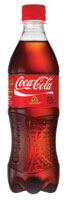
Coca Cola's ‘hybrid’ PlantBottle elegantly combines the use of renewable material resources with PET in a 100% recyclable format.
Bottle breakthrough
However, it was its closest rival and runner-up in our exclusive beverage rankings, the Coca-Cola Co., that grabbed the lion’s share of the packaging innovation spotlight in 2009. That was done largely in a single stroke with the debut of the PlantBottle.Containing of up to 30% plant-based material, with the balance polyethylene terephthalate (PET), the PlantBottle is a first-of-its-kind packaging made from renewable sources that is, like traditional PET bottles, 100% recyclable. PlantBottle packaging can be recycled in the existing commercial recycling infrastructure.
Announced in May 2009 and launched in Denmark in December, PlantBottle packaging has expanded for a variety of pack sizes for the company’s sparkling and still beverage products in the United States, Canada, Japan, Mexico, Brazil and Norway.
Shell Huang, Coca-Cola’s director of packaging research, says her team is developing the next generation of the PlantBottle: “We are working with R&D partners to advance next-generation technologies to allow us to produce future generations of PlantBottle packaging. Our ultimate vision is to develop recyclable plastic bottles made from 100% renewable materials.”
The company was highly proactive on another sustainability front: in early 2009, it opened the world’s largest plastic bottle-to-bottle recycling plant in Spartanburg, S.C. The plant will produce approximately 100 million pounds of recycled PET plastic for reuse yearly-the equivalent of nearly 2 billion 20-ounce Coca-Cola bottles.
This bold move reflects an industry-wide, sustainability-driven repositioning of companies’ goals and changes to their fundamental approach to packaging.
Rival PepsiCo (at number 9 in our rankings) has stated its sustainability intentions to use at least 10% recycled PET (rPET) in its primary soft drink containers in the U.S. and broadly expand the use of rPET across key international markets. The company is also creating partnerships to promote the increase of U.S. beverage container recycling rates to 50% by 2018. Currently, both glass and PET bottle recycling rates are in sync at 27%.
Another enviro-minded approach sweeping the beverage industry is through lightweighting of containers. Around mid-2009, Nestlé Waters North America extended its extra-thin Eco-Shape PET water bottle to three new sizes.
Introduced in 2006, the new sizes included 20 ounces, 1 liter and 1.5 liters. Nestlé claims that the Eco-Shape has the least amount of plastic of any branded beverage bottle on the market, with up to 30% material savings over competitive brands. It is currently available in all of Nestlé’s Spring Water brands. A Life Cycle Assessment by Quantis Intl. released in February 2010 indicated that Nestlé Waters’ Eco-Shape bottled water has the smallest environmental impact among bottled beverages because the containers use the least amount of plastic.
These kinds of steps are evident in the growing amount of environmental claims brand owners are making for packaged product introductions. Market researchers at Mintel report that claims relating to environmentally friendly packaging tripled last year, growing from 3% of all products launched in 2008 to 9% in 2009. It is a trend that can be expected to grow.
It is also worthwhile to get a look at beverage industry statistics related to container types.
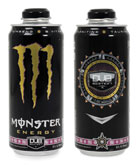
Energy drinks like Monster have been making heavy use of aluminum cans.
Metal movement
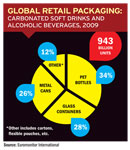
According to research firm Euromonitor International, the global retail beverage packaging market for 2009 comprised 943 billion containers, of which 34% were PET bottles, 28% glass containers, and 26% metal cans, with the remaining 12% comprising other formats including aseptic cartons. Euromonitor research manager Ben Punchard, speaking at the Packaging Strategies’ Package Design and Development Conference in March 2010, pointed to a trend whereby packagers are increasing margins by shrinking pack sizes while holding retail prices steady. For example, a 96-ounce container is trimmed to 89 ounces and a 355-milliliter can downsizes to 222ml, he said.A case study of that occurred in late 2009 when Coca-Cola introduced in select Eastern U.S. markets a “portion control” 7.5-oz can containing only 90 calories rather than the 140 calories packed in a traditional 355ml. The can also coincides with the company’s initiative to note calories and other nutritional information on the front of its packaging. The can was rolling out nationally this spring following its debut.
Punchard also expects aluminum bottles to gain market share, growing from 1.1 billion to 1.5 billion units by 2012. Energy drinks have moved strongly into aluminum, including brands such as Monster, Burn, and No Fear.
For instance, Monster DUB edition energy drink from Hansen Natural Corp. debuted last fall in the U.S. with a reclosable top. The 550ml aluminum can has a resealable end consisting of a flat plastic disk that rotates to open or seal off the can’s aperture. Unlike other devices for resealing metal cans, Monster’s version allows the cans to be stacked-a reseal feature that first appeared in Europe in 2008.
An April 2010 article in Beverage Industry credits market research firm Nielsen for statistics showing that U.S. carbonated soft drink sales grew 2.6% to $18.8 billion amidst a global market of $40 billion, while volume remained flat.
“It’s a combination of the economic downturn as well as a lot of negative publicity around the soft drink industry that’s really leading to the decline,” says Alison Lipson, a research analyst at Euromonitor. “Additionally, because of the negative publicity, when consumers are [purchasing] beverages, they are choosing healthier options-bottled functional waters mostly and ready-to-drink teas.”
That’s exactly what Coca-Cola did in 2009 when it introduced glacéau smartwater to new markets within the United States and launched the brand in Canada. As a result, the product’s unit case volume grew 33% in what was generally a flat market for beverages.
In leveraging the health-bent nature of today’s consumers, beverage packagers will respond in kind-change always represents opportunity for the reactive packager. Perhaps next year at this time the beverage market will be healthier than 2009 in several respects. F&BP
Looking for a reprint of this article?
From high-res PDFs to custom plaques, order your copy today!