
Four trends shaping industrial packaging market's future
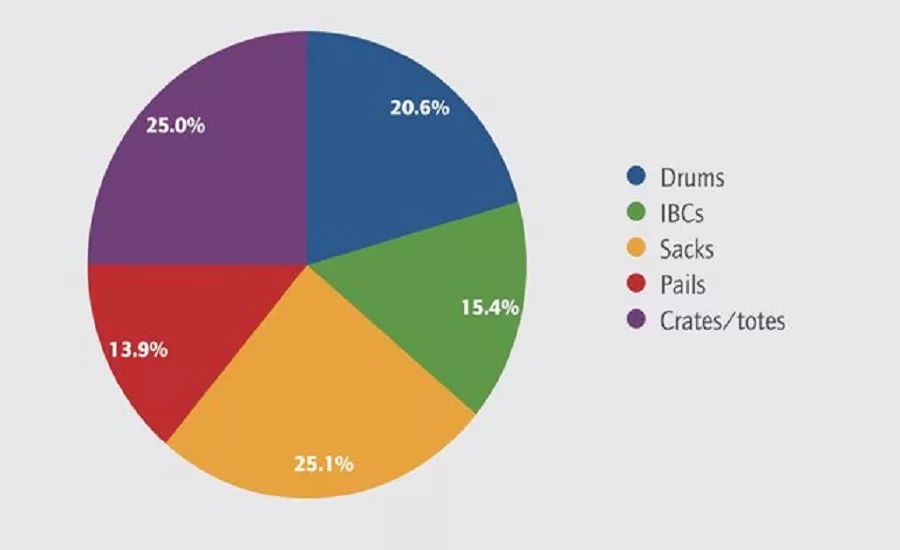
Smithers Pira offers the four key trends that will be drivers for the industrial packaging market through to 2020.
The global market for industrial packaging, estimated at $48.6 billion in 2013, is forecast to reach $61 billion by 2020 – an annual growth of 3.4% – according to a recent market study by Smithers Pira (smitherspira.com). Data in the study The Future of Industrial Packaging to 2020 shows the largest share of this market (31%) has now shifted to Asia, placing it ahead of Western Europe and North America.
Asia will continue to see the highest growth in demand across the study period (2015-2020), increasing its total share to 34% of the world market at its end. In contrast, Western Europe is expected to drop to a 28% market share in 2020 as overall growth falters and some national markets decline.
The industrial packaging sector is dependent on four main user industries:
• Chemicals and pharmaceuticals
• Lubricants
• Bulk food and beverages
• Building and construction
These industries are still exhibiting inconsistent recovery from the global economic downturn of 2008, which is influencing overall growth in the segment.
Today, the chemicals and pharmaceuticals sector is the most significant end-use market for industrial packaging, accounting for more than 30% of total sales. The chemicals market represents more than three-quarters of the steel drum and rigid intermediate bulk containers (IBC) market, and accounts for more than half of all plastic drums in use.
Drums and IBCs together accounted for just under a third of the market in 2013, but are forecast to represent 36% of total usage by 2020, with the strongest growth expected in IBCs. In addition, many lower volume chemicals and pharmaceutical products are packed in sacks. Sacks are expected to lose share from 27% to 25% as a move away from manual handling toward further mechanization continues. The chart shows the global market for industrial packaging products, percentage share by value, 2020.
Greater emphasis is also being placed on bulk supplies in the fast-growing Asian market.
Recycling: Minimizing the environmental impact is a pressure being felt across the whole packaging market. The single biggest driver of sustainable packaging has been the introduction of legislation that calls for the 3Rs – reduce, re-use and recycle.
Reuse is a major trend in metal packaging because of the increased pressure to prolong the life cycle of finite resources through the re-use of containers. In contrast to consumer applications, many industrial packaging markets benefit from a highly effective and well-established infrastructure for products like reconditioned drums to maximize repeat use.
The recycling of steel has also been proven in numerous studies to be less harmful to the environment than the extraction of virgin ore. The recycling process significantly reduces air and water pollution, as well as saving production phase energy and water, and lowering mining waste.
This trend will be most pronounced in metal packaging, as it has the ability to maintain integral strength through successive stages of recycling. This constitutes a major advantage over alternative materials, such as plastic and fibreboard, which require a degree of virgin material to maintain the desired performance.
Downgauging: In other industrial packaging segments, sustainability efforts are continuing to focus on material reduction or downgauging. Engineers have succeeded in improving packaging performance while using fewer materials in all formats. For example, the typical weight of a plastic drum today is 9kg – less than one-third the weight of the same product in the 1970s. Similar improvements have been made with steel drums.
Technical advances have also taken place in the construction of multiwall paper sacks. The average weight of these sacks has been reduced without sacrificing strength and performance. Cutting the weight of plastic films has also been successful.
Minimizing the volume of material used in an industrial package saves on the bill of materials, and also logistics costs to the customer. Demand to realize further incremental improvements will foster further innovation from industrial packaging designers across the study period.
Optimizing pack shape: Another top influencer of the impact of industrial packaging on logistics and distribution costs is the shape of the pack itself and how this can optimize cargo space without compromising protection. This is running in parallel to the development of packaging materials that offer same or better performance while reducing materials usage; both are, and will continue to have, a positive impact on transportation costs.
Smithers notes that the influence cube size has on logistics chains is increasingly being appreciated. The cylindrical shape of a steel or plastic drum has the advantage of being one of the few forms of package that can be handled safely by one person, without the use of mechanical handling equipment or prepared surfaces. On the downside, drums do not allow for the most efficient use of space for distribution.
Rectangular-shaped rigid IBCs that enable containers to be packed closer together with less void space will increasingly be used by large companies. This will manifest itself in greater volume usage for containers and ultimately improved trailer transportation efficiencies. Investment in mechanical handling equipment down the logistic chains is necessary to realize these gains however.
Safety: Where governments and public sector organizations are most interested in controlling packaging waste, the industrial packaging sector is sensitive to the need to balance this with the necessary protection that packaging provides its product – particularly when dealing with hazardous materials.
In an increasingly global market, the responsibility for assuring safety is growing and relies on international bodies, such as the United Nations. The UN’s Recommendations on the Transport of Dangerous Goods – published in its Orange Book – is now established as the bedrock for all national and international regulations for transporting hazardous materials.
Looking for a reprint of this article?
From high-res PDFs to custom plaques, order your copy today!