
Packaging Strategies logo
search
cart
facebook twitter linkedin youtube
  • Sign In
  • Create Account
  • Sign Out
  • My Account
Packaging Strategies logo
  • FEATURED
    • Brand Packaging
    • Extended Producer Responsibility
    • New Products & Materials
      • Featured Products
    • Packaging News
    • Packaging Perspectives Podcasts
    • Steve Fairfield Innovation Award
    • Supply Side
    • Top 100 Food & Beverage Packaging Companies
      • Submit Your Company
  • FLEXIBLE PACKAGING
  • VERTICAL MARKETS
    • Beer / Wine / Spirits Packaging
    • Beverage Packaging
    • Candy / Confectionery
    • Dairy Food Packaging
    • FoodService Packaging
    • Household Packaging
    • Meat / Seafood Packaging
    • Personal Care Packaging
    • Pet Food Packaging
    • Pharma / Medical Packaging
    • Produce Packaging
    • Snack Food Packaging
  • MATERIALS
    • Adhesives / Sealants
    • Beverage Multipacks
    • Blister Packaging
    • Cans & Bottles
    • Closures/Lids
    • Films & Coatings
    • Labels
    • Material Converting
    • Paperboard / Corrugated / Cartons
    • Rigid Containers
    • Sustainable Packaging
  • MACHINERY
    • Automation / Controls
    • Case Forming / Packing / Sealing
    • Cartoning
    • Coding / Marking / Printing
    • Conveyors
    • Form-Fill-Seal / Filling & Closing
    • Inspection / Detection / Vision
    • Labeling
    • Unitizing / Palletizing
    • Robotics
    • Track & Trace / Serialization
  • DIRECTORIES
    • Packaging Strategies Resource Guide
    • Flexible Packaging Buyer's Guide
  • EVENTS
    • Converters Expo
    • Converters Expo South
    • Global Pouch Forum
    • Industry Events
    • Webinars
  • MORE
    • Videos
    • Book Store
    • Classifieds
    • Custom Content & Marketing Services
    • eXTRA Newsletter
    • Market Research
    • PACKSTRAT Wordplay
    • PS Resource Guide
    • Sponsor Insights
  • EMAG
    • eMagazines
    • Archived Issues
    • Contact Us
    • Advertise
  • SIGN UP!
Unitizing/ PalletizingRobotics

Machinery Technology: Palletizing

Choosing the best palletizing system

Follow this effective guide for multiple infeed palletizing.
By Jason Bennett
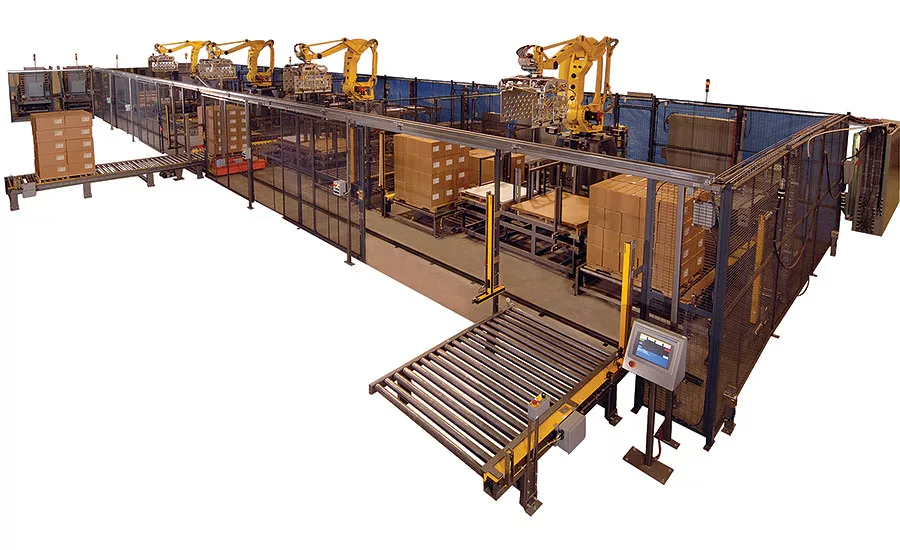
Palletizing system with four robotic cells, each handling two lines

Four robotic cells, each handling two lines, are being staged at the factory acceptance test level.
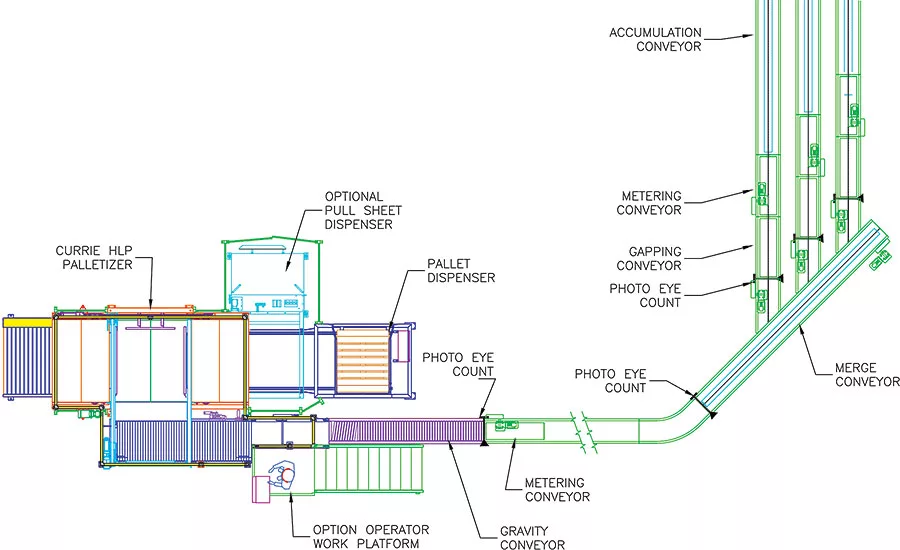
Layout of consolidating three lines into one palletizer

A customer came to the applications team with the desire to consolidate three lines into one palletizer. A conventional palletizer was the best solution based on budget, ROI, volume and pack pattern.
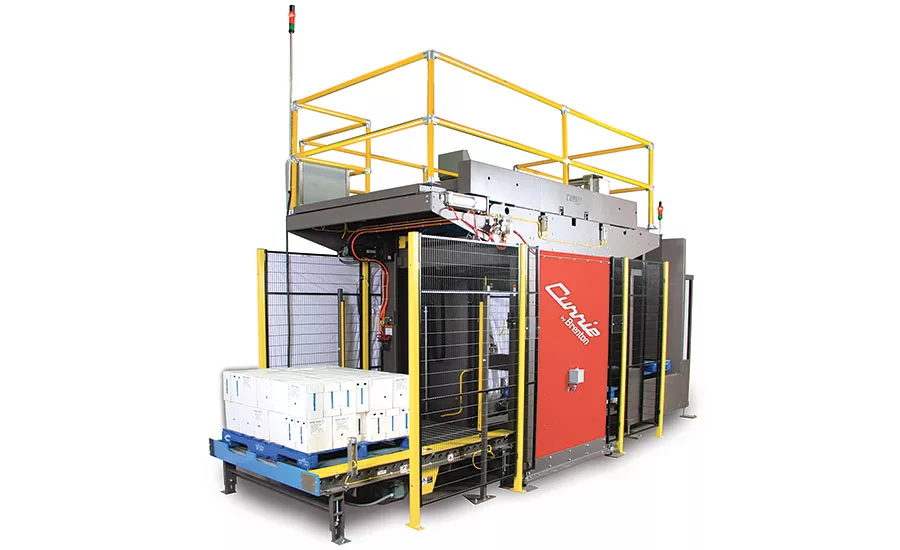
Conventional high-level palletizers come in multiple configurations

Conventional high-level palletizers come in multiple configurations in order to accommodate a wide variety of plant layouts.

Palletizing system with four robotic cells, each handling two lines
Layout of consolidating three lines into one palletizer
Conventional high-level palletizers come in multiple configurations
June 13, 2016

There is growing interest in consolidating palletizing/stretch wrapping operations closer to the shipping dock or warehouse facility in order to free up space for additional packaging capacity. Running multiple conveyors to a single palletizer/stretch wrapping operation not only adds valuable real estate for expanding packaging operations but also offers these advantages:

  • Minimizes the number of palletizers/stretch wrappers at the plant, thereby decreasing capital costs and maintenance and labor;
  • Lowers handling time associated with moving pallets;
  • Keeps the packaging room cleaner by reducing the dust associated with shipping cases and fork trucks;
  • Improves safety by removing fork trucks from areas of high foot traffic.

There are two solutions for multiple infeed palletizing: robotic cells and conventional palletizers.

Robotic cells

Robotic cells can accommodate multiple infeed lines – two to five lines per robot on average – and either single or multiple discharge lanes. The robot’s claim to fame is its flexibility and quick changeover. Depending on its end-of-arm tooling, a robot can handle various types of shipping containers – regular slotted container RSC, half-slotted container HSC, bags and more. Robots are re-deployable and reprogrammable for use in other areas of the plant. Robotic palletizers are also scalable; as more infeed conveyors are added, additional robotic cells can be cost effectively and efficiently installed. Robotic palletizers do not require accumulation conveyors, which is a large cost savings. In many applications the robotic palletizer has a smaller footprint than a conventional palletizer.

Conventional palletizers

High-level, high-speed palletizers are notable for their speed and volume capacity. These are large, rugged automated systems capable of forming pack patterns and laying down seven or more pallet layers per minute. These workhorses can handle up to 10 infeed lines, and typically have a larger footprint than robotic palletizers. Accumulation conveyors are required for each infeed line to a conventional palletizer, adding cost to the system and expanding the footprint required. A rule of thumb is that each infeed line needs to accumulate a minimum number of cases equivalent to one and a half pallet loads.

Conventional high-level palletizers come in multiple configurations in order to accommodate a wide variety of plant layouts. Control systems store multiple pack patterns and enable rapid automatic changeover. In state-of-the-art machines, touchscreen pack pattern programming saves time and makes the operation of the equipment more efficient. Advanced servo technology identifies problems with pack patterns more quickly than ever before and, like robots, remote diagnostics and tech support help create greater uptime.

Which to choose, and why

Unfortunately, there is no rule of thumb for when to apply a robotic cell or conventional palletizer. It would be wonderful to be able to say definitively that lower volume multiple infeed systems always do best with robotic systems and heavier volume multiple lanes are ideal for conventional palletizers, but it is not that simple. There are a number of factors that impact which system is best for the operation. These variables include:

  • Cases per minute
  • Number of SKUs
  • Pack patterns required
  • Case sizes
  • Type of shipping material
  • Number of infeed lines
  • Footprint
  • Future plans for the operation in terms of new products and expansion potential
  • Budget
  • Return on investment (ROI)

For example, a customer came to us with plans to run eight different infeed lines in a single palletizing area. Based on the generalization that one robot is best for two to five lanes and the conventional palletizer best for three to 10 lanes, the obvious answer would be to specify the conventional palletizer. However, based on the cases per minute, number of SKUs, pack patterns, budget, lack of room for accumulation conveyors, and many other factors, the Currie by Brenton applications engineering team determined that the optimum investment for this customer would be four robotic cells, each of which would handle two lines. See the image on the previous page of the actual four stations being staged at the factory acceptance test level.

A second customer came to the applications team with the desire to consolidate three lines into one palletizer. A candidate for a robot cell? Turns out a conventional palletizer was the best solution based on budget, ROI, volume and pack pattern. See figure above for the final schematic and image on the next page for a look at a high level palletizer.

And lastly, another customer wanted a system for five multiple lines. Could the solution be two robots or perhaps one high-level palletizer? No. Volume and pack pattern were such that this customer came away with a highly cost-effective one-robot system. These examples demonstrate that there is no easy approximation for identifying the best system. Each application must be examined on its own merits and a unique determination made.

When moving lines to a central area, it is best to work with an original equipment manufacturer (OEM) with expertise in both high-level, high-speed palletizers and robotic palletizing cells. The dual system OEM will be neutral in finding the best solution; while the single system OEM can only respond with its solution, not necessarily the best solution.

The new solution has to be an integrated one – conveyors, palletizer and stretch wrapper all tied together. Either a system integrator will put it together, or the palletizer OEM will be the integrator and stage the factory acceptance test. There is a case to be made for the OEM as integrator. The reason is that the palletizer – either robotic or conventional – is the anchor device. To work effectively, the conveyors must infeed and discharge perfectly with the whole system streamlined for communication handshakes between units upstream and downstream of the palletizer. No one knows how to efficiently operate the palletizer and maintain the proper flow as well as the OEM. This is a powerful rationale for the OEM to integrate the system.

When discussing the project with the OEM, determine whether the technical and project management teams have a track record of success. The main point to remember is that the necessary technology exists for a central palletizing area to be successful; however it requires application expertise and robotic or conventional palletizing options in order to obtain the optimum solution.

KEYWORDS: packaging robots palletizing robotic palletizing

Share This Story

Looking for a reprint of this article?
From high-res PDFs to custom plaques, order your copy today!


Jason bennett

Jason Bennett is currently the product line manager for Currie Conventional and Robotic Palletizing. During his 18-year career in the packaging industry he has held senior level management and sales and marketing roles with such firms as HK Systems, vonGAL Corporation and Daifuku America. Bennett is a graduate of Troy University and has a Bachelor’s of Science degree in Finance.

Recommended Content

JOIN TODAY
to unlock your recommendations.

Already have an account? Sign In

  • Golden award trophy in the shape of a star. Text: 2026 Top 100 Food and Beverage Companies

    Top 100 Food and Beverage Packaging Companies of 2026

    Celebrating 30 years as a B2B journalist, I’ve revisited...
    Sustainable Packaging
    By: Brad Addington
  • Women In Packaging 2025 homepage hero

    Women in Packaging: Seizing Opportunities, Pushing Boundaries

    Seven women share their personal journeys in the...
    Materials
    By: Brad Addington
  • Image of the Spyder Pick and Place Joint Robot sorting pre-rolls.

    Cannabis Packaging Goes High-Tech

    Packaging Strategies doesn't often cover cannabis...
    Automation/Controls
    By: Brad Addington
Subscription Center
  • eMagazine Subscription
  • Manage My Preferences
  • Newsletters
  • Subscription Customer Service
  • Online Registration

More Videos

Sponsored Content

Sponsored Content is a special paid section where industry companies provide high quality, objective, non-commercial content around topics of interest to the Packaging Strategies audience. All Sponsored Content is supplied by the advertising company and any opinions expressed in this article are those of the author and not necessarily reflect the views of Packaging Strategies or its parent company, BNP Media. Interested in participating in our Sponsored Content section? Contact your local rep!

close
  • Hand Holding Various Semaglutide and Insulin Injection Pens for different stages of the treatment.
    Sponsored byInline Plastics

    How GLP-1 Is Reshaping Food Packaging, and Why It Matters More Than You Think

  • A stack of clear plastic containers, the bottom full of mixed fruit
    Sponsored byInline Plastics

    Packaging Trends Shaping 2026: Where Trust Is Won

Popular Stories

Podcast | Packaging EPR’s 2026 Reality Check” with guest Anna Kendall headshot and title. Also pictured Cardboard boxes on conveyor belt.

PODCAST | Packaging EPR’s 2026 Reality Check

Logo for New Earth Ventures

Atlantic Packaging Launches New Earth Ventures to Accelerate Packaging Technology

Image of persimmons fruit in plastic packaging

IFPA Issues Position on EPR as Compliance Deadlines Hit Fresh Produce Industry

See the Top 100 Food and Beverage Packaging Companies of 2026

Products

Advances in Sustainable Food Packaging Technology

Advances in Sustainable Food Packaging Technology

See More Products

Packaging Perspectives Podcast

Play Packaging Strategies' captivating WordPlay game, PackStrat! There's a new word every Tuesday.

Related Articles

  • palletizing and depalletizing models

    Finding the Best Solutions for Palletizing & Depalletizing

    See More
  • Employees of Unilever’s nutrition factory in Ploiesti, Romania

    Unilever expansion sustained by Sidel’s central robotic palletizing system

    See More
  • AF-PLT gantry robot palletizing system offers economical solution

    See More

Related Directories

  • Midwest Engineered Systems

    Midwest Engineered Systems (MWES) designs, builds, and integrates custom automation for packaging and material handling applications. From robotic palletizing and case packing to web handling and converting, MWES delivers engineered solutions that enhance productivity, precision, and efficiency for manufacturers across North America. Learn more at www.mwes.com .
  • ESS Technologies - A Pacteon Co.

    ESS Technologies has extensive experience in cartoning, case packing, and robotic palletizing. Palletizers range from single-pallet mini cells to fully integrated systems. Space-saving and precision handling, including robotic pick-and-place, cartoners, and case packers, are available with top, side, or bottom loading options. Specialized options include IQ/OQ-compliant, serialization, leaflet placement, and labeling.
  • Schneider Packaging - A Pacteon Co.

    Schneider Packaging Equipment has a 50+ year legacy of excellence in case packing and robotic palletizing solutions. Tailored to optimize efficiency and productivity, our case packing portfolio includes robotic, horizontal, high-speed, bottom-loading, and gable top models. Our palletizers include collaborative, modular, centralized, high-speed layer, and fully integrated systems.
×

Keep the info flowing with our Newsletters!

Get the latest industry updates tailored your way.

JOIN TODAY!
  • RESOURCES
    • Advertise
    • Contact Us
    • Directories
    • Store
    • Want More
  • SIGN UP TODAY
    • Create Account
    • eMagazine
    • Newsletter
    • Customer Service
    • Manage Preferences
  • SERVICES
    • Marketing Services
    • Reprints
    • Market Research
    • List Rental
    • Survey/Respondent Access
  • STAY CONNECTED
    • LinkedIn
    • Facebook
    • YouTube
    • X (Twitter)
  • PRIVACY
    • PRIVACY POLICY
    • TERMS & CONDITIONS
    • DO NOT SELL MY PERSONAL INFORMATION
    • PRIVACY REQUEST
    • ACCESSIBILITY

Copyright ©2026. All Rights Reserved BNP Media, Inc. and BNP Media II, LLC.

Design, CMS, Hosting & Web Development :: ePublishing