
Packaging Strategies logo
search
cart
facebook twitter linkedin youtube
  • Sign In
  • Create Account
  • Sign Out
  • My Account
Packaging Strategies logo
  • FEATURED
    • Brand Packaging
    • Extended Producer Responsibility
    • New Products & Materials
      • Featured Products
    • Packaging News
    • Packaging Perspectives Podcasts
    • Steve Fairfield Innovation Award
    • Supply Side
    • Top 100 Food & Beverage Packaging Companies
      • Submit Your Company
  • FLEXIBLE PACKAGING
  • VERTICAL MARKETS
    • Beer / Wine / Spirits Packaging
    • Beverage Packaging
    • Candy / Confectionery
    • Dairy Food Packaging
    • FoodService Packaging
    • Household Packaging
    • Meat / Seafood Packaging
    • Personal Care Packaging
    • Pet Food Packaging
    • Pharma / Medical Packaging
    • Produce Packaging
    • Snack Food Packaging
  • MATERIALS
    • Adhesives / Sealants
    • Beverage Multipacks
    • Blister Packaging
    • Cans & Bottles
    • Closures/Lids
    • Films & Coatings
    • Labels
    • Material Converting
    • Paperboard / Corrugated / Cartons
    • Rigid Containers
    • Sustainable Packaging
  • MACHINERY
    • Automation / Controls
    • Case Forming / Packing / Sealing
    • Cartoning
    • Coding / Marking / Printing
    • Conveyors
    • Form-Fill-Seal / Filling & Closing
    • Inspection / Detection / Vision
    • Labeling
    • Unitizing / Palletizing
    • Robotics
    • Track & Trace / Serialization
  • DIRECTORIES
    • Packaging Strategies Resource Guide
    • Flexible Packaging Buyer's Guide
  • EVENTS
    • Converters Expo
    • Converters Expo South
    • Global Pouch Forum
    • Industry Events
    • Webinars
  • MORE
    • Videos
    • Book Store
    • Classifieds
    • Custom Content & Marketing Services
    • eXTRA Newsletter
    • Market Research
    • PACKSTRAT Wordplay
    • PS Resource Guide
    • Sponsor Insights
  • EMAG
    • eMagazines
    • Archived Issues
    • Contact Us
    • Advertise
  • SIGN UP!
LabelingLabels

Maximizing efficiency and throughput in shrink sleeve packaging operations

Automatic splicing enables operation to reap benefits of marketing optimization.
By Michael Mucci
shrink sleeving
October 23, 2017

Shrink sleeve packaging is on the rise, primarily in the beverage industry, though it has also seen an increase in use in tamper-resistant packaging applications. Shrink sleeves are gaining in popularity in these applications because they provide marketing optimization by allowing the product manufacturer to utilize the entire surface of the package for artwork and information, regardless of surface contours. 

This type of packaging therefore enables rapid, cost-effective packaging design changes, providing product marketing groups the ability to make sure that the product stands out from competitive products on the shelf. As with all packaging applications, finding ways to increase efficiency is critical in shrink sleeve packaging operations, as increased efficiency directly translates into higher throughput and greater profit margins.

Shrink sleeve process and challenges

Shrink sleeve film is generally composed of either Polyvinyl Chloride (PVC) or Polyethylene Terephthalate Glycol-modified (PETG). The film is converted from a flat film to a tube structure with an overlap seal. During the labeling process, the tube is cut to length by the labeling equipment and placed over the exterior of the package. The package then proceeds through a heat tunnel, generating radiant heat, hot air, steam, or hybrid of these, where the film shrinks under the heat exposure to conform to the shape of the package.

As with all packaging film, shrink sleeve film must be spliced together, joining the end of an expiring roll of film to the start of a new one. The typical challenge to creating a hand splice in these applications is the struggle to achieve a consistent splice joint for smooth operation over the mandrel. In many cases, an overlap joint is created with the expiring tube of material being “tucked” inside the new tube, thus allowing the new material to be guided over the mandrel. This can create issues if the combination of the tape and double-thickness of shrink sleeve does not move smoothly over the forming mandrel, as is frequently the case.

The process of expanding the shrink sleeve to a tube shape through the use of a mandrel within the labeling machine requires the material to be very consistent through the splice joint. Any inconsistencies in the film alignment, print pattern repeat, and/or ability to open to a tube shape can result in a stoppage of the labeler and significant downtime.

In addition, it can be difficult and time-consuming for an operator to create a manual splice in-registration, such that the repeat pattern of the printed material remains consistent through the splice joint. Finally, creating a manual splice generally requires the process to be stopped as the expiring roll is spliced into the new roll. The urgency to minimize production downtime is difficult for the operator to balance with the effort required to create a very precise splice joint that does not exhibit any of the potential problem areas noted above, thus leading to stress and errors.

Meeting challenges to maximize efficiency

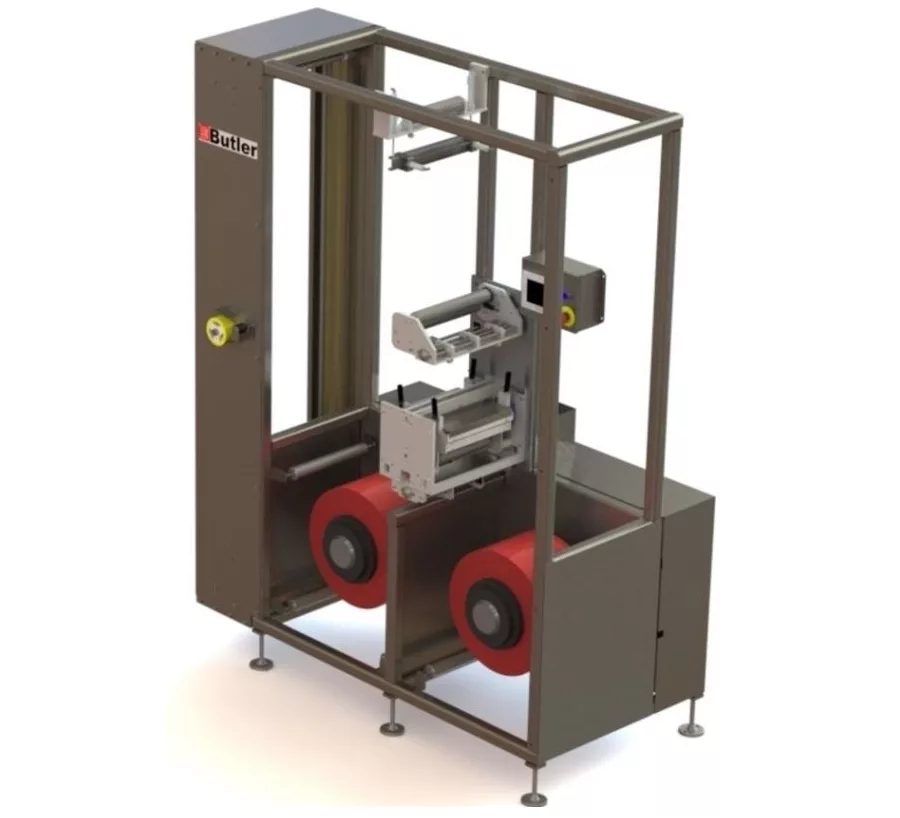
Automatic splicing technology in the form of the patent pending Butler Automatic (www.butlerautomatic.com) SP3HSL Sleeve Splicer solves the challenge of striking this balance faced in manual splicing. Butler’s SP3HSL provides a zero-speed, in-registration, automatic splice from an expiring roll of film to a new roll, all while continuously providing film to the downstream process without interruption or any need to reduce the process speed. The SP3HSL provides a butt-splice joint with tape on both sides and can support line speeds up to 450 feet per minute.

To achieve this, the operator loads a new roll of sleeve material on the air shaft of the splicer and prepares the splice. This process usually takes 2-3 minutes and is performed while the downstream process is supplied material from the initial roll, thus eliminating the need for line stoppage. Then, when a preset, calculated diameter of the running roll has been reached, the splicer automatically splices the expiring roll to the prepared splice joint without any need for operator involvement. The splicer will create an in-registration, two-sided tape joint that is both strong and capable of fitting over the forming mandrel.

The overall product thickness is kept to a minimum with automatic splicing by forming a butt-splice joint, thereby eliminating the extra thickness of sleeve material that results from the typical “tuck” joint. In addition, the SP3HSL incorporates patent pending guiding features to ensure the sleeve is centered going through the splice head, regardless of its lateral position exiting the roll. This ensures the properly prepared splice will be in alignment with the expiring roll of material and all resulting packages will be sleeved correctly.

Finally, the SP3HSL uses a fiber-optic, multi-color sensor to address the challenge of identifying the registration marks, printed image gaps, or printed image repeat patterns in the film artwork. The combination of this sensing hardware and the ability to offset the splice from the mark via the splicer software provides operators with the ability to locate the splice joint precisely and repeatedly anywhere on the product.

Clear benefits of automatic splicing in shrink sleeve packaging

A typical sleeve machine processes between 200 and 800 bottles each minute. Assuming an average label length of 6 inches, the process could consume 400 feet of sleeve material per minute. At that rate, the typical roll of sleeve film lasts less than 15 minutes before it expires and must be spliced to a new roll. In these applications, it is not unusual for roll changes and manual splicing to take at least 2-3 minutes each time, often longer. By eliminating this 8-12 minutes or more of downtime per hour, automatic splicing can result in an immediate 13-20% increase in production.

In conclusion, automatic splicing is a critically important tool to maximize efficiency in increasingly popular shrink sleeve packaging applications. Automatic splicing technology enables packaging operations to fully reap the benefits of this type of packaging, in terms of marketing optimization and rapid, cost-effective packaging design changes.

KEYWORDS: automatic splicing solutions film labeling machinery shrink sleeve labeling shrink sleeves

Share This Story

Looking for a reprint of this article?
From high-res PDFs to custom plaques, order your copy today!

Michael Mucci is the vice president of engineering, Butler Automatic

Recommended Content

JOIN TODAY
to unlock your recommendations.

Already have an account? Sign In

  • Golden award trophy in the shape of a star. Text: 2026 Top 100 Food and Beverage Companies

    Top 100 Food and Beverage Packaging Companies of 2026

    Celebrating 30 years as a B2B journalist, I’ve revisited...
    Materials
    By: Brad Addington
  • Women In Packaging 2025 homepage hero

    Women in Packaging: Seizing Opportunities, Pushing Boundaries

    Seven women share their personal journeys in the...
    Material Converting
    By: Brad Addington
  • Image of the Spyder Pick and Place Joint Robot sorting pre-rolls.

    Cannabis Packaging Goes High-Tech

    Packaging Strategies doesn't often cover cannabis...
    Robotics
    By: Brad Addington
Subscription Center
  • eMagazine Subscription
  • Manage My Preferences
  • Newsletters
  • Subscription Customer Service
  • Online Registration

More Videos

Sponsored Content

Sponsored Content is a special paid section where industry companies provide high quality, objective, non-commercial content around topics of interest to the Packaging Strategies audience. All Sponsored Content is supplied by the advertising company and any opinions expressed in this article are those of the author and not necessarily reflect the views of Packaging Strategies or its parent company, BNP Media. Interested in participating in our Sponsored Content section? Contact your local rep!

close
  • Hand Holding Various Semaglutide and Insulin Injection Pens for different stages of the treatment.
    Sponsored byInline Plastics

    How GLP-1 Is Reshaping Food Packaging, and Why It Matters More Than You Think

  • A stack of clear plastic containers, the bottom full of mixed fruit
    Sponsored byInline Plastics

    Packaging Trends Shaping 2026: Where Trust Is Won

Popular Stories

Podcast | Packaging EPR’s 2026 Reality Check” with guest Anna Kendall headshot and title. Also pictured Cardboard boxes on conveyor belt.

PODCAST | Packaging EPR’s 2026 Reality Check

Main image for podcast with Kevin Kelly regarding Flexible Packaging for Produce. Main image includes Kevin Kelly’s headshot and an image of potatoes in a bag incorporating 30% PCR content.

Looking Forward to Global Pouch Forum

Logo for New Earth Ventures

Atlantic Packaging Launches New Earth Ventures to Accelerate Packaging Technology

See the Top 100 Food and Beverage Packaging Companies of 2026

Products

Advances in Sustainable Food Packaging Technology

Advances in Sustainable Food Packaging Technology

See More Products

Packaging Perspectives Podcast

Play Packaging Strategies' captivating WordPlay game, PackStrat! There's a new word every Tuesday.

Related Articles

  • Tamper proof packaging

    Why Perforations Are Used in Shrink Sleeve Packaging

    See More
  • butler

    Increasing production uptime and throughput in packaging applications

    See More
  • Low-density, multi-layer shrink sleeve film enables seamless end-of-life separation

    See More

Related Directories

  • AWT Labels & Packaging

    AWT Labels & Packaging specializes in innovative and sustainable flexible packaging solutions. Our expertise lies in creating custom flexible packaging designs that meet the unique needs of each client. AWT's commitment to quality ensures that products are not only visually appealing but also functional and environmentally friendly.
  • Brown Packaging

    Brown Packaging offers a full range of packaging solutions—from custom corrugated boxes, folding cartons, POP displays, foam, clamshells, and pouches to stock shipping supplies. Serving industrial, retail, ecommerce, medical, food, electronics, and more, we provide design, prototyping, testing, fulfillment, and sustainable packaging—all backed by ISO-certified quality and service.
  • The Griff Network

    The Griff Network is an ISO 9001:2015 certified manufacturer of papers, films, and laminates. We specialize in heat sealable, coextruded, packaging, and processing substrates. Offering finished rolls, perfing, and product development services. Ask about our green bio-based products. Visit us online for more information. Call for a quick quote.
×

Keep the info flowing with our Newsletters!

Get the latest industry updates tailored your way.

JOIN TODAY!
  • RESOURCES
    • Advertise
    • Contact Us
    • Directories
    • Store
    • Want More
  • SIGN UP TODAY
    • Create Account
    • eMagazine
    • Newsletter
    • Customer Service
    • Manage Preferences
  • SERVICES
    • Marketing Services
    • Reprints
    • Market Research
    • List Rental
    • Survey/Respondent Access
  • STAY CONNECTED
    • LinkedIn
    • Facebook
    • YouTube
    • X (Twitter)
  • PRIVACY
    • PRIVACY POLICY
    • TERMS & CONDITIONS
    • DO NOT SELL MY PERSONAL INFORMATION
    • PRIVACY REQUEST
    • ACCESSIBILITY

Copyright ©2026. All Rights Reserved BNP Media, Inc. and BNP Media II, LLC.

Design, CMS, Hosting & Web Development :: ePublishing