Initiative Targets Recovery of Small-Format Plastics as California EPR Looms
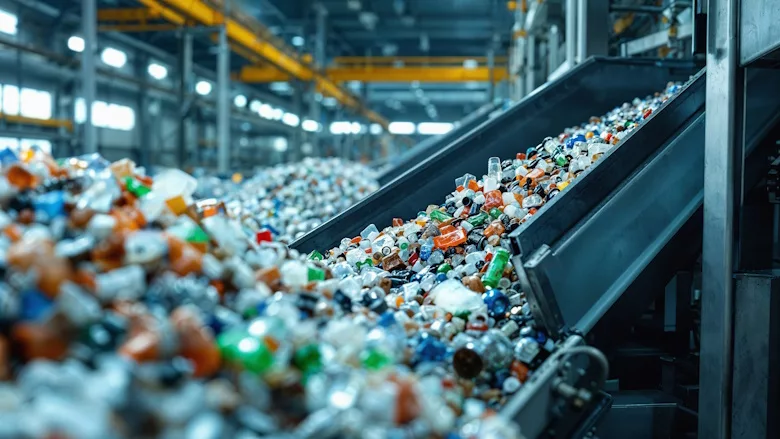
Billions of small-format plastics currently end up in landfills each year simply because they are too small to be properly captured by traditional recycling equipment.
To address this challenge, Closed Loop Partners’ Center for the Circular Economy (the Closed Loop Center) on Monday announced the next phase of its Smalls Consortium: Advancing the Recovery of Small-Format Packaging (the Smalls Consortium), joined by founding partner L’Oréal, supporting partners Kraft Heinz and CVS Health, and strategic advisor Circular Action Alliance (CAA).
“With this powerful cross-industry backing, the Smalls Consortium is focusing its field-testing efforts on California,” Closed Loop Partners said in a statement. “As the state prepares for the implementation of SB 54—the historic Extended Producer Responsibility (EPR) law set to take effect on January 1, 2027—this initiative serves as a critical proving ground to help brands, recyclers, and end-markets build a scalable roadmap for capturing small rigid plastics before they are lost to waste.”
“L’Oréal is helping to build the systems needed to recover, sort, process and ensure market demand for small-format materials,” said Marissa McGowan, Chief Sustainability Officer, North America, L’Oréal. “As a founding member of the Smalls Consortium, we’re motivated to continue our work with Closed Loop Partners. This is both an environmental priority and a business imperative. Advancing solutions for small-format packaging is a credible path to reduce supply chain risk, strengthen EPR readiness, and secure future material supply. We encourage other companies to join us in scaling solutions that no company can solve alone.”
To trial recovery solutions in the field, the Smalls Consortium is partnering with Potential Industries, a leading recycling operator with more than 50 years of experience, four regional satellite facilities, and a large regional materials recovery facility in Southern California. Potential Industries also provides glass recycling for millions of residents across Los Angeles, Long Beach, and other major cities.
Using the Smalls Consortium’s established methodology—spanning site diligence, material characterization studies, equipment assessments, financial modeling, recovery testing, and end-market engagement—the initiative aims to design a scalable recovery solution. The goal is to generate real-world learnings at a California facility that can inform a broader roadmap for small-format packaging recovery across California and other states where EPR is gaining momentum.
“As one of the longest-standing MRF operators in Southern California, we know firsthand that sortation is necessary, but without consistent viable end markets paying reasonable scrap pricing to sell to, the system is not sustainable,” says Dan Domonoske, VP of Potential Industries, Inc. “That is why Closed Loop Partners' approach that includes demand pull from end markets is so valuable.”
The Closed Loop Center is also collaborating with CAA, the nonprofit Producer Responsibility Organization (PRO) selected by California, Colorado, Maryland, Minnesota, Oregon and Washington to develop the EPR program plan for paper and packaging under each state’s law. Through ongoing engagement with CAA, the Closed Loop Center is sharing learnings and insights on small-format recovery to help ground this work in the realities of California’s evolving policy and producer responsibility landscape.
"The Smalls Consortium, which advances small-format recycling, offers a critical opportunity to address a complex system design challenge using practical, data-driven evidence,” says Jeff Meyers, Chief Strategy Officer at CAA. “By testing and learning together, we are building a shared understanding of what it takes to recover these materials at scale and where investments can have the greatest impact. Those field-tested insights are valuable inputs as we develop EPR program plans that are grounded in real-world conditions and designed to deliver measurable recovery outcomes.”
The Smalls Consortium’s work is organized around four key focus areas:
- Developing a practical, data-backed roadmap to serve as a resource for CAA and other stakeholders
- Strengthening recycling infrastructure to capture small-format packaging curbside
- Ensuring recovered materials can be used in new products
- Improving packaging design in partnership with brands and retailers
This latest phase builds on four years of research, field testing, and market analysis. In 2025, the Smalls Consortium released a comprehensive report, “Small Materials With A Big Opportunity For Recovery: Unlocking A Hidden Value Stream,” which summarized key insights from recycling facilities in New York. Now, the Smalls Consortium is bringing its proven framework to California—one of the most consequential packaging policy markets in the country.
Companies across the beauty, personal care, pharmacy, foodservice, retail, and beverage sectors are invited to join the Smalls Consortium to help shape this vital California-focused phase of work. To learn more, contact centerforthecirculareconomy@closedlooppartners.com.
Looking for a reprint of this article?
From high-res PDFs to custom plaques, order your copy today!