
Crossing the Great Divide: Communicating "Green" to Consumers
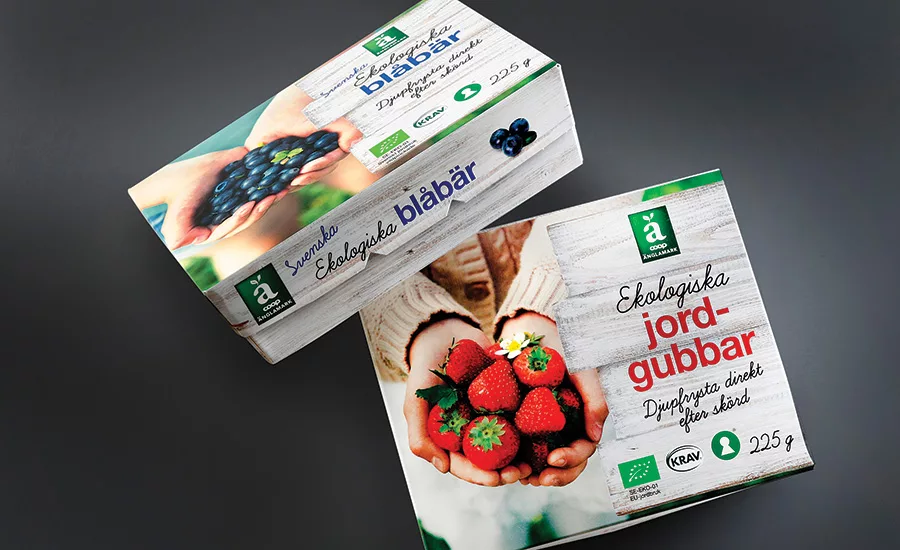
The Swedish retail chain Coop deliberately chose a higher-priced base material for environmental reasons when packaging its own- brand frozen berries. Iggesund’s Invercote Bio, a virgin fiber-based board coated with bioplastic, makes the clamshell containers compostable. www.iggesund.com

As part of the Kiehl’s “Recycle and Be Rewarded” program, store customers can select any product from Kiehl’s travel collection for every ten full-sized product containers returned. The brand weekly sends empties to TerraCycle to be recycled. www.kiehls.com
Sustainability has become an inconsistently defined concept. Applying to everything from beauty and healthcare to foods and cosmetics has spread its definition thin. Marry this with the concepts of natural and green, and one has a web of unrelated facets that confuse consumers rather than enlighten them.
Companies can use packaging, messaging and branding to relay claims, consumer-facing language and imagery that are genuine, clear and offer environmental benefits.
DEFINITIONS
Natural products, very simply, are devoid of artificial ingredients. However, this does not say anything about how the ingredients are harvested or the company mission, meaning the word “natural” alone is not enough information for today’s savvy consumers.
Organic usually refers to food and not personal care products, owing to the legality behind it. Food meeting a detailed farming requirement set by the USDA is considered organic: free of toxic pesticides and not genetically modified. Natural products may not be organic, but all organic products are natural.
As for sustainability, Merriam-Webster defines it as “a method of harvesting or using a resource so that the resource is not depleted or permanently damaged,” or “relating to a lifestyle involving the use of sustainable methods.”
IDENTIFY THE PURPOSE OF “GREEN,” AND WHERE IT APPLIES
While claims are traditionally solitary elements of consumer-facing persuasive language, they can come in a variety of forms. This includes environmental sustainability statements, marketing campaigns, product labels, or even imagery associations and logos of organizations. As such, the word “claim” has evolved beyond its textual definition.
Nonetheless, advertising about green elements has a few distinct purposes:
- Educating consumers
- Enabling consumers (to make choices)
- Driving business (either in terms of development or to acquire profitability to reinvest into sustainable practices)
While “green” may be a more commercial term, “natural” can be broken into a variety of comprehensible segments that distinguish which part of the product life cycle the term is being applied to:
- Product form: Is it natively natural, or is it engineered with natural ingredients?
- Product/process chemistry: Is it organic or inorganic? (The latter implies a natural process versus a natural ingredient.)
- Packaging and storage: Is the product sealed in synthetic or bio-friendly packaging?
- Life cycle and disposal: Is it biodegradable? Waste management and renewability are key to sustainability and reflective of how people consume products.
SUSTAINABILITY IN PACKAGING
When communicating how packaging can contribute to sustainability, marketers have to balance talking about what benefit it offers versus how it fulfills that benefit. The primary focus should be the advantage to the consumer.
Technological advancements in packaging science enable more packaging to be sustainable or waste efficient, and because of this, sometimes brands can use visual cues over text claims. Refills like Method’s hand wash showcase waste reduction through the structure without any direct communication. However, not all products can be in such obvious environmentally friendly packaging. Bleaches and hair colorants are classic examples of products that must meet strict packaging regulations to remain on store shelves.
As such, the suggestion to marketers is to find ways to communicate packaging that accurately relays the efforts being made. For example, some brands are now employing biomimicry, a term coined by Janine Benyus in “Biomimicry, Innovation Inspired by Nature” and defined by beauty company Pangea Organics. It is the science of studying nature to find solutions to human problems. Examples of biomimcry include modeling efficient trains off of streamlined Kingfisher beaks or Velcro, inspired by burs sticking on animal fur. By communicating an inspiration from nature, brands can engage consumers in the thought process of moving toward being more environmentally friendly and showcases to them that the companies are actively thinking of ways to be more conscientious.
Similarly, nanotechnology — manipulating matter on an atomic level — can be a benefit to brands working to express sustainability. A very common use is in the wrapping used to keep grocery stores meats and fruits fresher longer. In such cases, the benefit to consumers is obvious: food that stays fresh for a longer period of time. Marketers can bring this benefit to the forefront, communicating needed benefits in a comprehensible way.
SUSTAINABILITY IN MESSAGING
Consumers want a product that works and does what it is meant to do. Shampoo should cleanse; yogurt should taste good and be healthy. Addressing human concerns first is critical, and only thereafter can the product be tied to green elements. Clearly articulating the benefit is necessary; statements must be prominent and understandable, leaving no room for interpretation.
Whether it is an organic ingredient that reduces irritation or a green one that extracts moisture properties, specifying the exact benefit that the product brings about is valuable to consumers. Beauty brand Biotherm, for example, often includes ingredients derived from rice, oats or seaweed, and brings them to life by clearly relaying the product benefits. The best way to do so is to keep the benefit clear, and support it with such inclusions.
Another way to demonstrate green elements is to focus on biggest impacts: Does the process involve significant prevention or control of environmental damage because of the good use of packaging? In addition to communicating why the product works, the impact, actions taken and encouragement of similar actions to the consumer can all be shown.
SUSTAINABILITY IN BRANDING
As previously mentioned, there are other elements outside of a textual claim to communicate environmental commitment. Many companies have declared a mission to help the environment, whether through associations with rainforest alliances, giving back to local farmers or supporting sustainable ingredient harvesting. Utilizing these to create a healthier lifestyle for consumers communicates “green” without written words: Visual imagery, events marketing and advertising are primary examples.
Many brands can also use their mission as a way to educate consumers and raise awareness of environmental problems. Integrating these missions into the sale of their products helps consumers feel like participants in the environmental efforts. Tips and information on how to best dispose of products are a great way to achieve participation.
Several brands have made green elements a part of their consumer lifestyle via apt branding. Starbucks promises to “nurture the human spirit — one person, one cup and one neighborhood at a time,” and one of its mission statements is “Starbucks Shared Planet is our commitment to do business in ways that are good for people and the planet.”
Beauty brand Aveeno takes it to a stakeholder level with its declarations: “Developing products so effective they are trusted by consumers and recommended by healthcare and beauty professionals,” and “bringing communities back to a healthier, more naturally beautiful state.” The cult purchasers of the brand are engaged in living this lifestyle with Aveeno.
Sponsoring marathons, being part of community outreach and engaging in protection programs are all non-claim ways that brands can showcase their environmental efforts. Not only does this alleviate confusion, but also it enables communities of consumers to become more informed about the choices they make, and hopefully, they become brand loyal over time.
Brands have a plethora of opportunities to communicate their environmental commitments to consumers. The clearest opportunity is on the packaging at the point of purchase, either via a brand story or claim. By harnessing the relevance of the product to the consumer, brands can choose the best way to motivate, enlighten and integrate themselves into their consumers’ lifestyles.
Looking for a reprint of this article?
From high-res PDFs to custom plaques, order your copy today!