
What Does “Collaborative” In Packaging Really Mean?
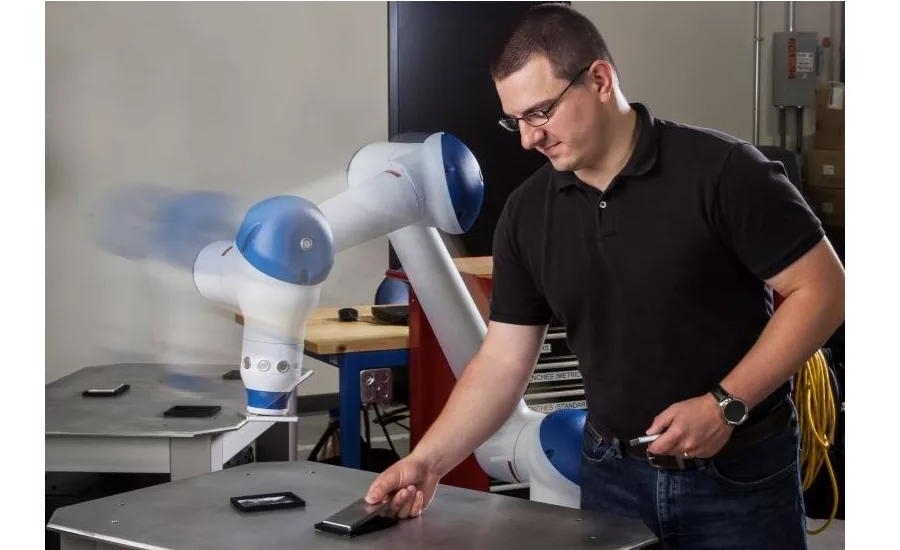
Only one in five companies have fully integrated automation lines in existence today, igniting a growing competitive demand to adopt technology on the plant floor to deal with the uptick in market complexity(1). From increased pressures to accommodate product individualization and shorter product life cycles, to the continued growth of the skilled labor shortage, company leaders are looking to create flexible and efficient operations through the utilization of more affordable and capable robots, while insuring operator safety.
The emergence of collaborative automation within the global packaging industry is here. And, with the bulk of machine automation predicted to occur on the packaging side of the line(2), manufacturers in this space would be wise to understand the collaborative modes and robotic solutions available to compliment factory operations while fostering growth.
Human-Robot Collaboration
While traditional industrial robotic automation is still a viable option for a wide variety of applications, new consumer dynamics and technological breakthroughs are pushing manufacturing to a turning point, prompting many businesses to consider the switch from centralized to distributed manufacturing systems (DMS). This promising production layout approach utilizes regionally dispersed manufacturing facilities intertwined with empowered employees and smart technologies, fulfilling diverse customer demands in facilities less prone to disruption, while lowering supply chain costs.
A key piece of the DMS puzzle, is the use of human-robot collaboration (HRC), where robots – enabled by special technology to work collaboratively – share a common workspace with human operators to efficiently and safely carry out defined tasks. The foundation of future intelligent production, the use of HRC is quickly changing the landscape of manufacturing operations. The most difficult and monotonous applications, that were once performed manually, can now be carried out by robots in an ergonomic and timely manner, freeing human workers to focus on value-added tasks more in line with their specific skill sets.
When considering human-robot collaboration, it is important to look at the entire application. For example, manufacturers that set out to buy a “collaborative” robot (in name) without consideration for payload, speed, etc. may be in for a surprise. Periodically, an application will mandate the presence of a larger and faster industrial style robot that does not possess the “collaborative” title or inherent collaborative functionality. Does this imply that human-robot collaboration is off the table? Absolutely not! It just means that a different style of robotic collaboration may be in order, depending on an in-depth risk assessment by a qualified individual.
When it comes to human-robot collaboration, there are three common forms:
- Coexistence – when a robot and human have separate working areas, but the human occasionally enters the robot work envelope. Human-robot interaction is not very frequent.
- Cooperation – when a robot and human have a shared working area, and the human often enters the robot work envelope. However, both work on separate tasks.
- Collaboration – when a robot and human have a shared working area, and the human frequently or constantly enters the robot work envelope. In this situation, the human closely interfaces with the robot.
Modes of Collaboration
A large number of people today hold to the concept that a collaborative robot (cobot) is simply a robot that can be used without safety fencing and can work alongside humans. While these items make a process collaborative, the ISO 15066 standard dictates four types of robot modes that enable collaborative operation:
Safety Monitored Stop
Effectively removing the need to turn off or re-enable servo motors, Safety Monitored Stop is for occasional human-robot interaction and can be utilized with all robots that are equipped with a Functional Safety Unit (FSU). Often used with a traditional industrial robot paired with a series of sensors or a laser scanner, this mode can detect human worker entrance into the monitored area, temporarily pausing robot movement until the person is clear. For example, when occasionally re-stocking piece parts, Safety Monitored Stop improves operational efficiency. This mode is commonly used in conjunction with Speed & Separation Monitoring.
Speed and Separation Monitoring
Ideal for environments where there is frequent human-robot interaction, Speed and Separation Monitoring can be used on PFL robots to increase cycle times, as well as on traditional industrial robots to streamline human-robot interaction. Eliminating costly door interlock systems, this mode employs the use of laser scanners, light curtains or vision systems to safely sense the presence of a human upon entry into the robot’s work zone. In this situation the robot operates within a pre-defined safety zone and slows to an assigned safe speed when a human worker approaches the monitored area. Common uses for this collaborative mode include loading jigs, removing finished products and replenishing dunnage/packaging materials.
Hand-Guiding
A unique feature on certain robots that simplifies robot teaching, Hand-Guiding allows intuitive pendant-free programming and rough position of a robot. Ideal for users branching out into robotics, this mode utilizes built in torque sensors to allow a programmer to physically guide robot movement, providing a simpler learning curve for lesser-skilled operators. This mode also provides users a fast and efficient manner to recover from robot error, making it easy to get back on track. Commonly used for basic pick and place jobs, this method is generally used on robots equipped with Power and Force Limiting technology.
Power and Force Limiting
Eliminating the requirement for external safety sensors, Power and Force Limiting (PFL) robots allow robot motion when a person is present within the robot work envelope. PFL robots are also the only robots that are inherently safe by design, meaning they can work with, or in close proximity, to human workers without additional safety devices or process interruption. Used for frequent human-robot interaction, PFL technology allows the robot to monitor external forces applied to its body, and it stops – reacting when needed – if the force exceeds a calculated safe threshold, protecting workers from potentially harmful contact situations.
This method is ideal for light assembly, machine tending, and simple pack-out operations. Power and Force Limiting can be combined with other modes of collaboration as well to improve safety and cycle time. Keep in mind, when considering the initial design, PFL robots will not possess higher speeds of operation such as industrial style robots.
While each of these features by itself qualifies a robot as collaborative, testing and safety validation of any workcell design is a necessary task to ensure user safety. When considering the implementation of a collaborative-type robotic solution, it is important to understand several key points:
- A Risk Assessment must be performed for the specific application.
- A cell may or may not need some safety fencing or similar devices, based upon the risk assessment.
- While the robot itself may be configured as “collaborative” and meet the required safety standards, the end effector to be used must be assessed as well, along with the actual product(s) to be handled, meeting the overall safety standards.
More Flexible and Productive Work Environments
While human workers remain central to manufacturing, the widespread use of robots and Industry 4.0 technologies is benefiting manufacturing ecosystems around the world. So much so, that a record high number of robot units were shipped globally last year(3). This has fueled a higher level of production efficiency and greater return on investment (ROI) throughout the manufacturing sector, especially for small- to medium-size manufacturers branching out into robotics, as well as larger OEMs with processes that could not be automated in the past.
Collaborative-type robots are a rapidly growing segment of robotics, providing for a safe and easy-to-use platform combined with the flexibility needed in today’s environment. Smart technologies(4) are bolstering efforts to enable a wider user group to adapt robotic technology on the factory floor, while aiding in managing a significant void in a viable labor pool.
Whether it is through incremental upgrades or ground-up automation, companies that embrace these innovations will not only increase process flexibility, but also, they will compliment worker talents, creating a more productive work environment(5).
1, 2 The Evolution of Automation, PMMI, 2017
3 Outlook on World Robotics Report 2019, International Federation of Robotics (IFR), 2019
4 The Landscape of Industrial Manufacturing and Warehouse Robots, Design News, 2019
5 Tech Trend 2019: Beyond the Digital Frontier, Deloitte, 2019
Looking for a reprint of this article?
From high-res PDFs to custom plaques, order your copy today!