Sahar Mehrabzadeh and Sara Lowe of Bay Cities share how the company is helping retailers and brands achieve compliance with California’s SB 54 and other state-level Extended Producer Responsibility programs.
IDFA emphasizes that many dairy packaging materials and formats—including HDPE, PET, polypropylene, gable-top cartons and aseptic cartons—are recyclable but are not yet meeting the recycling rate thresholds required under SB 54.
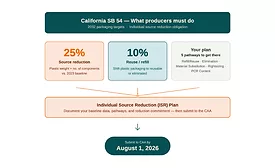
With California’s Individual Source Reduction Plan deadline of August 1, 2026, fast approaching, brands selling packaged products in California are under pressure to model, document and submit defensible plans across five approved source reduction pathways.
With California’s SB 54 set to take effect in 2027, the initiative aims to provide a roadmap for recovering, sorting, processing and ensuring market demand for small-format materials.
As Extended Producer Responsibility (EPR) laws are being implemented across seven U.S. states, there is growing pressure to meet ambitious recycling performance targets that cannot be achieved through infrastructure alone.
We sat down with Latricia Fry of Inteplast to discuss how both mono-material and multi-material flexible packaging formats are viable options when it comes to meeting Extended Producer Responsibility mandates.
The partnership delivers the first integrated digital solution to make EPR and PPWR reporting across all EU markets seamless, scalable and cost-efficient.
 RSS
RSS

.webp?height=168&t=1782152552&width=275 "trailer-trucks")