New Study Foresees Leading Market Share for Fiber-Based Packaging by 2045
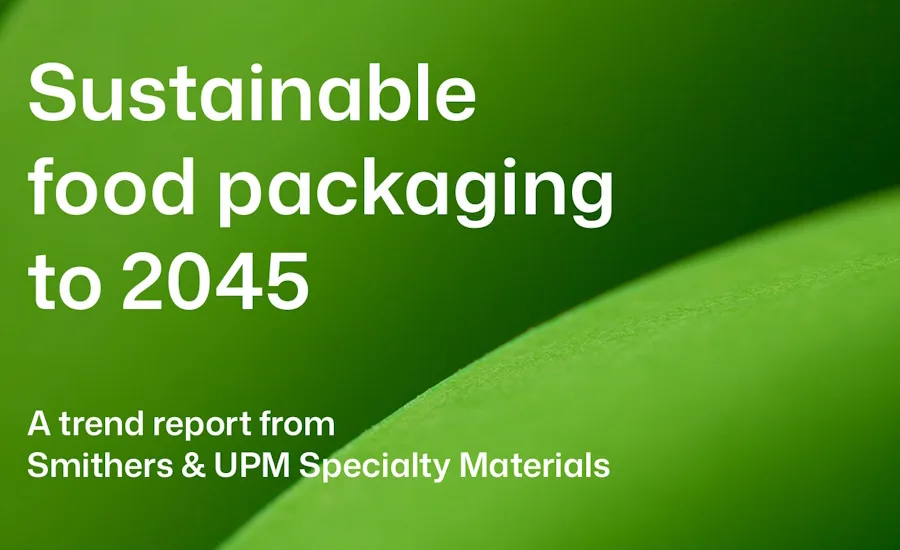
A new study from UPM Specialty Materials and global consultancy Smithers points to changing dynamics in the food packaging landscape, with fiber-based materials taking the leading share by 2045, recycling rates climbing toward 37%, and a regulatory landscape where sustainability becomes a strict government mandate.
Based on the study, Sustainable Food Packaging to 2045, fiber-based food packaging is on track to become the leading sustainable material by 2045, driven by breakthrough barrier coating technologies, tightening global regulation, and a decisive consumer shift away from single-use plastics.
More than 230 global packaging professionals from across the value chain contributed to a collective assessment of the key trends projected to drive sustainability in food packaging by 2045.
Packaging Strategies took a look at the study and notes that, of the more than 230 packaging professionals providing their views, 37% of respondents were suppliers, 27% were converters, and 16% were brands. “Creative agencies” made up 5% of respondents, and “Others” made up 14%.
As for the geographic breakdown of the respondents, 52% were in Europe, 25% were in the Americas, and 19% were in Asia (including 11% in China).
According to the survey, respondents see strong interest in fiber-based packaging, with its share of the global food packaging market expected to rise from 37% today to 42% by 2045.
The survey notes that 71% of respondents believe fiber-based packaging will be perceived as the most sustainable solution by 2045, citing advances in barrier coatings that are set to unlock food applications that were previously the exclusive domain of plastics.
The study outlines a future in which sustainability becomes a strict government mandate, not a brand differentiator: 71% of those surveyed believe this is likely, and 88% expect it to fundamentally reshape packaging choices.
Extended Producer Responsibility (EPR) schemes and eco-modulation fees are projected to become a primary driver of material selection, rewarding recyclable, high-performance solutions and penalizing hard-to-recycle alternatives.
Recycling rates are forecast to climb from 31% in 2030 to 37% by 2045. Yet challenges remain, with respondents expecting that landfilling and incineration will persist. Outcomes vary significantly by region, with Europe leading in recycling while the United States and Asia-Pacific face distinct infrastructure and regulatory hurdles.
“For fiber-based materials, progress will depend on aligning packaging innovation with recycling system capabilities,” says Eric Yu, Senior Manager, Packaging Application, APAC, UPM Specialty Materials. “While specialized recycling solutions are needed for complex structures such as double-side extrusion PE-coated carton board, parallel advancements in packaging technologies are equally critical.”
Yu adds: “This includes new machine designs to handle fiber-based materials, emerging food pack formats such as premade pouches, and next-generation barrier solutions, including coatings such as SiOx (silicon oxide) applied to base paper.”
The full Sustainable Food Packaging to 2045 report is available here.
Looking for a reprint of this article?
From high-res PDFs to custom plaques, order your copy today!