
Meaty opportunities exist for packaging improvements

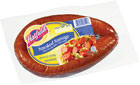
Photos of “serving suggestions” on fresh meat packages appeal to shoppers who aren’t familiar with cooking.
Photos
of “serving suggestions” on fresh meat packages appeal to shoppers who aren’t
familiar with cooking.
There are many reasons for the declining share of the traditional packages, even at a time when value-added products are competing against lower cost basics.
For many years, traditional meat packages were a major source of shoppers’ complaints. Today, though, shoppers are less focused on meat in general, and meat packages have improved.
A few concerns still linger, though. One is the perception that when buying fresh meat, you don’t know what you’re getting until you take the meat out of the package:
“One of the things I dislike about meat packaging is the deceptive way several cuts (to a package) of chops/thin steaks are arranged, overlapping so that the less desirable pieces are on the bottom where they cannot be seen until one arrives home. I have found this to be true of all grocers where the meat is cut and packaged by on-premises butchers, as well as those packages that arrive from a central location, already packaged and sealed. The only way to avoid this is to pay a higher price per pound and pick out your own meat from the butcher case.”
At a time when many shoppers are trying to stretch their dollars and make sure they are getting their money’s worth, this perception works against the sale of fresh meat. Sad to say, it’s almost impossible to get meat merchandisers to stop doing it. Putting the best-looking steak or chop on top sells more packages in the short run even as it erodes confidence in the long run.
More competition, more options, more educated and skeptical shoppers, and more environmental concerns are all putting dampers on the sales of fresh meat.
In many households, sales of red meat have been eclipsed by chicken. Fresh meat sales have also been lost to heat-and-eat products. Many shoppers are buying filled, seasoned, marinated or sauced products that only have to be grilled, baked or zapped to serve. Some are buying packaged products that go directly into the toaster, oven, grill or microwave and don’t have to be touched at all.
Many of today’s shoppers are put off by the idea of “cooking”-something they avoid or reserve for special occasions. Some are put off by anything more demanding than ground beef, which just has to be shaped into burgers before being broiled or grilled. Some are even queasy about ground beef and aren’t sure it’s safe.
Some are ignorant as well as queasy. They simply don’t know what to do with a piece of raw meat or poultry, and aren’t sure about getting it to temperatures at which it tastes good and is safe to eat. Some aren’t sure what the beef or poultry is supposed to look like when they’ve done something with it.
Consumers’ ignorance offers meat packers, processors and merchandisers an opportunity to use packaging graphics to communicate about the product inside, even when the packaging is see-through. As the lines blur between fresh/raw and value-added meat and poultry, pictures of how this meat looks after an hour in the oven or 10 minutes on the grill could be effective.
Expecting packages of raw meat and poultry to fend for themselves in the meat case, to sell themselves by their red bloom or golden chicken skin, makes sense only if shoppers know what to do with raw meat and poultry once they get it home. Shoppers who feel stupid when they look at something walk away from it and select something that they know will work.
Many young shoppers already buy value-added meat and poultry by a picture of the finished dish. A blog called “Heat Eat Review” shows the pictures of microwavable meat products on the packages alongside a picture of the product as it actually looks when it’s ready to serve. Young shoppers use the information they get from pictures on frozen entrees, refrigerated or ready-to-heat entrees, and shelf-stable entrees in the same way that shoppers in earlier generations used marbling or plumpness.
With rare exceptions, they don’t get pictures on fresh meat and poultry. A couple exceptions are Hormel’s Jennie-O brand and the Hatfield brand. Hatfield has been clever enough to apply attractive gold labels to almost all its fresh meat packages. The small picture is of a finished product that is labeled “serving suggestion.” An improvement, though, might be making the image larger for greater appeal. These examples are worth looking at so you can see the potential of what you might do, as well as what not to do.
I am not saying that today’s shoppers are stupid. I am saying that many are ignorant about cooking and don’t react to raw pieces of meat the same way as shoppers who are familiar with cooking.
Less handling could be safer, too
Along with health and cost concerns, safety concerns have also acted as a barrier to red meat sales.This year, the Food Marketing Institute survey of shopper concerns showed that 90% of today’s shoppers feel confident that fresh meat sold in supermarkets in safe-that leaves 10% (or at least 10 million shoppers) who don’t. Shoppers who aren’t confident in the safety of fresh meat are less likely to buy. Put that together with ignorance about cooking fresh meat, and there are good reasons for concern.
But opportunities exist to address the concern, and build confidence and sales at the same time.
Preformed ground beef patties have long been treated as poor, overpriced stepchildren in the meat and freezer cases. Restaging shaped and packaged patties as burgers that require little or no handling could turn the tables on the formless blobs of ground beef that require messy, hands-on forming and warning labels to “cook to 160 degrees to be safe.”
Take the preformed patties another step, and include a safe-temperature strip on each burger-a strip that would turn colors or pop up like a turkey timer when the burger reached a safe temperature. Shoppers could cook the burgers a bit longer to get them to medium-well or well done. This may sound like overkill for burgers, but overcooked and undercooked burgers are a widespread source of dissatisfaction at home and at restaurants. Consumers who won’t bother to put a meat thermometer into a chicken or turkey surely aren’t going to put one into a steak or burger.