
The Brand Manager’s Guide to Chemistry in Fiber-Based Packaging
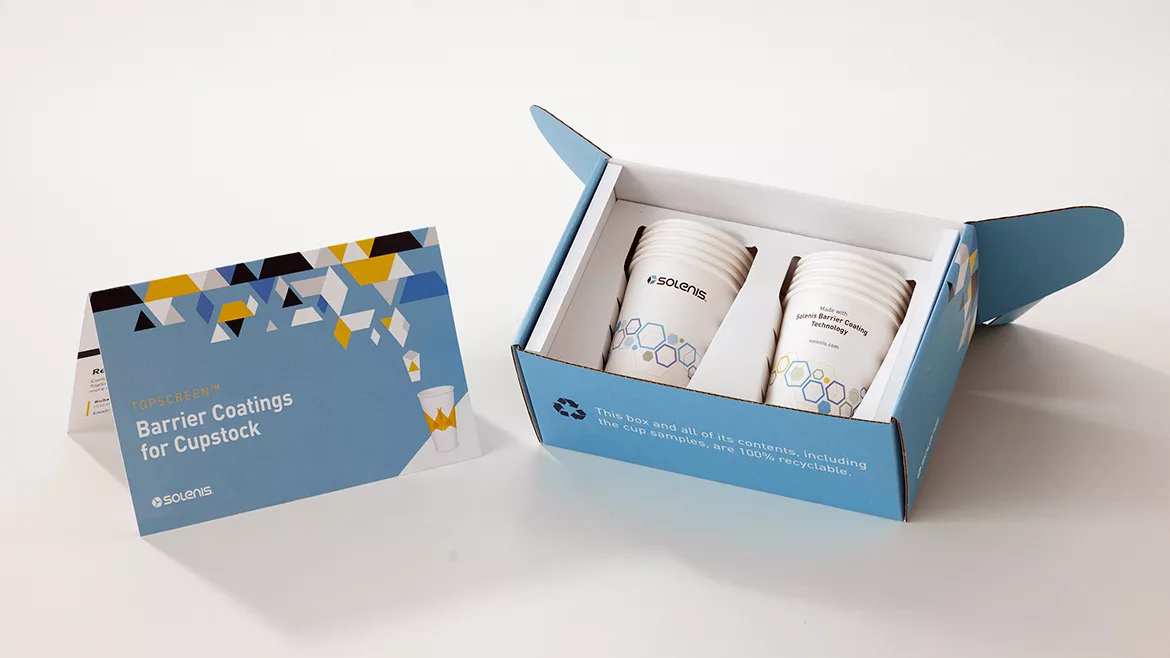
A barrier coating alternative to polyethylene offers the same liquid resistance—strong enough to withstand two servings of a hot beverage—while making cups fully recyclable in paper waste streams.
Image courtesy of Solenis
The shift to paper-based packaging isn’t optional anymore—it’s happening now. Regulations are tightening, consumers are demanding plastic-free solutions, and corporate sustainability teams are setting ambitious goals.
But as a brand manager, it’s not just about choosing the right solution—it’s about leading the transition, ensuring your packaging meets performance, sustainability, and regulatory goals – all while getting to market on time and at scale.
To help lead that shift, it’s important to understand three key fundamentals about why chemistry matters in this transition:
- Fiber alone is not enough—how chemistry fills the gaps.
- Novel real-world innovations from leading chemical suppliers are transforming fiber-based packaging.
- Great chemistry isn’t just in materials—it’s in how teams and partners work together
1) Fiber Alone Isn’t Enough
Fiber-based packaging has long been positioned as the sustainable alternative to plastic—but it has limitations.
The challenge? Plastic is a highly reliable and robust material. It maintains product integrity, adapts to diverse formats, and runs efficiently on high-speed converting equipment.
However, to make fiber a viable replacement for plastic, it takes more than a material swap – it takes science. Without it, fiber-based packaging simply cannot replace plastic at the level brands require—especially in high-performance applications.
2) Here’s Where Chemistry Comes In
Global innovators in chemistries are advancing fiber’s capabilities—helping it meet the functional, performance, and sustainability standards required for real-world applications.
The following three innovation examples break down how their advancements in chemistry are at the forefront of this transformation:
Example 1: Powering fiber with the right tools – without disruption
-
The challenge
- Barrier coatings are essential tools that reinforce fiber to effectively replace single-use plastics. They strengthen paper-based packaging with critical moisture, grease, and oxygen resistance, making it fit for purpose. Yet, many converters are hesitant to add them to their toolbox – concerned that an extra coating step could complicate production processes or require significant capital investments.
-
The chemistry:
- Advancements in water-based barrier coatings now enable converters to easily apply them using an existing tool—their flexographic printing presses. By combining these tools, converters can fully outfit their toolbox to streamline operations, drive cost efficiency, and accelerate the shift to high-performance, eco-friendly packaging solutions.

Advancements in water-based barrier coatings now enable converters to easily apply them using an existing tool—their flexographic printing presses. Image Source: nyvltart / iStock via Getty Images Plus
Example 2: Recyclability, biodegradability, and compostability need to be real—not just buzzwords
-
The challenge
- As sustainability claims face increasing scrutiny, brands need more than just a “recyclable” label—they need credible solutions. Many fiber-based packages still contain polyethylene (PE) layers or plastic laminates that hinder proper recycling, raising concerns about greenwashing.
-
The chemistry:
- Breakthroughs in chemistry can now replace PE, while maintaining required performance properties. Take paper cups, for example—traditionally lined with PE to prevent leaks, they have been difficult to recycle. Now, a barrier coating alternative offers the same liquid resistance—strong enough to withstand two servings of a hot beverage—while making cups fully recyclable in paper waste streams.
- Even more exciting, Polyhydroxyalkanoates (PHA)-based coatings - a biodegradable polymer produced by microorganisms - fully degrade in marine and freshwater environments and is home-compostable, unlike conventional bioplastics like Polylactic Acid (PLA).
Example 3: Future-proof molded fiber – amid an evolving regulatory landscape
-
The challenge
- Molded fiber has long been favored in foodservice packaging, but historically, per- and polyfluoroalkyl substances (PFAS) were added during production to provide oil and grease resistance. When PFAS bans emerged, plastic laminates were added to molded fiber, but they compromised sustainability.
- Now, with expanded polystyrene (EPS) and rigid plastics facing increasing bans, molded fiber is positioned as a leading alternative—but it must match the high barrier performance of these materials to be a true replacement.
-
The chemistry
- New fiber-integrated barrier coatings provide oil, grease, and temperature resistance without disrupting production—acting as a drop-in replacement for intentionally added PFAS to keep molded fiber fully recyclable or compostable.
- At the same time, advancements in surface-applied coatings are being developed to enhance moisture, grease, and oxygen resistance - expanding molded fiber’s potential to replace EPS and rigid plastics in high-barrier applications like meat trays and back-of-house packaging.

New fiber-integrated barrier coatings provide oil, grease and temperature resistance without disrupting production—acting as a drop-in replacement for intentionally added PFAS to keep molded fiber fully recyclable or compostable. Image Source: karinsasaki / iStock via Getty Images Plus
3) The Chemistry of Successful Collaboration
Internal alignment is critical to bringing any brand’s new product to market, but it’s not always easy. Different teams—operations, sustainability, procurement, and R&D—often have competing priorities, leading to disconnects between performance requirements, cost considerations, and sustainability goals.
That’s why engaging with key suppliers in the supply chain early—especially chemistry suppliers—isn’t just helpful, it’s essential.
The right chemistry partner, like Solenis, helps brands navigate the complexities of fiber-based packaging—not by simply filling gaps, but by bridging them. They achieve this by listening to the diverse needs of internal stakeholders across the brand and working closely with teams to develop future-proof fiber-based solutions that achieve the brand’s key objectives.
Great chemistry isn’t just found in materials—it’s created through collaboration.
The brands that understand the science behind fiber-based solutions and foster strong connections—both internally and across the supply chain—will be the ones that successfully scale, differentiate, and lead the transition.
Looking for a reprint of this article?
From high-res PDFs to custom plaques, order your copy today!