
Packaging tape 101: The hot melt difference
Submitted by Shurtape (shurtape.com)
In business, first impressions count.
That’s why manufacturers invest a considerable amount of time and money in developing their products and packaging, and put in place several measures, from adding protective packaging to picking the right carrier, to ensure they arrive intact at their final destination. Shouldn’t the packaging tape you use to seal your cartons be held to the same expectation of quality?
Packaging tape is a critical element to producing a secure seal that can withstand the distribution network. Unfortunately, it’s not always a top-level concern when viewing the packaging line, but failure to do so can result in case sealing issues such as packaging tape not sticking and loose case seals. The results of which can include production downtime, carton reworks, material waste, heightened labor costs, and higher risk of product damage, contamination and theft in transit.
That’s why it’s so important to choose the right packaging tape to seal your cartons. When selecting, keep in mind the following characteristics of a good packaging tape:
• Easy Unwind: dispense easily to keep things moving efficiently
• Good Adhesion: good, quick stick to the corrugated surface
• Strength and Durability: resist stress, nicks and abrasion to withstand the rigors of the distribution system
• Strong Hold: a good bond with the corrugated surface to ensure it maintains its hold on your cartons
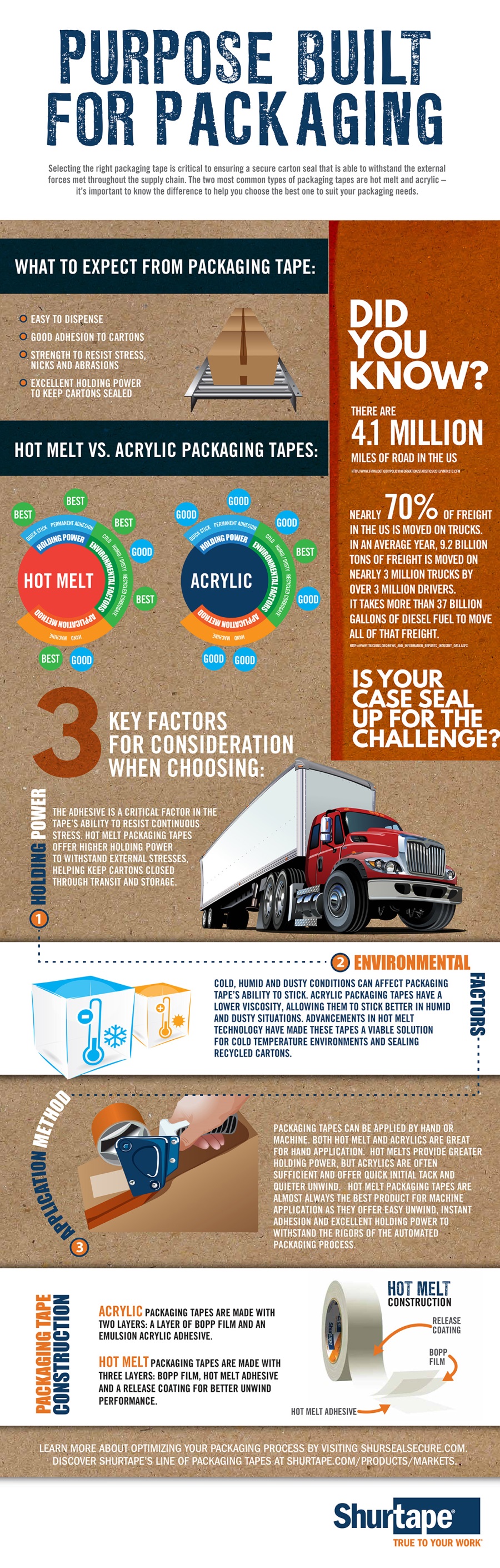
Not all packaging tapes are the same, especially when it comes to construction. The biggest difference is adhesive type. The two most common are acrylic and hot melt.
Acrylic Packaging Tapes
Acrylic tapes are constructed with two layers: a film backing and an emulsion acrylic adhesive.
The backing, often cast BOPP film, provides uniform thickness and durable performance, while the adhesive, which is viscous (or liquid like), offers good initial tack to the corrugated surface. In general, acrylic tapes provide users with stability over time, UV resistance to protect against yellowing, good adhesion in low temperatures and quieter unwind.
Although acrylic tapes offer good initial quick stick, their holding power can be somewhat limited. This is because their bond to the corrugated surface builds over time. It can also be attributed to the viscosity of the adhesive, which makes it prone to flow out – or fail – when external stress forces are met, such as lifting, shifting, forklifts and general stress applied during storage and transit.
Hot Melt Packaging Tapes
While acrylic tapes are designed with two layers, hot melt packaging tapes offer three: a film layer like that found in acrylic tapes, a special release coat that allows these tapes to unwind consistently and easily off the roll, and an aggressive adhesive layer.
Hot melt tapes are produced with a very strong synthetic rubber/resin adhesive, which generates an instant, permanent bond and superior holding power to corrugated surfaces. Because these adhesives are more aggressive, once applied, it would take an extreme amount of force to cause the adhesive to pull away from itself. So, if applied properly, it would be more likely to rip the corrugated material than fail.
While they may be easier on lines thanks to the release coat and produce a stronger bond to cartons, hot melt tapes may not offer the longevity, UV resistance and temperature range needed for some applications.
How to Choose the Right Packaging Tape
Now that you know there’s a difference between the adhesive systems, it’s important to know that there are several factors to consider before choosing a tape for your application, especially as various conditions can affect the quality and security of your carton seal. Among these factors are: Grade, Environment, Substrate, Application Method and Tape Quality.
Grade
Packaging tapes are available in a variety of grades, meaning varying levels of film thickness and amounts of adhesive. These grades ensure you have the right holding power and tensile strength based on several variables, including the carton’s size, weight and production/shipping environment. As any of these factors increases, so must the tape grade. Oftentimes, lower grade tapes offer thinner backings and lower levels of adhesives, making them ideal for lightweight carton sealing. Higher grade tapes are constructed with thicker backings and adhesive layers, making them useful for heavy duty or high security sealing.
Environment
From temperature to sealing conditions, the production and shipping environment is also a significant consideration when selecting the right tape for the job.
When it comes to temperature, understanding the difference between an application and a service temperature is critical. Application temperature is when the tape is applied, while service temperature is where the tape is stored. Why does it matter? Adhesion.
In order to stick well to the carton, the right tape must be used. This is especially important in cold, harsh environments, like produce packaging, meat and poultry processing, dairy facilities, cold weather storage and unheated warehouses in cold-weather areas. In the past, acrylic tapes were the go-to for these applications as hot melts were nearly impossible to apply due to their adhesive hardening too quickly. Not so with new advancements in hot melt adhesive technology. Today, there are specialized tapes engineered specifically for performance in the cold.
Shurtape HP 132 and HP 232 are specially formulated with a synthetic rubber-resin hot melt adhesive that provides an instant, permanent bond in sub-freezing temperatures to keep packages sealed and secured. They work in application temperatures ranging from 20 F to 75 F and in service temperatures from -20 F to 100 F.
Sealing conditions can also impact the performance of the tape. Keep in mind that not every facility is pristine – many production environments are plagued with humidity or dust. Hot melt tapes are hydrophobic – or “afraid” of water – so they may not perform well in a humid environment. Acrylic tapes, on the other hand, can withstand humidity, so may be the suitable choice.
Tapes with an aggressive adhesive and thicker adhesive coat should be used in environments where dust and dirt particles are prevalent. Since an acrylic tape’s adhesive is more liquid-like, it can move around the dirt and dust easily and still adhere well to the carton.
Substrate
The surface to which the packaging tape is applied also dictates the type of tape used. These substrates may include plastic, as well as popular corrugated options such as recycled, thick or double wall, printed or waxed.
Recycled cartons are used by many manufacturers, but the highly recycled content of these containers can affect the packaging tape’s ability to deliver a secure seal. As the recycled content increases, smaller fibers and more fillers are used, which can make it hard for packaging tape to stick.
In the past, acrylic tapes were relied upon for these “difficult” sealing situations. But, here again, specialized hot melt packaging tapes can be the solution. Shurtape HP 235, for example, is designed for taping highly recycled corrugated cartons, including 100-percent recycled. An optimized hot melt adhesive formula results in higher shear, tack and adhesion to produce better seals, no matter the recycled content of the carton.
Application Method
Just as important as the substrate is the application method. Packaging tapes can be applied to cartons via a manual or automated process.
In manual – or tape-by-hand – processes, both hot melt and acrylic tapes are good choices. Unwind is a vital consideration. Look for a quiet tape, especially for those working in close proximity to others, and one that offers tighter unwind for better cutting and easier handling. Additional tape features to look for include good tack for initial grab to the corrugated surface, a strong film backing for less stretching and breaking, and good adhesion to backing for those applications that require shingling, or stacking several strips of tape together to create the seal.
For automated processes, hot melt tapes offer the performance demanded to keep lines running. The best choice is tapes offering easy unwind to reduce tension that causes stretching and tearing, instant adhesion to allow for immediate palletization, and excellent holding power to enable carton seals to withstand stress applied by overstuffed cartons, automated pick and place or palletization processes, transit and storage. Choosing longer roll lengths can also minimize changeovers that cause downtime.
Another critical factor in an automated environment is shear strength, or the measure of an adhesive’s ability or inability to resist continuous stress. A high shear resistant adhesive will withstand external stress factors to keep the carton securely closed. A poor shear resistant adhesive will release its bond quickly when stress is applied. This often leads to “flagging,” or the edges of the tape becoming unstuck and lifting at the corners of cartons.
Shear strength is especially important to keep in mind in operations where robotic arms lift cartons by way of suction cups adhered to the top of the box. While an efficient way to move cartons, this adds stress to the tape. Other conditions where shear strength may be a factor are overfilled or thick-walled cartons where there is an upward force on the tape seal, heavy content cartons where downward force is applied to the bottom tape seal, or in rigorous transportation situations, such as single parcel shipment, where external forces place stress on cartons.
Tape Quality
A final factor to consider when selecting a tape is quality. A tape that’s manufactured well allows lines to run faster and longer. Variables such as inconsistent film thickness, thin adhesive coating and little release coating may hinder the performance of the tape.
Bottom line...while just a small part of the overall operation of the packaging line, selecting the right packaging tape for your application is critical to carton sealing success. Learn more about Shurtape’s comprehensive line of acrylic and hot melt packaging tapes, including specialized formulations, by visiting Shurtape.com.
Looking for a reprint of this article?
From high-res PDFs to custom plaques, order your copy today!