
Packaging Strategies logo
search
cart
facebook twitter linkedin youtube
  • Sign In
  • Create Account
  • Sign Out
  • My Account
Packaging Strategies logo
  • FEATURED
    • Brand Packaging
    • Extended Producer Responsibility
    • New Products & Materials
      • Featured Products
    • Packaging News
    • Packaging Perspectives Podcasts
    • Steve Fairfield Innovation Award
    • Supply Side
    • Top 100 Food & Beverage Packaging Companies
      • Submit Your Company
  • FLEXIBLE PACKAGING
  • VERTICAL MARKETS
    • Beer / Wine / Spirits Packaging
    • Beverage Packaging
    • Candy / Confectionery
    • Dairy Food Packaging
    • FoodService Packaging
    • Household Packaging
    • Meat / Seafood Packaging
    • Personal Care Packaging
    • Pet Food Packaging
    • Pharma / Medical Packaging
    • Produce Packaging
    • Snack Food Packaging
  • MATERIALS
    • Adhesives / Sealants
    • Beverage Multipacks
    • Blister Packaging
    • Cans & Bottles
    • Closures/Lids
    • Films & Coatings
    • Labels
    • Material Converting
    • Paperboard / Corrugated / Cartons
    • Rigid Containers
    • Sustainable Packaging
  • MACHINERY
    • Automation / Controls
    • Case Forming / Packing / Sealing
    • Cartoning
    • Coding / Marking / Printing
    • Conveyors
    • Form-Fill-Seal / Filling & Closing
    • Inspection / Detection / Vision
    • Labeling
    • Unitizing / Palletizing
    • Robotics
    • Track & Trace / Serialization
  • DIRECTORIES
    • Packaging Strategies Resource Guide
    • Flexible Packaging Buyer's Guide
  • EVENTS
    • Converters Expo
    • Converters Expo South
    • Global Pouch Forum
    • Industry Events
    • Webinars
  • MORE
    • Videos
    • Book Store
    • Classifieds
    • Custom Content & Marketing Services
    • eXTRA Newsletter
    • Market Research
    • PACKSTRAT Wordplay
    • PS Resource Guide
    • Sponsor Insights
  • EMAG
    • eMagazines
    • Archived Issues
    • Contact Us
    • Advertise
  • SIGN UP!
Packaging NewsBeer/Wine/Spirits PackagingBeverage PackagingHousehold PackagingPersonal Care PackagingPrepared FoodsSnack Food Packaging

How Covid-19 Is Affecting Fast-Moving Consumer Goods Businesses

By Giedrius Daujotas
How Covid-19 Is Affecting Fast-Moving Consumer Goods Businesses
March 27, 2020

Income elasticity analysis reveals that adidas, Nike, LVMH and Groupe Danone have higher Coronavirus (COVID-19) risk exposure among select FMCG companies, while Kraft Heinz and Kimberly-Clark, which are less dependent on discretionary spending, appear to be less exposed.

Unlike the 2008-2009 Global Financial Crisis, which started in sub-prime financial loans and spread to other sectors, the impact of COVID-19 is harder to ascertain as there are not many indicators to explain company performance. Income elasticities, which measure category volume sales change relative to GDP change, appear to be a good measure of company risk in this scenario, showing a high correlation with the recent stock market performance.

FMCG as a relative safe haven compared to broader market

Not all companies are equally exposed to COVID-19 risk. The SP500 index, measuring the Top 500 companies in the US, declined by 28% over 21 February-17 March, with the largest declines concentrated in travel and transportation, banks and some tech companies, where stock prices dropped in excess of 30%, and even 50%.

In such a context, consumer goods are a relative safe haven; the declines, while steep, have still not been as pronounced as in other sectors. Stock prices for typical FMCG companies like Unilever and Procter & Gamble dropped 15.6% and 6.7% respectively over 21 February-17 March, which is less than the 28% in the overall stock market. Many consumer goods are considered necessity products and thus do not react to slowdowns as much as products in other sectors.

Apparel, luxury and discretionary goods companies face greater risk exposure

In the chart below, we have plotted company income elasticities weighted by company country/category exposure against the stock market performance over 21 February-17 March 2020. The riskier companies as measured by income elasticity are on the right, such as adidas and Estée Lauder. Companies on the left of the chart have lower income elasticity, like Kimberly-Clark and Kraft Heinz.

Note: Income elasticity refers to category volume sales change as a result of a 1% change in GDP growth. Elasticities are weighted by retail sales of each company in every country and category.
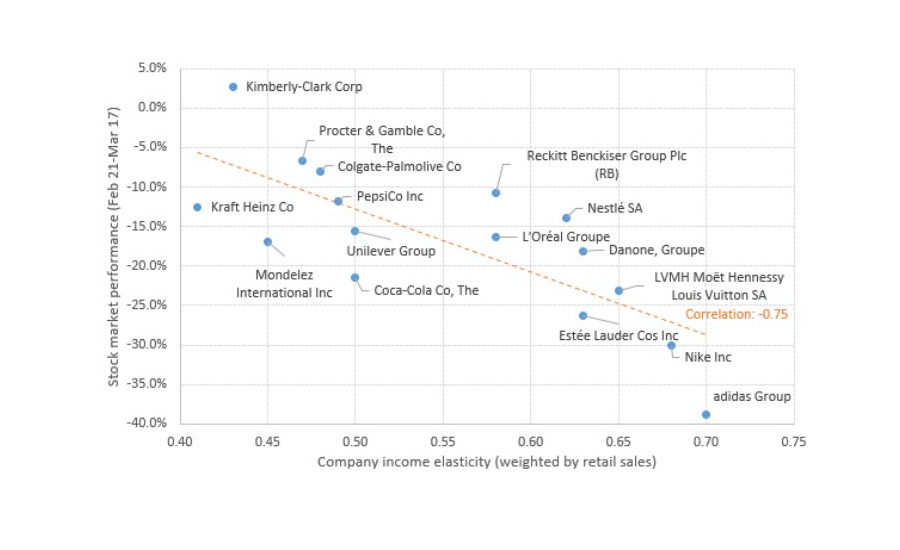
COVID-19 and FMCGs
Source: Stock prices from Yahoo! Finance, company elasticities calculated by Euromonitor International based on Passport market sizes

Overall, company income elasticities and stock market response show a strong correlation; companies with higher elasticity have also declined more during the recent market slowdown, indicating that income elasticity could be used as a metric to measure company exposure to COVID-19 risk. Companies with the highest income elasticities, like adidas and Nike, have also recorded the sharpest declines in the stock market. The best performer on the stock market from these selected companies, Kimberly-Clark, where the stock price rose by 2.7% over 21 February-17 March, also shows low-income elasticity.

We could take Unilever as a benchmark FMCG company, with strong presence in both beauty and foods; it has an income elasticity of 0.5 and its stock price declined by 15.6% over 21 February-17 March. Interestingly, Estée Lauder appears high on risk exposure dimensions; its chairman, Leonard Lauder, coined the famous phrase “lipstick effect”, which stipulates the beauty industry’s resistance to the recession, but the company seems to be responding to the recent slowdown more steeply compared to other beauty companies.

Not all companies align perfectly near the correlation line. Kraft Heinz, for example, has declined more than its low-income elasticity would suggest, as has The Coca-Cola Co. On the flip side, Nestlé’s stock price declined by 13.9% over 21 February-17 March, but its income elasticity suggests the company’s portfolio could be more risk-sensitive. Its Nespresso coffee business, in particular, appears to show high-income elasticity, which could fall more in a recession environment.

Why look at the stock market?

Stock markets are forward-looking by nature and are the best real-world measure of company risk. Companies that are most likely to see a negative impact on earnings from COVID-19 have already declined the most, as investors attempt to price-in all the developments – economy and/or company level – when they happen.

The period since Feb 21 fits the analysis best since markets started to take a hit on 24 February in particular, when COVID-19 cases in Italy made it clear that the virus was not going to be contained in China, triggering the global market fear. As a result, the SP500 declined by 28% over the 21 February-17 March period (taking end day closing prices).

Income elasticity as a measure of company risk

We have compared 16 select FMCG companies against recent stock market declines, and income elasticities appear to be a good measure of a company’s exposure to COVID-19-related risk. While some companies stand out as outliers, overall, there is a strong correlation between the two: companies that appear riskier on elasticity dimension have also recorded the largest declines on the stock market.

While this is not intended to show overvalued/undervalued companies (many other factors such as how leveraged companies are could also have an effect), it shows that income elasticities could help explain the risk exposure of companies to such pandemic scenarios at country/category level.

The 13 FMCG industries analyzed are Apparel and Footwear, Beauty and Personal Care, Consumer Health, Eyewear, Home and Garden, Home Care, Hot Drinks, Packaged Food, Personal Accessories, Pet Care, Soft Drinks, Tissue and Hygiene and Toys and Games.

KEYWORDS: CPGs FMCG packaging brands packaging trends

Share This Story

Looking for a reprint of this article?
From high-res PDFs to custom plaques, order your copy today!

Giedrius Daujotas is an analyst at Euromonitor International, a world-leading independent provider of strategic market research. The firm creates data and analysis on thousands of products and services around the world.

Recommended Content

JOIN TODAY
to unlock your recommendations.

Already have an account? Sign In

  • Golden award trophy in the shape of a star. Text: 2026 Top 100 Food and Beverage Companies

    Top 100 Food and Beverage Packaging Companies of 2026

    Celebrating 30 years as a B2B journalist, I’ve revisited...
    Sustainable Packaging
    By: Brad Addington
  • Women In Packaging 2025 homepage hero

    Women in Packaging: Seizing Opportunities, Pushing Boundaries

    Seven women share their personal journeys in the...
    Special Reports
    By: Brad Addington
  • Image of the Spyder Pick and Place Joint Robot sorting pre-rolls.

    Cannabis Packaging Goes High-Tech

    Packaging Strategies doesn't often cover cannabis...
    Unitizing/ Palletizing
    By: Brad Addington
Subscription Center
  • eMagazine Subscription
  • Manage My Preferences
  • Newsletters
  • Subscription Customer Service
  • Online Registration

More Videos

Sponsored Content

Sponsored Content is a special paid section where industry companies provide high quality, objective, non-commercial content around topics of interest to the Packaging Strategies audience. All Sponsored Content is supplied by the advertising company and any opinions expressed in this article are those of the author and not necessarily reflect the views of Packaging Strategies or its parent company, BNP Media. Interested in participating in our Sponsored Content section? Contact your local rep!

close
  • Hand Holding Various Semaglutide and Insulin Injection Pens for different stages of the treatment.
    Sponsored byInline Plastics

    How GLP-1 Is Reshaping Food Packaging, and Why It Matters More Than You Think

  • A stack of clear plastic containers, the bottom full of mixed fruit
    Sponsored byInline Plastics

    Packaging Trends Shaping 2026: Where Trust Is Won

Popular Stories

FPA President and CEO Dan Felton moderates a panel discussion at Global Pouch Forum with Rebecca Mick (Association of Plastic Recyclers), Adam S. Peer (American Chemistry Council) and Gregory Melkonian (Serlin Haley).

Key Takeaways from Global Pouch Forum

Machine packing six plastic bottles with milk.

Secondary Packaging for Dairy: Trends and Innovations

Image of plastic and carton packaging surrounding a recycle symbol.

New York Legislature Adjourns without Passing Packaging EPR Bill

See the Top 100 Food and Beverage Packaging Companies of 2026

Products

Advances in Sustainable Food Packaging Technology

Advances in Sustainable Food Packaging Technology

See More Products

Packaging Perspectives Podcast

Play Packaging Strategies' captivating WordPlay game, PackStrat! There's a new word every Tuesday.

Related Articles

  • The Future of the Fast-Moving Consumer Goods Sector

    The Future of the Fast-Moving Consumer Goods Sector

    See More
  • Report examines global consumer packaged goods market

    See More
  • Digital commerce remains a largely untapped opportunity for consumer packaged goods companies

    See More
×

Keep the info flowing with our Newsletters!

Get the latest industry updates tailored your way.

JOIN TODAY!
  • RESOURCES
    • Advertise
    • Contact Us
    • Directories
    • Store
    • Want More
  • SIGN UP TODAY
    • Create Account
    • eMagazine
    • Newsletter
    • Customer Service
    • Manage Preferences
  • SERVICES
    • Marketing Services
    • Reprints
    • Market Research
    • List Rental
    • Survey/Respondent Access
  • STAY CONNECTED
    • LinkedIn
    • Facebook
    • YouTube
    • X (Twitter)
  • PRIVACY
    • PRIVACY POLICY
    • TERMS & CONDITIONS
    • DO NOT SELL MY PERSONAL INFORMATION
    • PRIVACY REQUEST
    • ACCESSIBILITY

Copyright ©2026. All Rights Reserved BNP Media, Inc. and BNP Media II, LLC.

Design, CMS, Hosting & Web Development :: ePublishing