
Materials
Exploring Tomorrow’s Packaging
Sustainable, improved quality and reduced cost.
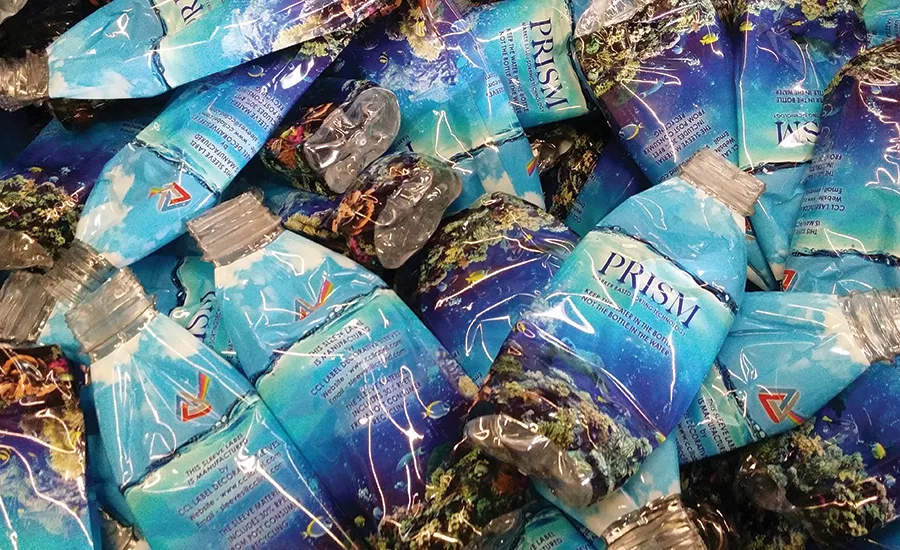
Most packaging on shelf these days was designed with the primary purpose to engage with the consumer, protect the contents within and tell a strong brand story. What recyclable features it may include are not always by design and they certainly are not thought through.
Despite most brand owner’s sustainability claims, the uncomfortable truth is that very little, if any, thought goes into the actual design for optimum recycling. It is time to acknowledge that the current recycling levels of most packs and bottles is woefully insufficient. If we continue buying into the fallacy that we are all doing our best and that is enough we are fooling ourselves.
It has been estimated that by 2040, 29 million metric tons of plastic per year will have entered the oceans from land. That is equivalent to 50 kg of plastic per meter of coastline worldwide. Because plastic remains in the ocean for hundreds of years and may never biodegrade, the cumulative amount of plastic stock in the ocean could grow by 450 million metric tons in the next 20 years.
So whilst brand owners may feel risk averse, the risk to our planet far outweighs the risk of trying something different. In fact, with careful thought, redesigning a pack or bottle to be as recyclable as possible should improve its quality and reduce its cost. Let’s deep dive into this.
Topping It Off
It might seem like a small thing but over the last 30 years, more than 20 million bottle caps and lids were found during beach cleaning activities around the world. We have lost track of how many bottle caps actually enter our oceans and wash up on shore, yet these caps are among the five main ocean trash items that are deadly to sea life.
A few small changes would flip this situation around.
Tethering Caps
In an ideal world, all caps would never leave the bottle, by tethering caps the total volume of caps being recycled would be boosted to provide more material for recycling back into caps. Current commercial designs for tethering caps to bottles are increasingly being light-weighted and would be a minor cost to the drinks companies but a huge benefit to the environment.
Pick a Polymer
Currently most PET bottle caps are made of either HDPE or polypropylene depending on the brand owners’ choice. Separating them into their relevant polymer types is a nightmare and as a consequence, they end up in low value applications as a mixture or in landfill due to their size and detachment from the bottle.
There is no reason why we can’t adopt one polymer type per country to simplify the separation problem.
Shed the Pigments
If all caps were either natural or white, we would actually capture, recycle and reuse all caps ad-infinitum. Instead we are literally drowning in a sea of multi-colored caps. Surely the consumer in each of us does not need a color-coded cap to recognize our favorite beverage?
All Label, No Glue
Moving on down the bottle to the label, Evian recently made a bold sustainability statement with its label-free bottle. It may seem like a minor detail, but the fact that the brand has kept the pink cap still leaves room for improvement. Were Evian to create a totally ‘naked’ bottle, from cap to base, the statement and action would be more impactful.
We should consider ditching the pressure sensitive adhesive labels that contaminate the recycling streams and opt for stretch labels or shrink sleeves. The aggressive glues are particularly an issue for recyclers of PET and HDPE packaging, and some options like self-peeling labels are already on the market. We need to ensure that these labels don’t bleed inks. The labels themselves need to be readily separated and recycled to avoid unwanted waste.
Back to the Source
There is little point in transforming the design details without going back to the source of the material used in the container. Take an HDPE milk bottle. Many resin manufacturers will use the minimum required stabilizer that prevents reactions that can lead to polymer degradation during processing. In turn, this impacts the quality of the recycled material, especially once we enter the circular economy where plastics will go through the loop many.
If the bottles were designed for constant recycling, the plastic quality could be maintained which would improve recycling rates. In many cases the stabilizers need to be present during their initial processing, as this is where oxidation reactions can occur that can trigger later impacts through gel formation or photo-chemical reactions during outdoor exposure.
Seeing Through Colors
As for the rainbow of colors brands are currently deploying, this only goes to show how little deep recycling features in the design remit. Colored plastic packaging is much harder to recycle economically than clear plastic, since there is little demand for the resulting “recycling grey” that we get when we mix all of these colors. Unscrambling the colors is potentially possible via sorting equipment, but the multitude of color variants means that it is impossible to produce a color that would suit any one brand-owner.
The fact is that in many cases, the colored plastic is often covered by a large label as a means of marketing, making the package below invisible. It might as well be grey or natural to save the pigment costs and improve the final recyclability!
There is no doubt that color is one of packaging designers’ key tools yet the impact on a pack’s recyclability is huge. Tomorrow’s ideal bottle would be either transparent, white or self-colored grey and shrink sleeves would be used to ensure the brand is loud and clear.
Tomorrow’s Bottle
The fact is that were we to craft the type of highly recyclable bottle described above, we would end up with a very close replica of a brand’s original product. Only an expert would be able to notice the difference. So is it cost that is creating a roadblock? A 360-degree recyclable bottle should actually cost less to produce. Here is why:
Starting with the caps produced of one polymer type in clear or white would mean a greater opportunity to recycle caps back into new caps that would reduce the need for new virgin resin.
Shedding the colors of the actual bottle would vastly reduce masterbatch costs and all the design cues would be focused on the label (with self-peeling or dissolvable glue) or stretch-sleeves. Recycling yields would increase making high-quality recycled material more plentiful and less expensive. And the actual brand recycling story would be authentic.
These design details would greatly contribute to the total recyclability of a pack and actually require a change in mindset rather than a massive upheaval.
Brand owners can challenge the status quo by adopting good design principles that embrace recyclability to the core. They should step up and take responsibility for every facet of their packaging for recycling sake.
Looking for a reprint of this article?
From high-res PDFs to custom plaques, order your copy today!